Table of Contents
Introduction
Most startups don’t fail because they don’t do any marketing; they fail because they spend money on marketing whose outcomes they can’t measure. This is exactly what performance marketing strategies for start-ups are meant to fill. Every dollar is dedicated to a specific action: sign-up, qualified lead, or completed purchase; instead of spending money on exposure, hoping it will convert in the future. According to Google, reducing page load time by just one second can significantly increase conversion rates.
For small businesses and start-ups, every marketing decision is crucial, especially when budgets are tight. It’s not just about driving visitors to your site; it’s about making an investment in traffic that will produce real business results. Here are a few performance marketing strategies that can offer you a practical framework for smarter marketing investments and sustainable growth.
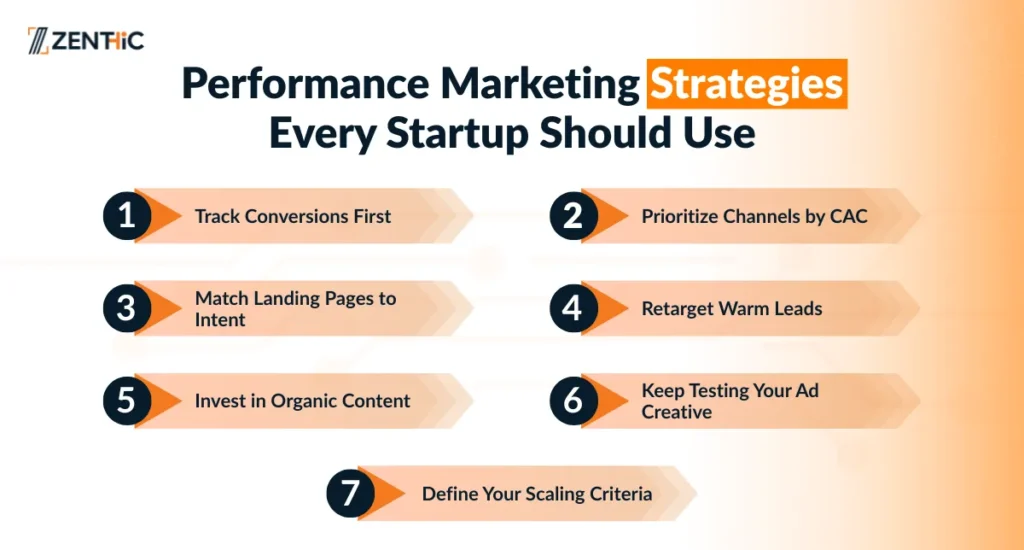
Performance Marketing Strategies Every Startup Should Use
Performance marketing is based on accountability. All channels, campaigns, and creative assets are measured against one question: did they generate the results we are paying for? This is especially useful for startups looking to test product-market fit with limited resources.
The first step is to determine what constitutes “conversion” for the business: a free trial sign-up, a demo request, an app install, or a completed transaction. Once this definition is established, all other targeting, creative, and budget allocation decisions are made to accomplish this goal at the lowest possible sustainable cost.
1. Track Conversions First
When creating any kind of ad campaign, ensure that your conversion tracking is working properly. If it’s not tracked, there is no way to be sure of which campaigns, ads, or channels are working. You can use Google Analytics 4, Meta Pixel, or other attribution systems to measure all of the crucial moments, from the first click to the final conversion.
For example, trace your customer path and measure at every step, such as when customers click an ad, visit your landing page, fill out a form, or make a purchase. This information can help you understand where your potential customers are going, giving you the confidence to optimize your campaigns accordingly.
2. Prioritize Channels by CAC
Not all marketing channels will be equally effective. Rather than investing in a large number of platforms, try a handful of platforms that you know are relevant to your business, like Google Ads, social media ads, LinkedIn for B2B audiences, or niche communities.
Test each channel for 2 to 3 weeks at a time, and compare customer acquisition cost (CAC) for each channel. If you know which platforms will bring you more quality customers at a lower cost, then focus more of your budget on those channels instead of spending all of it among all platforms. To see a detailed explanation of how to determine this, please read our article: How to measure ROI in performance marketing?.
3. Match Landing Pages to Intent
Once your users click through your ad, they will likely move on without taking any action. Ensure the messaging, offer, and call to action on the landing page match up with the ad copy or keyword that the person clicked on. The landing page for your ad campaign should be relevant to your ad, such as if your ad is about a free trial, your landing page should have a focus on that offer, not just a generic homepage.
Use simple forms, fast-loading pages, and put your call to action in places where visitors can see it easily. Creating a seamless landing page experience can make a huge difference in conversion rates, particularly on mobile devices.
4. Retarget Warm Leads
Not everyone will take a conversion at their first visit to your site, and that is okay. Retargeting enables you to reconnect with people who have previously expressed interest by visiting your site, watching a product, or interacting with your content. These audiences are already familiar with your brand, which means that they are more likely to convert at a lower cost.
If you want to get the best of your retargeting, you should segment your retargeting lists by user behavior. A buyer who checked out your pricing page might require a different message from a person who left the sign-up page or added something to their shopping cart. Personalized retargeting ads are more relevant and are more likely to convert.
5. Invest in Organic Content
Traffic from paid ads can come quickly, but then there is a limit to how long it will last. Blog posts, comparison pages, and SEO-optimized landing pages will continue to drive visitors over time and will serve as a valuable resource for long-term leads and customers.
The best strategy is to use paid campaigns and a strong content strategy together. Paid ads offer instant visibility; organic content offers long-term benefits of customer acquisition by driving search visibility and establishing brand authority. If you’re curious about the time frame of each approach to see results, we explain that in how long does it take to see results in performance marketing.
6. Keep Testing Your Ad Creative
Even the most successful ads eventually lose their power, especially on social media sites like Meta and TikTok. Creative testing should never be a one-time decision but should be an ongoing component of your performance marketing plan.
Try out various headlines, images, videos, ads, value propositions, and their combinations over time to see what works best for your audience. As your campaigns grow, continuously refreshing creatives will help you avoid ad fatigue, boost engagement, and keep your conversion rates high.
7. Define Your Scaling Criteria
Don’t boost marketing efforts before deciding what success would be. Don’t scale from the initial positive results; set clear measures like a 1:3 ratio of customer acquisition cost (CAC) to customer lifetime value (LTV) or a payback period of less than six months. As you continue to spend more on your campaigns, these metrics will keep your campaigns profitable.
Going through the process of scaling too quickly, without a validation of the unit economics, can result in increasing costs and decreasing returns. With clear performance metrics, startups can expand their businesses with confidence, where their marketing investments remain sustainable.
Conclusion
The key to successful performance marketing isn’t to follow all the new platforms or trends. It’s about making informed decisions based on data, optimizing campaigns all the time, and investing in those channels that are providing measurable business results. Consistency and smart decision-making based on data are more useful than any short-term marketing hacks for startup businesses that have limited resources.
With a targeted approach, monitoring progress, and ongoing adjustments, startups can create a sustainable growth model that leads to long-term success. Partnering with a trusted performance marketing company can also provide the expertise and strategic guidance needed to maximize return on investment, reduce customer acquisition costs, and scale your business with confidence.