Table of Contents
Introduction- What Does ROI Mean in Performance Marketing?
- The Basic ROI Formula
- ROI vs ROAS: Know the Difference
- 4 Metrics That Matter Beyond ROI
- 1. Customer Acquisition Cost (CAC)
- 2. Customer Lifetime Value (LTV)
- 3. Conversion Rate
- 4. Attribution Model
- How Long Before ROI Becomes Clear?
- Choosing the Right Channels to Track ROI
- The Role of AI in ROI Measurement
- Conclusion
Every dollar you invest in advertising should generate measurable value and contribute to your business growth. The whole idea of performance marketing is that it leads to quantifiable outcomes, not a blind shot. However, many businesses are still having difficulty in accurately measuring ROI from performance marketing, and they are often not aware that clicks or impressions are not a true indicator of ROI. Without the correct measurement, you won’t be able to improve it, and your budget will be working against you and not for you.
This guide explains in detail what ROI really means in a performance marketing context, how to calculate it properly, and how to use the right metrics to determine if a campaign’s worthwhile in terms of profit.
What Does ROI Mean in Performance Marketing?
In simple terms, ROI is the profit generated from a campaign compared to the money invested in the campaign. In the world of performance marketing, this gets complicated, as spend doesn’t just relate to ad spend, it also covers creative production, tools, agency fees, and the time your team puts into optimizing.
A campaign can have high click-through rates and low cost-per-click but fail to generate revenue that will convert into long-term value for the business. That’s why it’s important to know about ROI correctly rather than simply reading ad platform dashboards.
The Basic ROI Formula
The basic marketing ROI formula is:
ROI = [(Revenue Generated – Cost of Campaign) / Cost of Campaign] x 100
For example, if you spent $1,000 on a campaign and it generated $3,500 in revenue, your ROI would be 250%. This means that for every dollar you invested, you earned your original dollar back plus an additional $2.50 in revenue.
This formula is straightforward, but the key is to accurately measure what you define as “revenue generated” and then correctly attribute it to the right channel or campaign, particularly when a user touches multiple touchpoints before converting.
ROI vs ROAS: Know the Difference
The biggest mistake in performance marketing is confusing ROAS (Return on Ad Spend) with ROI (Return on Investment). ROAS only tracks ad spend and revenue, excluding any other expenses such as production, tools, or team time. ROI considers all of the costs, providing a fair representation of profitability.
A campaign may have a great ROAS of 4x, but after agency fees, creative costs, and overheads have been taken into account, the ROI could be much lower or even negative. You can’t overestimate the performance of a campaign that is based only on ROAS.
4 Metrics That Matter Beyond ROI
To measure ROI correctly, you need to consider the supporting metrics that lead to the ROI number:
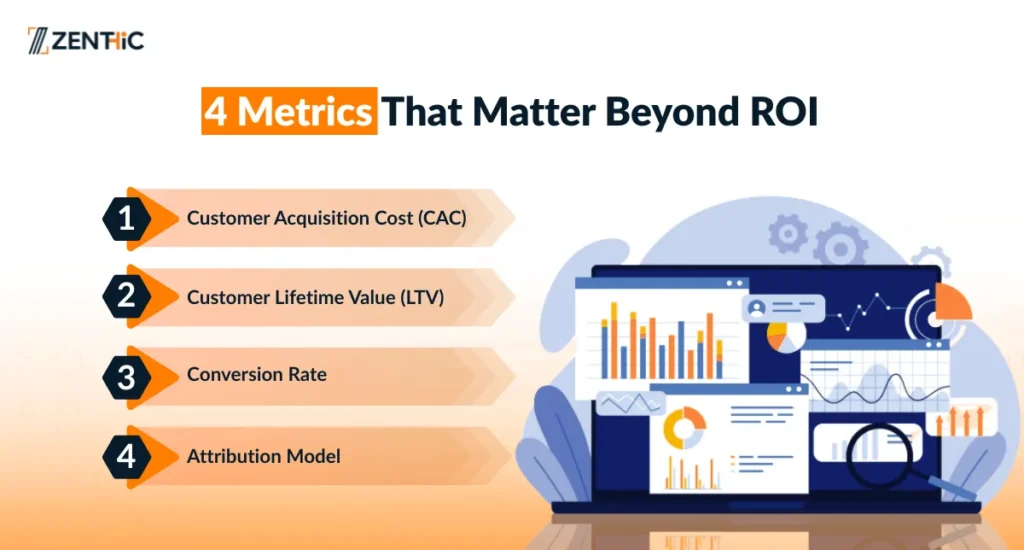
1. Customer Acquisition Cost (CAC)
Average cost to get one paying customer. A falling CAC with consistent conversion rates is a good indicator of a healthy funnel.
2. Customer Lifetime Value (LTV)
Customer Lifetime Value (CLV) is the total revenue a customer is expected to generate for your business throughout their relationship with your brand. LTV vs. CAC (3:1 or higher) is a good way to determine if your acquisition strategy is viable over time, rather than just a quick profit.
3. Conversion Rate
The percentage of users that reach the desired action. One of the 5 common mistakes in performance marketing is that a low conversion rate is not due to a targeting problem. Rather, it is due to a mismatch between ad messaging and landing page experience.
4. Attribution Model
The choice of last-click, first-click, or multi-touch attribution affects how ROI is calculated by channel. The wrong model can make one channel appear significantly more or less effective than the other.
How Long Before ROI Becomes Clear?
One of the most common inquiries that businesses have is when they can expect to see returns. Honestly, it depends on the industry, length of the funnel, and the goal of the campaign. We cover this in detail in our earlier post on how long it takes to see results in performance marketing, where we explain why judging ROI too early, often within the first two weeks, can lead to premature and costly decisions about pausing or scaling campaigns.
Choosing the Right Channels to Track ROI
Different platforms will provide different amounts of reporting, and ROI can be very different depending on where you invest your money. When it comes to choosing the platform to invest in, our Google Ads vs Meta Ads comparison compares the two platforms’ performance in various business scenarios, which directly influences how you can calculate and interpret ROI for each platform.
The Role of AI in ROI Measurement
Today’s performance marketing heavily depends on AI-powered tools for tracking attribution, forecasting customer value, and identifying underperforming campaigns early on to prevent wasting a valuable budget. Marketers can use these tools to go from reporting to optimization. We examine how AI is reshaping performance marketing and how automation is more quickly and accurately tracking ROI than manual spreadsheet-based methods.
Conclusion
ROI in performance marketing isn’t a single number that you can extract from an ads dashboard; it’s about associating spend with actual business results through the entire customer journey. When you combine the right formula with the metrics you’re tracking, such as CAC, LTV, and conversion rate, and select the right attribution model for your customer buying cycle, you will have a much more accurate understanding of what is effective and what needs to be adapted.
If you still don’t know what performance marketing really is before you start calculating ROI, start with our performance marketing guide: “What is performance marketing and how does it work?”
The right ROI measurement makes performance marketing a growth engine, not a cost center, and every decision made on a performance marketing campaign is made on a data-driven basis, not on an assumption. When you work with a trusted performance marketing firm like Zenthic, this is measured on the first day, and your money is always spent in a way that yields measurable growth.