Table of Contents
Introduction- Is It Possible to Get Results Immediately?
- A Realistic Performance Marketing Timeline
- Week 1: Campaign Launch and Data Collection
- Week 2–4: Initial Optimization
- Month 2–3: Consistent Growth
- Month 3–6: Scaling Successful Campaigns
- 6 Factors That Affect Performance Marketing Results
- 1. Industry Competition
- 2. Campaign Goals
- 3. Advertising Budget
- 4. Landing Page Quality
- 5. Audience Targeting
- 6. Creative Quality
As a digital marketing method, performance marketing has emerged as one of the most effective strategies for businesses that want measurable outcomes. Performance marketing is also very different from traditional advertising because it provides real-time tracking of each click, lead, conversion, app download, or form submission
One of the most frequently asked questions that businesses ask before investing is when they can expect to see measurable performance marketing results.
It really depends on your industry, your goals, your budget, your competition, and the platforms you’re running on. There are some campaigns that can produce leads in days, but if you want to get consistent and profitable leads, it may take several months to optimize the campaign.
In this guide, you will learn what you can expect from a performance marketing campaign and how your timeline is affected by these factors.
Is It Possible to Get Results Immediately?
Traffic can be generated from paid ads almost instantly after launch. If the targeting, messaging, and landing pages are well optimized, you could get clicks, leads, or even sales in the first few days. However, early activity doesn’t necessarily indicate long-term success.
Machine learning and audience data are the driving forces behind performance marketing platforms, which optimize campaigns. In the learning phase, the algorithms test various audiences, placements, and bidding strategies to see which ones work best. This is why patience will be vital in the initial stages.
A Realistic Performance Marketing Timeline
Week 1: Campaign Launch and Data Collection
The first week is spent collecting data to a large degree.
During this period:
- Impressions are served to ads.
- Initial clicks and website visits start.
- The advertising platform collects the audience behavior data.
- Some early conversions may take place.
During this phase, do not make significant changes in the campaign daily. Continuous modification can disrupt the learning curve and delay optimizations.
Week 2–4: Initial Optimization
Once sufficient data has been gathered, marketers start to find patterns.
They typically analyze:
- Click-through rate (CTR)
- Cost per click (CPC)
- Conversion rate
- Cost per acquisition (CPA)
- Audience engagement
- Landing page performance
Poor ads are eliminated, successful ads get more of the budget, and audience targeting is made more precise. The business begins to get more consistent lead generation or sales by the end of the first month.
Month 2–3: Consistent Growth
This is where performance marketing starts to make a difference for businesses.
Marketers have sufficient historical data to optimize campaign performance:
- Ad creatives
- Keywords
- Audience segments
- Budget allocation
- Bidding strategies
- Conversion tracking
Businesses often notice the following:
- Lower acquisition costs
- Better conversion rates
- Higher return on ad spend (ROAS)
- Improved lead quality
This is not the time for making quick gains; this is the time for sustainable growth.
Month 3–6: Scaling Successful Campaigns
Once campaigns start to get a positive response regularly, then businesses can increase their investment.
Scaling may include:
- Entering new geographic markets.
- Testing other ad networks
- Introducing new audiences
- Increasing daily budgets
- Running seasonal campaigns
As campaigns are already optimized, scaling is usually less risky and more profitable.
6 Factors That Affect Performance Marketing Results
There are several factors that affect the speed of campaigning.
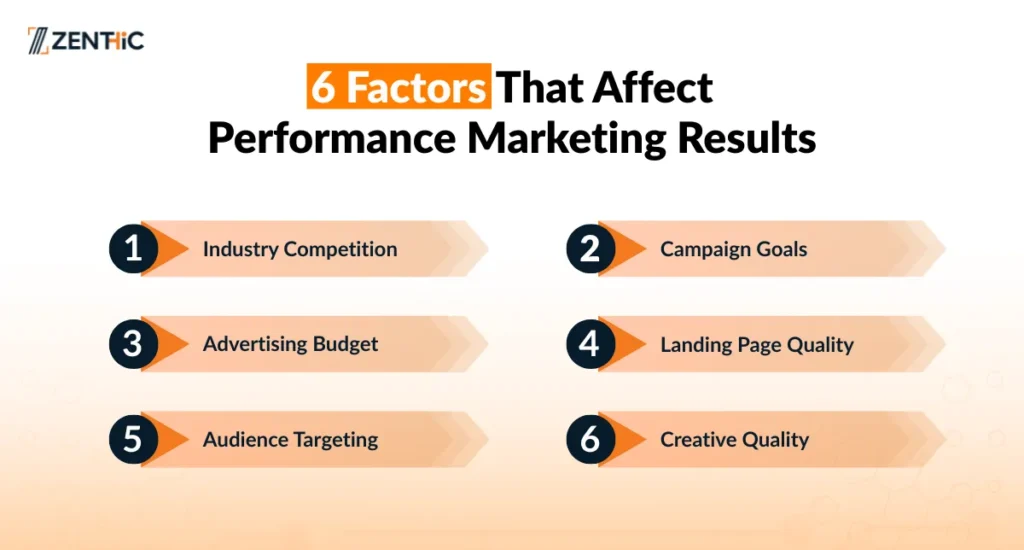
1. Industry Competition
Industries that are very competitive, like the financial sector, legal services, healthcare, and real estate, tend to have higher budgets and longer optimization periods. It may be easier to get qualified leads in less competitive markets.
2. Campaign Goals
The time constraint is directly related to your objective.
For example:
- The results of website traffic campaigns can be seen within days.
- Lead generation campaigns usually take a few weeks.
- Ecommerce sales could need continuous optimization before they turn into profitable sales.
- Brand awareness campaigns generally deliver results over a longer period.
- There are different ways to achieve success for each objective.
3. Advertising Budget
Budget is a significant factor of campaign performance. The more money that a platform has, the more quickly they can gather data to enable their algorithms to optimize. Excellent results can be achieved on smaller budgets, but it will take longer to get enough data to optimize it.
4. Landing Page Quality
A good landing page is sometimes more important than the best advertising.
If visitors encounter the following:
- Slow loading times
- Confusing navigation
- Weak calls to action
- Complicated forms
- A lack of trust signals
Conversions will be affected. Sometimes optimizing your landing pages can be just as critical as optimizing your ads.
5. Audience Targeting
Right targeting is essential for successful campaigns. Defining your customer personas enables your platform to serve ads to people who are truly interested in your products or services. If your targeting is incorrect, your advertising costs will be higher, and your conversion rate will be lower.
6. Creative Quality
Performance marketing is not all about numbers. Great visuals, catchy copy, and a compelling offer can have a significant impact on campaign performance. Trying several creatives regularly will help you determine which ones work best with your audience.
Conclusion
Performance marketing aims to produce quantifiable business results, and it doesn’t just happen on the first day. You might generate some traffic, leads, or sales in the first few days or weeks, but it usually takes 2 to 3 months of testing, optimization, and fine-tuning to achieve a campaign that makes money.
Having a trusted, reliable performance marketing partner is a good way to assist companies through the process. Data-driven strategies, accurate tracking, and optimization are employed over time by experienced professionals to maximize and optimize the performance of campaigns. Performance marketing is not about immediate results, but rather a long-term investment that yields better results as knowledge leads to better marketing decisions.