Table of Contents
Introduction- Custom Development Price?
- What Factors Affect Custom Software Development Cost?
- 1. Project Scope
- 2. Features and Functionality
- 3. User Interface and Experience
- 4. Development Team
- 5. Technology Stack
- 6. Integrations
- How timeline affects costs
- Compressing a six-month project into three months doesn’t always mean adding more developers. A rushed timeline can leave less time for testing and quality checks, which may lead to higher bug-fixing costs later. If you want to shorten the timeline without increasing the budget, ask what will be reduced or removed from the process.
- Red Flags in a Quote
- How to Get an Accurate Estimate
- 3 Ways to Reduce Cost
- Conclusion
Businesses can use custom software to automate repetitive tasks, optimize their operations, and provide better customer service. However, when it comes to custom software for your business, you will probably ask yourself the same question: How much will it cost?
The price may vary from one product to another, as custom software can have different meanings. Each of these has its own level of planning, development, testing, security, and support.
The price of custom software development in 2026 will vary significantly based on the specific software being developed, the complexity of the project, and the amount of development work required. Knowing these factors can help you plan your budget and prevent any extra expenses later.
In this guide, we’ll guide you through the cost of custom software development in 2026, the factors that influence pricing, and how you can keep your project within budget without compromising its quality.
Custom Development Price?
There is no fixed price for custom software because every project has different requirements. Here is a general estimate to give you an idea.
- Simple app or MVP: $15,000-$30,000
- Mid-complexity web or mobile app: $30,000-150,000
- Complex enterprise system: $150,000-$500,000+
- Highly regulated or AI-heavy platforms: $300,000-$500,000+
These figures are general estimates, not fixed prices. Two projects with a similar number of features can have very different budgets, for example, due to complex integrations, advanced security, real-time processing, or specialized technology.
The best way to get an accurate estimate is to define what the software needs to accomplish before development begins.
What Factors Affect Custom Software Development Cost?
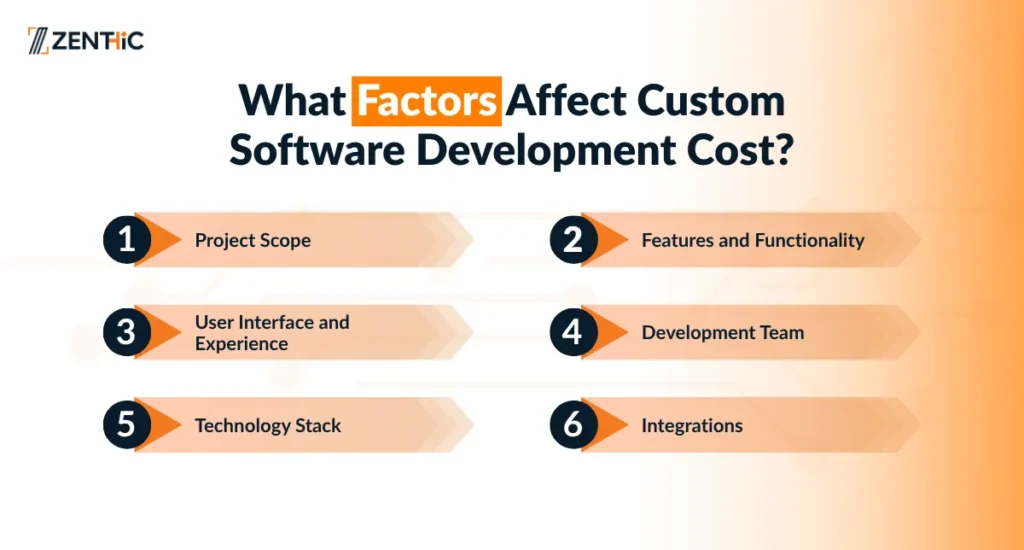
The top six factors determine how much you will ultimately spend on your software project.
1. Project Scope
One of the largest project development factors is the size of the project. A small application may only have a few screens and a single type of user. A larger platform may offer user-specific dashboards for employees, managers, customers, and administrators that have varying permissions and workflows. That’s why it’s crucial to establish the project’s scope in the very beginning.
The budget and time frame can increase if the project keeps growing during development. Starting with a focused first version can help you get the software into use sooner and add additional functionality later.
2. Features and Functionality
Not all features will need the same level of development. A simple login system may be relatively easy to implement. The payment system, real-time chat, advanced reporting dashboard, recommendation system, or AI-powered feature can take significantly more development and testing.
That is why it is important for businesses to prioritize functionality rather than just the features that are available. The priority list is easy to understand and helps the developers to estimate the project accurately.
Basic Features
These basic features are easy to implement.
- User registration
- Profiles, search
- Notifications
Advanced Features
These advanced features require additional development and testing. Therefore, businesses should prioritize essential features before starting development.
- Payment processing
- AI-powered recommendations
- Real-time tracking
- Video communication
- Advanced reporting
- Additional development and testing
3. User Interface and Experience
Overall cost is also influenced by the design of your software. A professional interface can improve usability but also contributes to the development budget as compared to a simple interface.
A highly customized interface requires more time and resources. An end-to-end customer journey, responsive design, custom interaction, onboarding screens, and usability testing might be necessary for a customer-facing product.
After the launch, good UX can make a great difference. When users do not know how to use a software feature, they might not use it even if it functions properly. The programming team can significantly affect the cost.
4. Development Team
Who builds the software can have a major impact on the budget. Businesses can work with an in-house team, freelancers, local development firms, or offshore or nearshore teams. Top hourly rates will differ based on experience and location.
However, the cheapest hourly rate doesn’t always mean the lowest project cost. A developer who costs less but delivers much later or code that is hard to maintain may end up costing more in the end. When selecting a development partner, be sure to select the one that has experience in your kind of project, communication, project management, testing practices, and post-launch support.
5. Technology Stack
The technologies you use to develop your software may impact both development time and maintenance. The decision can be made based on various programming languages, frameworks, databases, cloud services, APIs, and other tools. To learn more about software development technologies, you can find more information about the programming languages used in software development. The choice of the right technology should be made according to the requirements of the project and not just the latest technology.
6. Integrations
Businesses need to connect their custom software with existing tools and services, including payment gateways, accounting platforms, email services, CRM systems, and third-party APIs. Each integration requires development and testing, which can affect the overall budget.
How timeline affects costs
Compressing a six-month project into three months doesn’t always mean adding more developers. A rushed timeline can leave less time for testing and quality checks, which may lead to higher bug-fixing costs later. If you want to shorten the timeline without increasing the budget, ask what will be reduced or removed from the process.
Red Flags in a Quote
- No discovery phase: A project priced after a single call probably hasn’t been properly scoped.
- No mention of testing or support: The quote should clearly explain QA, testing, and post-launch support.
- An unusually low quote: If one quote is far below the others, ask what features, testing, or services have been left out.
How to Get an Accurate Estimate
A discovery or scoping phase is the best way to get a reliable estimate. Typically lasting 1–3 weeks, it helps the team understand your requirements, workflows, and technical needs before providing a quote.
A good discovery phase should include a prioritized feature list, rough technical architecture, and any integration or compliance requirements that could affect the project. If a quote comes without this supporting detail, the estimate may change later through additional work or change requests.
3 Ways to Reduce Cost
Here are three ways to reduce development costs without compromising quality:
- Build an MVP first
Launch with the smallest version that delivers real value before investing in additional features. - Use proven components instead of building everything custom
Authentication, payments, and notifications rarely need to be built from scratch in 2026. - Match team structure to project length
A short project may not need a dedicated team, while a long-term roadmap may benefit from an ongoing development team.
These approaches can help reduce unnecessary spending while keeping the project focused on quality and value.
Conclusion
The cost of custom software development in 2026 varies across different projects. A focused internal application may require a relatively small investment, while a complex platform with multiple integrations and advanced functionality can require a much larger budget.
The final expense will depend on the scope, features, design, integrations, security requirements, technology, and development team.
When asking for a quotation, spend some time to clearly establish the problem you want the software to address. A trusted software development company should be able to divide the work, explain the estimated cost, and identify the factors that would be able to affect the timing and budget.
That approach provides you with more helpful information than just a price range: It’s a development plan based on what your business requires.