Table of Contents
Introduction- 10 Things to Check Before Hiring a Software Development Company.
- 1. Define Your Software Requirements
- 2. Look for Relevant Experience
- 3. Evaluate Their Technical Expertise
- 4. Understand Their Development Process
- 5. Check Communication
- 6. Compare Pricing
- 7. Testing and Quality Assurance
- 8. Clarify Ownership
- 9. Check Support
- 10. Start With Discovery Phase
- Conclusion
When a business builds a new application, upgrades an existing system, or creates custom software, choosing the right software development company is a crucial decision. The right partner can help you turn your ideas into a useful product, while the wrong partner can cause delays, unexpected costs, poor communication, and software that doesn’t meet your business needs.
There are hundreds of companies that offer development services, and it may be hard to determine where to start. There are a number of attributes that all count, including price, technical skills, portfolios, communication, and experience, but none of these attributes are isolated.
The aim is to secure a software development partner who is familiar with your business, has the required expertise that your project needs, and can collaborate with you throughout the software development process.
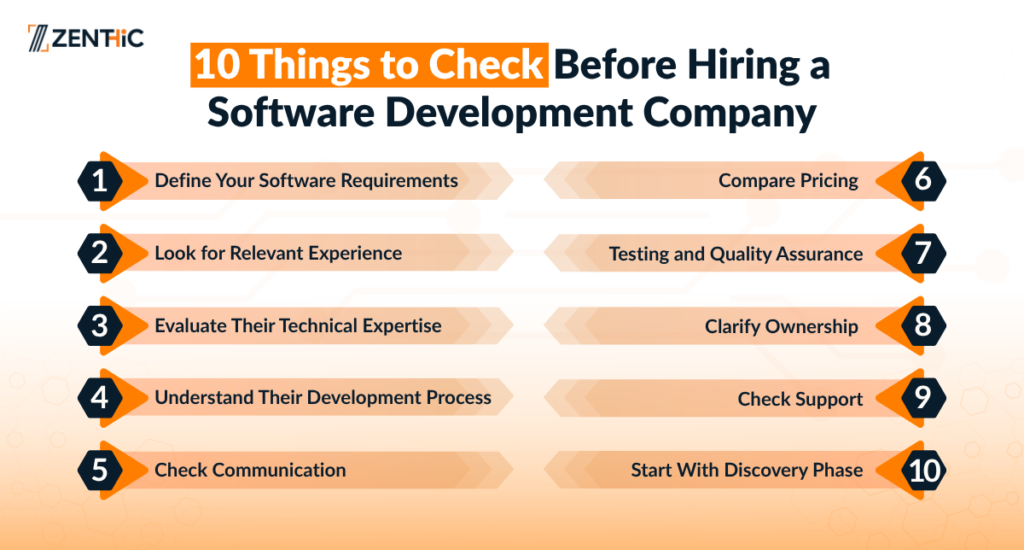
10 Things to Check Before Hiring a Software Development Company.
Here are the 10 key factors to consider before deciding.
1. Define Your Software Requirements
When you’re thinking about hiring a software development firm, you should have a clear idea of what you want in your software.
You don’t need to create a full technical specification. But you should be able to describe:
- What is the purpose of the software?
- Who will use it?
- What are the most important features?
- What’s the business purpose for it?
- Which type of software do you require: web, mobile, desktop, or cloud?
- Do you need integrations with existing systems?
When you have clear requirements, it will be easier to compare various companies and get more realistic estimates. If your idea is still in the development stage, a good development company can also help you define the requirements before you start developing.
2. Look for Relevant Experience
Just because a company has a large portfolio doesn’t indicate that it’s the right choice. It is more important to see if they have worked on projects similar to what you are doing.
Look at their previous work and consider the following:
- Have they developed software with similar features?
- Are they familiar with your industry or business model?
- Have they experience using the technologies your project needs?
- Are they able to explain what challenges they overcame?
- Do their case studies provide enough information to demonstrate results?
For example, a business that has previous experience in creating straightforward websites may not be the best fit for designing a complex SaaS application, enterprise application, or custom business management system. Relevant experience can minimize trial and error in the development process.
3. Evaluate Their Technical Expertise
The technology you choose can affect your software’s performance, security, maintenance, and development. When considering software development companies, ask them what technologies they suggest and why.
Depending on your project, this may include:
- Frontend and backend development
- Mobile app development
- Cloud infrastructure
- Database management
- Third-party integrations and APIs
- Cybersecurity
- Quality assurance and testing
- AI or automation
A good development partner should be able to present technical choices from a business perspective, not just a stack of technology.
4. Understand Their Development Process
Having a clear development process means you have a better understanding of what you will experience once you sign the contract.
Ask about their method of handling:
- Requirement gathering
- Planning and estimation
- UI/UX design
- Development
- Testing
- Client feedback
- Deployment
- Maintenance and updates
It is also important to know the frequency of progress reports and when to see working versions of the software. The process doesn’t have to be structured from the start. It is common in good software projects to have modifications, as users, requirements, or business needs become clearer.
To learn about the software development lifecycle in more detail, you can also read our blog about What Are the Stages of Software Development and How They Work?
5. Check Communication
While technical skills are essential, communication can be the difference between a successful software project and a failure.
Listen to the company’s communication during the initial discussion. Are they able to answer your questions in a way that is easy to understand? Do they ask questions regarding your business objectives? Is there technical language that you can understand?
Ask about:
- Meeting frequency
- Project reporting
- Communication tools
- Response times
- How feedback and changes are dealt with
If the communication is not clear from the beginning and then the development begins, it may be more challenging.
6. Compare Pricing
While it is important to consider the cost of the software development company, this is not the most favorable choice.
There are several factors that can cause two different companies to give very different estimates, such as the scope of the project, the way it will be developed, the technology used, the testing process, and the support services offered.
Inquire about whether the quote includes:
- Design and development
- Testing and quality assurance
- Project management
- Third-party integrations
- Deployment
- Maintenance
- Post-launch support
It is usually helpful to get a detailed quote rather than just comparing the hourly rate or initial project costs. See our guide on How Much Is Custom Software Development Cost in 2026? for more details.
7. Testing and Quality Assurance
The software is not complete when the features are developed. Ask about the company’s software testing procedures before launch. Testing can include functional, usability, performance, compatibility, and security testing, depending on the project.
You can also inquire about the quality assurance and test timing. A clear QA procedure will help a company identify issues before they impact customers or employees.
8. Clarify Ownership
Before signing a contract, remember who owns the final software, source code, designs, database, and other project assets.
Also, you need to find out how a company is going to protect your business and customer information during development.
Important questions include:
- What happens to the source code once it’s finished?
- How do you keep sensitive information safe?
- What access will you receive?
- What are the backup procedures?
- What if you switch development partners in the middle of the project?
This may sound insignificant at first, but once you start building your software, it might be very crucial.
9. Check Support
The process of software development does not come to an end when an application is live. After launching your software, it might require bug fixes, security patches, performance enhancements, new integrations, or new features.
Ask a company what they do after delivery before you select them. Does the company provide continuous maintenance? How do you deal with support requests? Does the agreement cover updates, or do they count as an additional cost?
A software development partner who can help you with software post-launch is more useful than a company that just supports delivery.
10. Start With Discovery Phase
If you’re not certain to invest in a long-term development project, you can begin with a discovery phase or a smaller project.
This enables you to see how the company functions before you enter full development.
You can assess their:
- Planning ability
- Communication
- Technical recommendations
- Understanding of your requirements
- Response to feedback
- Time management skills
This can help both parties to determine if this partnership is a good fit for them.
Conclusion
The selection of a software development company is not just about finding developers that can write code. You must have a partner who understands your objectives, has a good command of your communication, follows a structured process, and is able to support the software after it is launched.
First, establish your needs, then take a look at your experience, check out technical knowledge, compare development processes, and consider the entire development price. Above all, select a company that offers you good value, not just the lowest price.
The right software development partner can assist you in avoiding unnecessary expenses, reducing development risks, and producing software that will continue to support your business as it expands.
Ready to turn your software idea into a working solution? Discuss your needs with our team and select the best development method for your business.