Table of Contents
Introduction- Average Custom Software Development Timeline
- What Affects the Software Development Timeline?
- 1. Project Scope and Features
- 2. Software Complexity
- 3. User Interface and Experience
- 4. Third-Party Integrations
- 5. Security Requirements
- What Are the Main Stages of Custom Software Development?
- 1. Discovery and Requirements
- 2. Planning and Architecture
- 3. UI/UX Design
- 4. Development
- 5. Testing
- 6. Deployment
- How Long Does It Take to Build an MVP?
- Why Do Custom Software Projects Get Delayed?
- How Can You Speed Up Custom Software Development?
- Choose an Experienced Development Team
- How Does Development Time Affect Software Cost?
- How Should You Estimate a Custom Software Timeline?
- Conclusion

What is the time required to develop custom software? The duration of custom software development typically ranges from a few months to a few weeks, depending on the project’s scope, its features, integrations, design specifications, and testing needs. An MVP can take a few weeks; a business platform takes 6 months or longer.
Each project has its own schedule for completion. The time of custom software development will depend on the specific business needs that the software will be designed to address.
If you are thinking about implementing a new software solution, it is important to know the development timeline to plan, budget, allocate your staff resources, and have expectations for the launch of the software.
Average Custom Software Development Timeline
The time required to develop software varies based on its complexity. The following ranges can give you an idea of the cost of a project, although each project will require a specific estimate:
| Type of Software | Approximate Development Time |
| Simple internal tool | 4–8 weeks |
| Small business application | 2–4 months |
| Medium-complexity application | 3–6 months |
| Complex business platform | 6–12+ months |
| Enterprise-level software | 9–18+ months |
These timelines are subject to change and are not guaranteed deadlines. Even a project with limited features can take longer if it includes complex integrations, sophisticated security needs, or in-depth testing.
To estimate a project, thoroughly understand the requirements and break the work into manageable phases.
What Affects the Software Development Timeline?
Custom software development timelines can be affected by several factors. By knowing these factors, businesses can have more realistic expectations before the development process starts.
1. Project Scope and Features
The size of a project affects the amount of time it will take to develop.
The simplicity of an app with user accounts, basic dashboards, and some workflows is less time-consuming than a platform with multiple user roles, reporting options, third-party integrations, automation, and payment processing. Before development begins, it is useful to separate features into three groups:
- Essential features for the first release.
- Additional options that can be added later.
- Features that are optional.
This enables the development team to concentrate on the feature that gives the most immediate benefit.
2. Software Complexity
All software applications do not need the same technical requirements. For example, an internal web application could have simple processes and use a small number of users. If you are using a platform that is customer-facing, you may need real-time data, complex permissions, multiple integrations, advanced search, or AI capabilities. The more components a system needs to coordinate, the more time may be required for development and testing.
3. User Interface and Experience
The design process can also influence the overall time frame. The interface of a simple business application might be relatively simple. If the platform is designed to be used by the customer, it could require several steps of revisions, wireframes, prototypes, and usability testing. Good design isn’t just a matter of looks. The interface must be user-friendly and easy to navigate for the user.
4. Third-Party Integrations
Many custom software projects require integration with existing tools.
These might include:
- CRM systems
- Payment gateways
- Accounting platforms
- Email services
- Cloud platforms
- Business databases
- Communication tools
- External APIs
Each integration represents a new technical requirement. Developers should know how the external system works, how to securely exchange data, how to deal with errors, and how to test the connection. This is one reason two projects with similar feature lists can have very different development timelines.
5. Security Requirements
Development time may also be affected by security needs. If software is used for customers’ information, financial data, employee information, or other sensitive business information, it may need more security measures.
These may vary by project and include:
- Authentication
- Role-based access
- Data encryption
- Secure APIs
- Permission controls
- Audit logs
- Security testing
There’s a better approach to incorporating these requirements into the software from the outset rather than as an afterthought.
What Are the Main Stages of Custom Software Development?
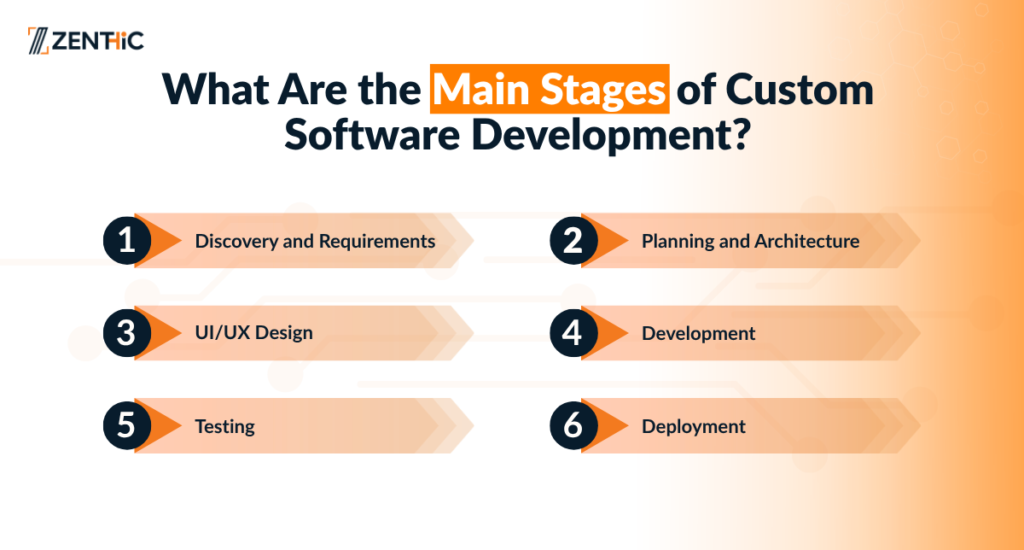
It is easier to understand the development timeline when you consider the whole process. The development of custom software typically involves several phases, such as planning, design, development, testing, and deployment. To understand more in-depth about each stage, check out our blog on the stages of software development and how they work.
Let’s see how these stages fit into the overall timeline.
1. Discovery and Requirements
The first step is to understand the business problem and define what the software needs to do.
The team can determine:
- Business objectives
- Target users
- Core workflows
- Required features
- Technical requirements
- Integrations
- Security needs
Spending enough time on this stage can prevent misunderstandings later in the project.
2. Planning and Architecture
If the requirements are clear, the team can begin to design how the system will work. This can include choosing the technology stack, designing the system architecture, planning the database and deciding the communication between different components. The complexity of this work depends on the type of software being developed.
3. UI/UX Design
The interface and user experience will be designed according to the requirements. This may involve wireframes, prototypes, interface designs, and user flow planning, among other things, depending on the type of project.
4. Development
Developers then turn the approved plans and designs into working software. This can include front-end development, back-end development, database work, APIs, integrations, automation, and other required functionality. Larger projects are often developed in smaller iterations so that progress can be reviewed throughout the process.
5. Testing
Testing checks whether the software works correctly and meets the original requirements. The teams can conduct functional, integration, performance, security, and user acceptance testing. Testing is an integral part of the original timeline since it can identify problems that may need further development.
6. Deployment
After testing and approval, the software can be deployed to its production environment. Depending on the project, deployment may involve configuring servers, databases, cloud infrastructure, domains, user access, and monitoring.
How Long Does It Take to Build an MVP?
An MVP, or minimum viable product, generally takes less time than a complete software platform because it focuses on the essential functionality needed for an initial release. A simple MVP may take around 4–12 weeks, while a more complex MVP can take several months.
The purpose of an MVP is not to include every feature that may eventually be needed. Instead, it provides the core functionality required to test an idea, support an initial group of users, or solve a specific business problem.
For example, a business creating a customer management application might initially need:
- Customer profiles
- User accounts
- Contact management
- Search
- Basic reporting
Advanced automation, additional integrations, and more detailed analytics could be introduced in later versions. This approach can help businesses start with a focused product instead of waiting until every possible feature has been developed.
Why Do Custom Software Projects Get Delayed?
Even when a project begins with a clear estimate, unexpected delays can occur.
1. Changing Requirements
Adding new features during development can increase the scope and affect the original timeline.
2. Unclear Requirements
If requirements are not clearly defined at the beginning, developers may need to revisit completed work or make additional changes.
3. Integration Challenges
External systems may have technical limitations, outdated APIs, or unexpected compatibility issues.
4. Delayed Feedback
Development often requires feedback and approvals from business stakeholders. Delays in these decisions can affect subsequent development tasks.
5. Additional Testing
Testing may reveal problems that require more extensive changes than initially expected.
For these reasons, a realistic development plan should allow some flexibility instead of treating the initial estimate as an exact deadline.
How Can You Speed Up Custom Software Development?
Reducing development time does not necessarily mean rushing the development team. Instead, businesses can focus on reducing unnecessary work and making important decisions early.
1. Define the Core Problem
Start by clearly identifying what the software needs to solve.
2. Prioritize Features
Focus on the features that are essential to the first release and move less important functionality to later phases.
3. Use an MVP Approach
A focused MVP can allow a business to launch the core product sooner and improve it based on the actual user feedback.
4. Prepare Requirements Early
Clear requirements help developers begin work with fewer assumptions and reduce unnecessary revisions.
Choose an Experienced Development Team
The right development team can help identify technical requirements, potential challenges, and realistic project phases before development begins.
If you’re comparing development partners, our guide on how to choose the right software development company can help you evaluate factors such as technical expertise, communication, project requirements, and development approach.
How Does Development Time Affect Software Cost?
Development time and software cost are often connected because longer projects generally require more development resources.
However, a timeline alone does not determine the final cost.
The total cost can also depend on:
- Project complexity
- Number of features
- Team size
- Technology requirements
- Integrations
- Security requirements
- Design work
- Maintenance needs
For a more detailed look at the factors that influence pricing, read our guide on how much custom software development costs in 2026.
Understanding both timeline and cost together gives businesses a clearer picture of what is involved before starting a project.
How Should You Estimate a Custom Software Timeline?
Instead of only asking, “How many months will development take?” businesses should first define what they actually need to build.
A useful project assessment should cover:
- What problem will the software solve?
- Who will use it?
- What are the essential features?
- How many user roles are required?
- Does it need third-party integrations?
- What security requirements apply?
- What platforms will it support?
- What testing will be required?
- Which features can be added after launch?
Once these questions are answered, the development team can divide the project into phases and provide a more realistic estimate.
Conclusion
So, how long does it take to build custom software? The answer depends on the scope and complexity of the project.
A simple internal tool may take a few weeks, while a medium-complexity application may require several months. More advanced business platforms and enterprise systems can take six months, a year, or longer.
The development timeline should account for more than coding. Discovery, planning, UI/UX design, development, integrations, testing, deployment, and post-launch improvements can all contribute to the total project time.
Rather than choosing a development timeline based on a generic estimate, businesses should first define their requirements and priorities. A clear roadmap makes it easier to determine what should be built first, what can wait, and how much time the project is likely to require.
With the right planning and development approach, custom software can be delivered in manageable phases while allowing the product to evolve as business needs change.