On this page
What can AI agents actually do in logistics? AI agents in logistics are software assistants that read the emails, documents and system data your team deals with every day, decide what needs to happen, and complete the routine steps on their own — quoting rates, processing shipping documents, updating carriers and customers, and flagging exceptions for a person to review. Most logistics companies see the fastest return from agents that take over high-volume, repetitive communication rather than from large, company-wide AI projects.
Think about a normal Monday at a freight forwarder. Forty quote requests are sitting in the inbox, each written differently. A carrier has emailed a new ETA for a container that three customers are asking about. Someone is retyping a bill of lading into the TMS for the second time because the first copy had a typo. None of this work is difficult. There is just a lot of it, and it keeps coming.
That is where AI agents fit. A single shipment can involve shippers, carriers, brokers, customs agents, warehouses and your own team, and most of that coordination still happens through emails, spreadsheets, PDFs and phone calls.
The market is moving fast. Gartner forecasts that spending on supply chain management software with agentic AI capabilities will reach $53 billion by 2030. Spending more, though, doesn’t guarantee better results. In this guide, we cover what AI agents are, which use cases pay off first, how to work out the ROI and how to get started without disrupting day-to-day operations.
Key Takeaways
- AI agents go beyond rule-based automation: they understand unstructured inputs such as emails and PDFs, make decisions within limits you set, and act inside your systems.
- The best first use cases are high-volume and repetitive: rate requests, shipping documents, track-and-trace updates and exception handling.
- ROI comes from hours saved, faster response times, fewer errors and more capacity without new hires. A focused agent can often pay for itself within the first year.
- Start with one workflow, keep a human in the loop for approvals, and measure a clear baseline before you launch.
What Are AI Agents in Logistics?
An AI agent is a software system that can understand a goal, gather the information it needs, decide on the next step and take action across different tools. In logistics, that means an agent can read a customer’s email, pull the right data from your transportation management system (TMS), prepare a response and either send it or pass it to a team member for approval.
This is different from traditional automation. Rule-based tools and robotic process automation (RPA) follow fixed steps and break when an input looks different from what they expect. An AI agent can handle variation: a rate request written in a different format, a bill of lading scanned at an angle or a carrier update sent in Spanish. If you want a deeper comparison, read our guide on AI vs RPA: what’s the difference.
A practical logistics AI agent usually has four parts:
- Inputs: emails, PDFs, portal messages, EDI and API data, spreadsheets.
- Knowledge: your rates, lanes, customer rules, SOPs and historical shipments.
- Actions: creating or updating records in your TMS, WMS or ERP, sending emails and notifying your team.
- Guardrails: approval steps, confidence thresholds and a full log of every decision.
8 AI Agent Use Cases in Logistics
Not every process is a good fit for an AI agent. The strongest use cases share three traits: they happen often, they follow a recognizable pattern, and they currently depend on people copying information between emails, documents and systems.
1. Rate Requests and Quoting
Freight forwarders and brokers receive dozens or hundreds of quote requests every day, often in completely different formats. An AI agent can read each request, extract origin, destination, weight, dimensions, equipment and dates, check your rate sheets or carrier APIs, and prepare a quote for approval. Faster quotes usually mean more won business, because the first credible answer often gets the load.
2. Shipping Document Processing
Bills of lading, commercial invoices, packing lists, delivery receipts and customs forms still arrive as PDFs and scans. An agent can classify each document, extract the key fields, check them against the shipment record and flag mismatches, such as a weight that does not match the booking or a missing HS code, before they turn into delays or billing disputes.
3. Shipment Tracking and Customer Updates
“Where is my shipment?” is one of the most common questions logistics teams answer. An AI agent can monitor tracking data and carrier messages, then answer status requests by email, WhatsApp or a customer portal, and send proactive updates when an ETA changes. Your team stops answering the same question twenty times a day and can focus on the customers who actually need help.
4. Exception Management
Delays, missed pickups, damaged freight and customs holds need fast action. An agent can detect exceptions early, collect the relevant details, suggest the next step based on your SOPs and route the case to the right person with all the context already attached. People still make the call. They just get the full picture in seconds instead of digging through five email threads to find it.
5. Carrier Communication and Appointment Scheduling
Confirming pickups, chasing PODs and booking dock appointments involve a lot of back-and-forth messages. An AI agent can handle these routine conversations, update the TMS when a carrier confirms, and only escalate when something does not match the plan.
6. Freight Audit and Invoice Reconciliation
Carrier invoices often include accessorial charges, fuel surcharges and rate differences that are easy to miss. An agent can compare each invoice against the agreed rate and the actual shipment data, approve clean invoices and flag discrepancies for review, which helps reduce overpayments and shortens the billing cycle.
7. Customs and Compliance Checks
For cross-border shipments, missing or inconsistent information can hold freight at the border. An AI agent can check that the required documents are present and consistent, prepare data for customs filings and remind the right people when something is still missing. Final compliance decisions should remain with qualified staff.
8. Internal Knowledge Assistant for Operations Teams
New team members spend a lot of time asking where to find customer rules, lane requirements or SOPs. A knowledge assistant connected to your documents can answer these questions instantly and cite the source, which speeds up onboarding and reduces mistakes caused by outdated information.
Here is a quick summary to help you compare the options:
| Use Case | Main Inputs | What to Measure | Typical Complexity |
|---|---|---|---|
| Rate requests and quoting | Emails, rate sheets, carrier APIs | Quote response time, win rate | Low to medium |
| Shipping document processing | PDFs, scans, TMS records | Minutes per document, error rate | Low to medium |
| Tracking and customer updates | Tracking data, carrier messages | Status requests handled, response time | Low |
| Exception management | Tracking events, emails, SOPs | Time to resolution, missed exceptions | Medium |
| Carrier communication | Emails, TMS, scheduling tools | Messages handled, confirmation time | Low to medium |
| Freight audit | Invoices, rates, shipment data | Overpayments recovered, cycle time | Medium |
| Customs checks | Commercial documents, filings | Holds avoided, preparation time | Medium to high |
| Knowledge assistant | SOPs, customer rules, contracts | Questions answered, onboarding time | Low |
How to Calculate the ROI of AI Agents in Logistics
ROI is where a lot of AI projects get vague. The simplest way to keep it honest is to measure one workflow before and after the agent goes live. The basic formula is the same one we use in our guide on how to measure ROI of AI automation:
ROI = (Annual Benefits − Annual Costs) ÷ Annual Costs × 100
Where the Benefits Come From
- Time saved: hours your team no longer spends reading, copying and replying.
- Capacity: more shipments handled by the same team, without hiring for every peak season.
- Speed: faster quotes and replies, which can improve win rates and customer retention.
- Accuracy: fewer data-entry errors, billing disputes and missed exceptions.
- Cost recovery: overcharges caught during freight audit.
What the Costs Include
- Design and development of the agent, including integrations with your TMS, email and other tools.
- AI model and hosting costs, which depend on volume.
- Monitoring, improvements and support after launch.
- Team time for testing, training and reviewing the agent’s work in the first weeks.
Example: ROI for a Quoting Agent
The numbers below are an illustrative example, not a guarantee. Replace them with your own volumes and costs to estimate your business case.
| Assumption | Value |
| Quote requests per month | 2,400 |
| Manual time per quote | 6 minutes |
| Requests the agent prepares end-to-end | 70% |
| Review time per agent-prepared quote | 1 minute |
| Hours saved per month | 2,400 × 70% × 5 min ≈ 140 hours |
| Loaded hourly cost of the team | $35 |
| Annual value of time saved | 140 × $35 × 12 ≈ $58,800 |
| Build cost (one-time, example) | $25,000 |
| Running and support cost (example) | $1,500 per month |
In this example, first-year costs are $43,000 ($25,000 build + $18,000 running), and the first-year ROI is about 37%. The agent pays for itself in roughly 7 months, and from year two onward, when only running costs remain, the return is much higher. This calculation also leaves out the value of faster quotes and fewer errors, which is often where the biggest gains appear.
Where to Start with AI Agents in Logistics
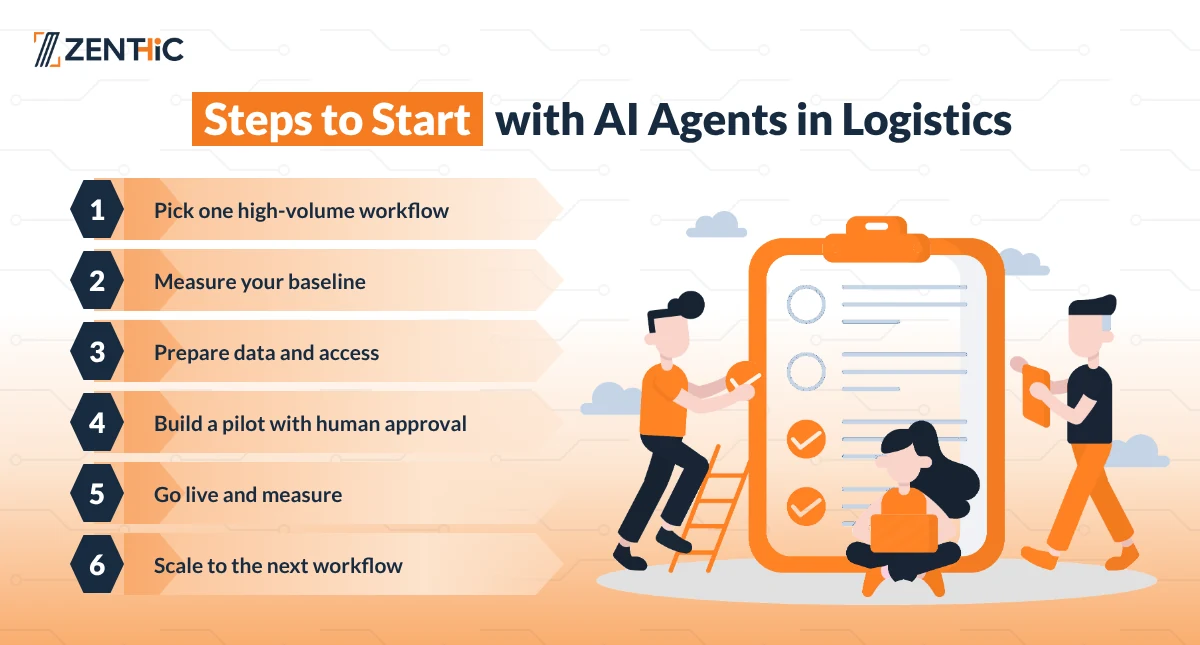
The companies getting real value from AI agents rarely begin with a big transformation program. They start small, prove that it works and then expand. These are the steps we follow with our own clients.
1. Pick One High-Volume Workflow
List the tasks that take most of your team’s time and happen every day. Choose one with a clear input and output, such as quote requests or POD collection. A focused first project is easier to build, test and measure.
2. Measure Your Baseline
Before anything changes, record how many requests you handle, how long each one takes, your response time and your error rate. Without a baseline, it is impossible to prove ROI later.
3. Prepare Your Data and System Access
Gather the rate sheets, SOPs, customer rules and example emails the agent will need, and confirm how it will connect to your TMS, inbox and other tools. Integration is often the part that takes the most planning, so it is worth addressing early.
4. Build a Pilot with a Human in the Loop
In the first version, the agent prepares the work and a person approves it. This keeps your service quality safe, builds trust in the system and creates feedback that improves the agent’s accuracy.
5. Go Live and Track Results
Compare the new numbers with your baseline every week. As accuracy improves, you can let the agent complete simple cases on its own and keep human review for exceptions.
6. Scale to the Next Workflow
Once the first agent delivers measurable results, reuse the same integrations and knowledge base for the next use case. Each new agent becomes faster and cheaper to launch than the first one.
Common Mistakes to Avoid
- Starting too big: trying to automate every process at once makes projects slow and hard to measure.
- Skipping the baseline: without “before” numbers, you cannot show the “after.”
- Ignoring integrations: an agent that cannot update your TMS just moves the copying work somewhere else.
- Removing people too early: keep approvals in place until the agent’s accuracy is proven on real volumes.
- Treating launch as the finish line: agents improve with monitoring and feedback after go-live.
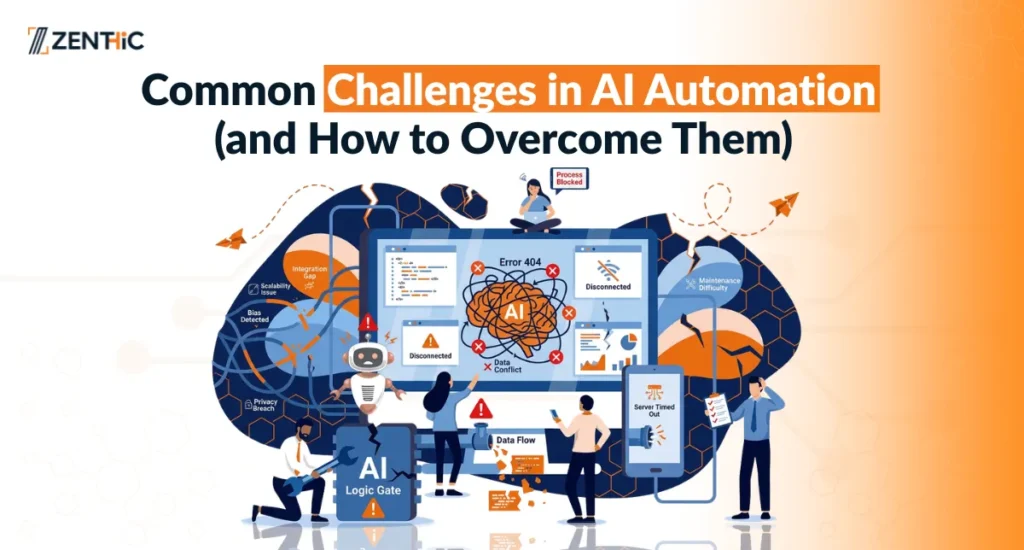
For a deeper look at these risks, see our article on common challenges in AI automation and how to overcome them.
How Zenthic Helps Logistics Teams
At Zenthic, we build AI agents that work inside the systems logistics companies already use, including their TMS, ERP, field tools and shared inboxes, so teams can work faster without replacing anything. Our AI for freight operations automates rate requests, shipping documents, carrier updates and ETA exceptions, with exceptions flagged for your team to review.
Every project starts with a free workflow assessment, where we map your processes, identify the use case with the fastest return and estimate the ROI before any development begins. Learn more about our AI agent development services.
Frequently Asked Questions
What is an AI agent in logistics?
An AI agent in logistics is software that reads information from emails, documents and systems, decides what needs to be done and completes routine tasks such as quoting, document processing, tracking updates and exception handling, while escalating anything unusual to a person.
How are AI agents different from RPA?
RPA follows fixed rules and works best with structured, predictable inputs. AI agents can understand unstructured inputs like free-text emails and scanned PDFs, adapt to variations and make decisions within the limits you define.
How long does it take to implement an AI agent?
A focused agent for a single workflow can often be piloted in a few weeks, depending on the number of integrations and how ready your data is. Larger, multi-workflow projects take longer and are usually delivered in phases.
Will AI agents replace logistics staff?
In most cases, AI agents take over repetitive tasks so the existing team can handle more shipments, respond faster and focus on customers, carriers and problems that need human judgment.
Do AI agents work with our existing TMS?
Yes. AI agents can connect to most TMS, WMS and ERP platforms through APIs, EDI, email or secure integrations, so you can add automation without replacing the systems your team already relies on.
Conclusion
AI agents give logistics companies a practical way to handle growing shipment volumes without adding the same amount of manual work. The best results come from starting with one repetitive, high-volume workflow, such as quoting, documents, tracking updates or exceptions, measuring the baseline, keeping people in control of approvals and scaling once the numbers prove the value.
If you are not sure which workflow to start with, a short assessment of your current processes is the best first step. It shows where the hours go, which use case will pay back first and what the realistic ROI looks like for your operation.