Table of Contents
Introduction- What Is ROI in AI Automation?
- Why Measuring AI ROI Matters
- Steps to Measure ROI of AI Automation
- 1. Define Clear Objectives
- 2. Calculate Total Investment Costs
- 3. Measure Financial Benefits
- 1. Cost Savings
- 2. Revenue Growth
- 3. Increased Productivity
- 4. Track Key Performance Metrics
- 1. Time Savings
- 2. Accuracy Improvements
- 3. Employee Productivity
- 4. Customer Satisfaction
- Common Challenges in Measuring AI ROI
- Conclusion
Over 75% of organizations are spending a considerable amount of money on AI automation to streamline their operations, boost efficiency, and optimize overall business performance. However, implementing AI is only the first step. The actual challenge is finding out if these solutions are driving measurable value and producing the desired outcomes.
That’s where measuring ROI is important. The key to measuring the ROI of AI automation is understanding how to do it, which will enable organizations to assess their AI projects, justify their investments, and identify areas for improvement. Measuring the right metrics and outcomes will help businesses make informed decisions and ensure their AI projects are contributing to long-term growth and success.
What Is ROI in AI Automation?
ROI, which stands for Return on Investment, is a ratio that compares the value of an investment with the amount of money invested. ROI is a key metric for evaluating the effectiveness of AI automation in businesses, helping them decide if the returns are more than the costs.
The basic formula is:
ROI = (Benefits – Costs) ÷ Costs × 100
If the ROI is positive, the AI solution is adding value; if it is negative, adjustments could be necessary for the solution to perform better. By measuring the ROI of AI automation, organizations can make informed decisions and optimize their technology investments.
Why Measuring AI ROI Matters
Businesses use AI for various purposes, including cost reduction, productivity gains, and customer experience. It can be hard to determine if you are getting results without measuring them. By measuring the ROI of AI automation, businesses can quantify the impact of their investment and ensure every initiative is driving meaningful results.
- Justify technology spendingEnhance
- future AI strategiesIdentify
- performance gapsSupport better
- decision-makingCommunicate
- business impact to stakeholders
A clear ROI framework ensures that AI initiatives remain aligned with business goals and deliver measurable outcomes.
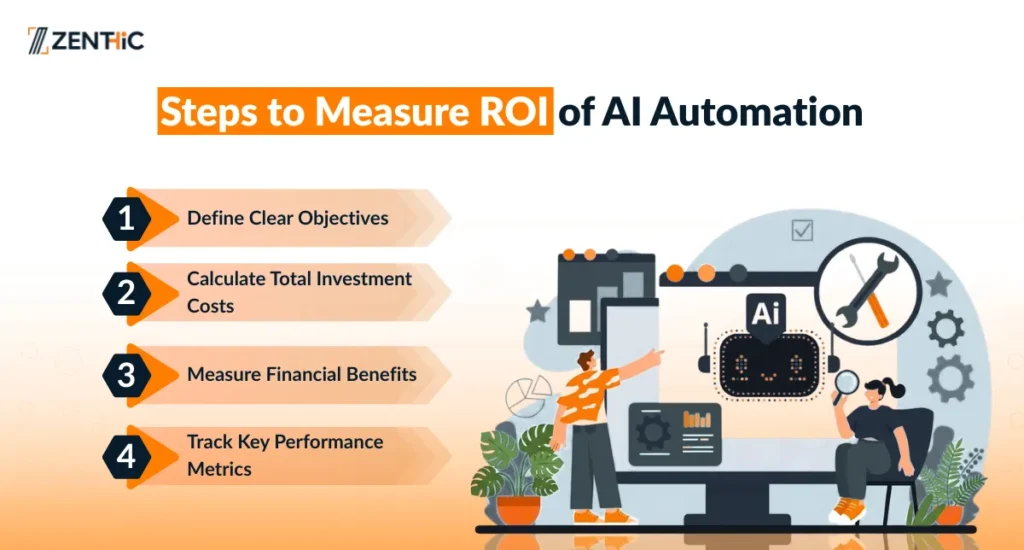
Steps to Measure ROI of AI Automation
There are four steps we can discuss here:
1. Define Clear Objectives
Businesses need to set clear objectives for their AI project to calculate ROI.
These objectives can be:
- Reducing operational costsIncreasing
- Employee productivityImproving
- customer serviceAccelerating
- Business processesGenerating more revenue
Setting clear goals makes it easier to track the results and assess if the AI solution is delivering the desired outcomes.
2. Calculate Total Investment Costs
The first step in measuring the ROI of AI automation is to understand the cost of AI automation.
Common expenses include:
- Software and licensing fees.
- The costs of development and integration.
- Cloud infrastructure and storage.
- Employee trainingThe ongoing maintenance and support are provided.
The problem is that many organizations consider only software costs and not other expenses, which can cause miscalculations in ROI.
3. Measure Financial Benefits
After determining costs, companies should estimate the financial benefits of AI automation.
Some of the most common benefits include:
1. Cost Savings
AI can automate time-consuming tasks, help prevent mistakes, and enhance productivity. These enhancements may result in substantial cost savings.
2. Revenue Growth
Businesses can boost conversions and enhance customer retention with AI-powered personalization, customer insights, and sales automation.
3. Increased Productivity
Working with automation tools can reduce repetitive tasks and free up employees to work on more strategic activities that add more value to the organization. The economic benefits are significant factors in the returns on AI investments.
4. Track Key Performance Metrics
While financial returns are important, they do not tell the whole story when it comes to the success of AI. Operational metrics that show improvements should also be tracked by businesses.
The following are significant AI metrics:
1. Time Savings
Calculate the amount of time that AI automation can save over manual processes.
Examples include:
- Improved response times from customer support.
- Saves time spent on data entry.
- Quicker document processing.
2. Accuracy Improvements
AI can help minimize human errors and ensure uniformity.
Track:
- Error rates before implementation.
- Errors made after implementation.
- Quality improvements
3. Employee Productivity
Compare the amount of work that teams are able to do before and after using AI.
4. Customer Satisfaction
One of the goals of AI projects is often to enhance the customer experience. Key performance indicators like customer retention, satisfaction ratings, and response rates can be used to quantify success.
Common Challenges in Measuring AI ROI
While ROI measurement is essential, there are several challenges.
A frequent problem is distinguishing between the effects of AI and other business enhancements. Multiple factors can affect performance, which means determining the specific impact of AI could be challenging.
One of the problems is the lack of quality data. The reliability of ROI calculations may be compromised due to inaccurate or incomplete data.
Companies should also pay attention to short-term results. Many AI solutions provide value over time because of their greater scalability, better decision-making, and stronger customer relationships.
Understanding these challenges allows organizations to create a more realistic and effective way of measuring the success of AI.
Conclusion
The key to maximizing the value of AI automation is its consistent tracking and optimization. Businesses that monitor key performance metrics, evaluate financial returns, and align AI initiatives with strategic goals are more likely to achieve long-lasting success. AI should not be seen as an end goal but rather as a continuous process of improvement and innovation.
By selecting an appropriate measurement approach and partnering with a reputable AI automation firm, businesses can achieve improved efficiency, better decision-making, and sustainable value from their AI efforts.