Table of Contents
Introduction- Why Businesses Are Investing in AI Automation
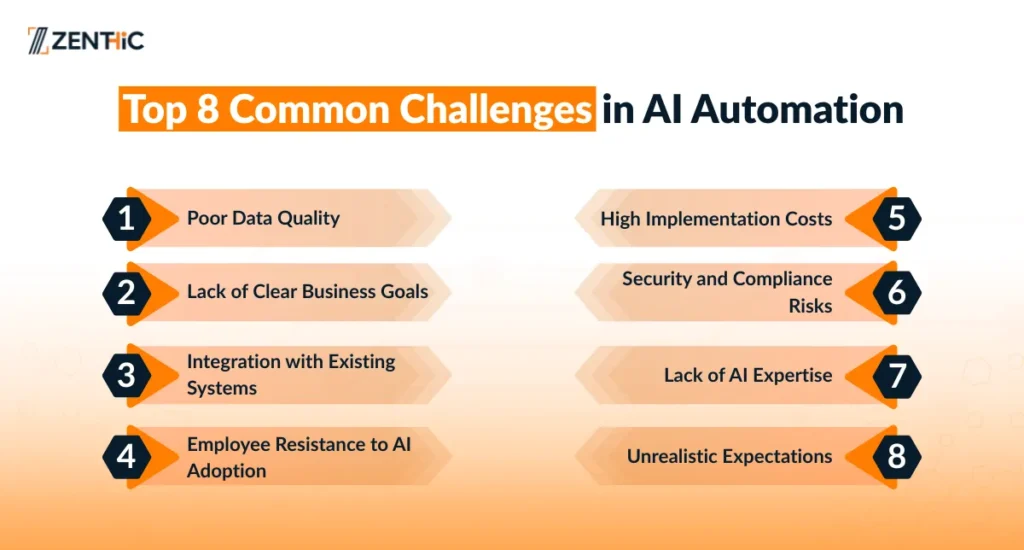
- Top 8 Common Challenges in AI Automation
- 1. Poor Data Quality
- 2. Lack of Clear Business Goals
- 3. Integration with Existing Systems
- 4. Employee Resistance to AI Adoption
- 5. High Implementation Costs
- 6. Security and Compliance Risks
- 7. Lack of AI Expertise
- 8. Unrealistic Expectations
- Best Practices for Successful AI Automation
- 1. Start Small
- 2. Prioritize Data Quality
- 3. Focus on Employee Adoption
- 4. Measure Results
- 5. Scale Gradually
- Conclusion
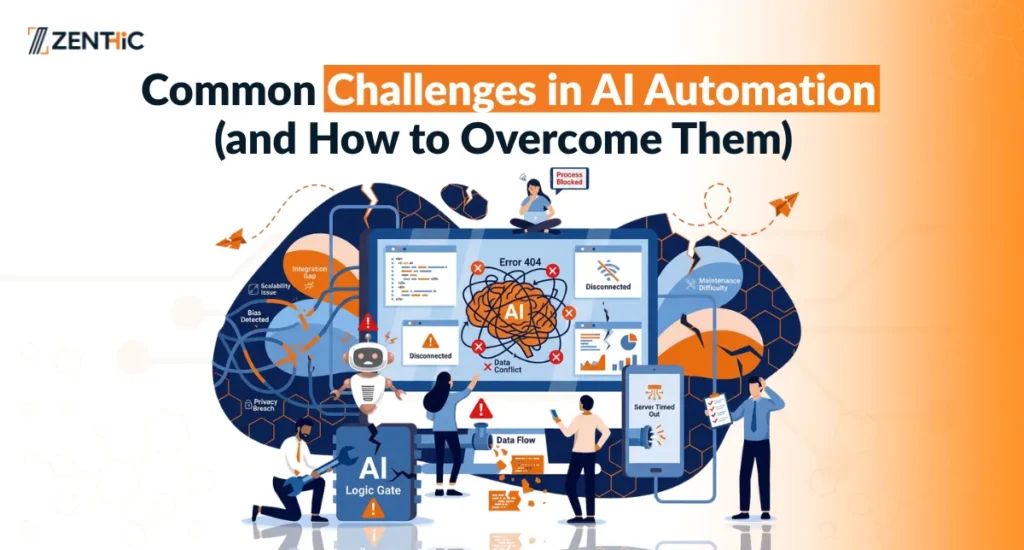
AI automation has emerged as a powerful tool that enables businesses to streamline repetitive tasks, optimize workflows, and create customer experiences that are better. While the potential benefits of AI are great, some challenges must be addressed. Many organizations have barriers that hinder the adoption, cost, or scalability of automation measures. Understanding these challenges is essential for building a successful AI implementation strategy.
In this article, we will explain the most common challenges in AI automation, their causes, and how businesses can navigate them to ensure sustainable success.
Why Businesses Are Investing in AI Automation
Before discussing the challenges, it is important to understand why organizations are adopting AI.
AI automation is applied to businesses to achieve the following:
- Minimize repetitive and manual tasks
- Enhance productivity and efficiency
- Enhance customer support
- Optimize business processes
- Utilize data to make decisions
- Reduce operational costs
While these benefits are substantial, achieving them requires a well-planned strategy for the implementation of AI.
Top 8 Common Challenges in AI Automation
Let’s explore eight common challenges in AI automation and how businesses can overcome them
1. Poor Data Quality
Poor data quality is one of the greatest challenges in implementing AI in businesses. Data is the fuel that powers AI systems, enabling them to recognize patterns, draw conclusions, and make decisions. AI-generated results may be unreliable and result in sub-optimal business decisions when the data is incomplete, inaccurate, outdated, or inconsistent. Problems that occur are often missing information, duplicate records, inconsistent data formats, outdated customer information, and disconnected systems.
To address this challenge, companies need to build a robust data infrastructure before implementing AI automation. This involves cleaning and organizing data sets, eliminating duplicate records, normalizing data formats, and establishing a robust data governance framework. It is important for organizations to also keep information up to date and centralized in systems to enhance accessibility and reliability. Data quality is essential for enhancing the accuracy and effectiveness of AI models, boosting automation, and ensuring that AI efforts yield accurate results.
2. Lack of Clear Business Goals
One related issue with AI automation is the absence of business objectives. Many organizations invest in AI because it is a trend, but not because it has a specific business need. Because of this, they have difficulty defining success, monitoring progress, and proving the ROI. AI initiatives can become less effective and lack impact if there are no clear goals.
The first step in addressing this challenge is for businesses to recognize specific issues that can be resolved through AI automation. This may involve automation of customer support inquiries, better lead qualification, minimizing manual data entry, faster payment of invoices, or better management of inventory.
Organizations need to define measurable goals and key performance indicators (KPIs) before deploying an AI solution and measure its performance and progress against them. A well-defined AI implementation strategy guarantees that automation initiatives stay aligned with the business goals and produce measurable benefits over time.
3. Integration with Existing Systems
Another challenge for organizations in the implementation process is integrating AI with their current business systems. In today’s business world, most companies are already using several platforms to run their daily operations, including the CRM software, ERP System, accounting software, and communication applications. Once AI solutions are implemented, integrating them with these systems can be challenging. Without systems that are interconnected and can share information effectively, automation processes can become inefficient and not produce the desired outcome.
As a result, businesses must focus on integration planning as part of their initial steps on the AI implementation journey. AI platforms with robust API support, early assessment of integration needs, and a collaborative relationship with experienced development partners can help avoid compatibility problems.
Testing before deployment is also important to ensure that all systems are communicating. A well-connected technology ecosystem allows AI automation to work seamlessly through various departments and business functions, improve the accessibility of data, and streamline workflows.
4. Employee Resistance to AI Adoption
One of the most frequent issues that businesses encounter when implementing AI is employee resistance. When implementing AI automation, there may be substantial changes to current workflows that can cause uncertainty among staff. This can make it harder to implement new technology, decrease employee engagement, and restrict overall technology success.
Businesses can address this challenge by communicating clearly and engaging their employees during the implementation process. It’s crucial to highlight the role of AI automation in enhancing job performance by alleviating repetitive tasks and boosting overall efficiency, enabling workers to engage in more value-added activities. Training programs, employee engagement, showcasing the value of AI in operations, and skill-building opportunities are also effective methods for encouraging adoption. When employees understand the value of AI and feel supported during the transition, they are more likely to embrace change and contribute to the success of AI automation initiatives.
5. High Implementation Costs
The cost of implementing AI automation is usually a challenge for enterprises, especially small and medium-sized ones. Even while AI has many long-term advantages, the upfront costs may appear prohibitive. Expenses may include software licensing, infrastructure updates, integration services, personnel training, and continuing support. Even though automation has the potential to increase productivity and lower operating costs over time, these expenses may discourage some organizations from implementing AI.
To effectively manage costs, firms should avoid starting large-scale automation projects from scratch. Instead, companies should start with smaller, higher-impact programs that can produce quantifiable outcomes immediately. AI chatbots, workflow automation tools, automated document processing, and customer service automation are examples of solutions that can offer instant benefits at a lower initial cost.
Before implementing AI automation throughout the entire company, companies can assess return on investment (ROI), identify any issues, and decrease financial risk by doing trial projects. Adoption of AI is more manageable and has a higher chance of long-term success due to this progressive approach.
6. Security and Compliance Risks
In AI automation, security and compliance are two of the most important issues. AI systems are at risk of cyberattacks and data breaches since they frequently manage substantial volumes of sensitive customer and company data. Without adequate security measures, firms may face major risks such as illegal access, compliance violations, financial losses, and loss of consumer trust. As businesses continue to implement AI technologies, data protection and compliance with industry standards become more critical than ever.
Instead of treating security as a secondary priority, enterprises should incorporate security into every phase of the AI adoption process to lower these risks. Sensitive data can be protected and vulnerabilities reduced with the use of robust security measures such as data encryption, multi-factor authentication, access control policies, frequent security audits, and ongoing compliance monitoring. Additionally, companies should make sure that their AI systems comply with industry standards and relevant data protection laws. A proactive approach to security not only eliminates operational risks but it also assists enterprises in developing trust and confidence in their AI automation programs.
7. Lack of AI Expertise
While many businesses see the benefits of AI automation, they don’t have the expertise to make it work. Without proper understanding and experience, organizations can select the wrong tools, encounter implementation issues, or not fully leverage their investment in AI.
There are several solutions to this problem, including recruiting AI experts, collaborating with experienced AI development firms, reskilling current staff, and taking part in AI training initiatives. Having access to the right expertise helps ensure smoother implementation and better results from AI automation initiatives.
8. Unrealistic Expectations
While many businesses see the benefits of AI automation, they don’t have the expertise to make it work. Without proper understanding and experience, organizations can opt for the wrong tools, encounter implementation issues, or not fully leverage their investment in AI.
To address this challenge, companies can recruit AI experts, find experienced AI development firms, reskill their current staff, and invest in AI training initiatives. The right expertise ensures smoother implementation and better results from AI automation initiatives.
Best Practices for Successful AI Automation
Businesses that successfully implement AI often follow a few key principles:
1. Start Small
Start with targeted projects that address a certain business issue.
2. Prioritize Data Quality
Reliable data is essential for successful AI automation.
3. Focus on Employee Adoption
Offer training and encourage collaboration throughout the implementation phase.
4. Measure Results
Monitor key performance indicators and analyze performance regularly.
5. Scale Gradually
Expand AI automation based on past performance and measurable results.
Following these best practices can assist companies in reducing risks and maximizing the benefits of AI automation.
Conclusion
AI automation offers significant opportunities for businesses to improve efficiency, reduce operational costs, and deliver better customer experiences. But it’s not enough to just implement new technology to achieve success. Many organizations face challenges including data quality, system integration, employee adoption, security, and a lack of AI skills.
The most successful businesses will adopt a strategic approach, define clear goals, invest in high-quality data, support their employees during this change, and deploy AI solutions gradually. Working with a trusted AI automation company can also help businesses overcome technical challenges, minimize risks, and ensure a smoother implementation process.
With the ongoing development of AI technology, businesses that face these challenges and collaborate with experienced professionals will be better positioned to harness AI automation, foster sustainable growth, and secure a competitive edge in the long term.