Table of Contents
Introduction- Why Businesses Are Investing in AI Automation
- Understand Your Business Needs First
- Look for Solutions That Can Scale
- Choose a User-Friendly Platform
- Check Integration Capabilities
- Top 5 AI Automation Features.
- Compare Security and Data Privacy
- Consider Long-Term Costs
- Read Reviews and Case Studies
- Request a Demo Before Choosing
- Common Mistakes to Avoid
- Conclusion
Artificial Intelligence has now been widely integrated across all domains. AI automation solutions are now being adopted by businesses of all sizes to save time, eliminate manual efforts, enhance customer experience, and boost productivity. AI is reshaping the business landscape, from customer support chatbots to data analysis tools and automated workflows.
However, there are numerous platforms and technologies to choose from, making it difficult to narrow down which AI automation solution is the right one. All providers say that they have the best features, smartest technology, and fastest results. The problem is determining a solution that really works for your business.
This guide will help you identify the best AI automation tool for your company, understand its capabilities, potential pitfalls, and the long-term benefits it can provide for your business growth.
Why Businesses Are Investing in AI Automation
In today’s world, businesses have to face many challenges, including increased workload, high customer expectations, and more competition. Manual workflows can slow down processes and decrease efficiency. AI automation can overcome these challenges by automating repetitive work, analyzing vast amounts of data, and enhancing decision-making processes.
AI automation is used in businesses for:
- Customer support chatbots
- Marketing automation
- Workflow management
- Analysis of data and reporting
- Inventory management
- Lead generation
- Predictive analytics
- Process optimization
The right AI automation can save time, minimize human error, boost productivity, and cut operational expenses.
Understand Your Business Needs First
Understand your business’s needs before comparing AI tools. The reality is that many companies invest in AI because it’s a trend rather than because they have a clear strategy. This frequently causes implementation problems and poor outcomes.
The first step is to determine the largest problems in your business.
Ask yourself:
- What is the most time-consuming task?
- Where do employees find themselves doing repetitive manual tasks?
- What processes might be quicker or more accurate?
- Do customers feel that support is taking too long?
- Are you having problems with data management or workflows?
For instance, in e-commerce, AI can enable personalized product suggestions and automated customer support, while in healthcare, intelligent scheduling systems and patient data management can be critical features. When your objectives are clear, selecting an AI automation solution is so much simpler.
Look for Solutions That Can Scale
Look for Solutions That Can Scale. As your business expands, your AI system should too. An AI automation solution that’s scalable enables you to grow your operations without replacing your current software. This is essential for businesses looking towards long-term growth.
A scalable platform must be able to accommodate the following:
- Increased workloads
- Additional users
- New workflows and automations
- More integrations
- Growing customer data
The answer is to invest in scalable technology now and avoid costly migrations and technical problems later.
Choose a User-Friendly Platform
Not all businesses will have their own technical team. That’s where the ease of use comes in. If the AI system is too complex, it may slow down adoption and can be a source of frustration for employees. The best automation tools make processes easier, not harder.
Search for sites that offer:
- Simple and easy-to-understand dashboards.
- Easy setup process
- Drag-and-drop automation builders
- Simple reporting tools
- Helpful tutorials and customer support
Employees who can easily understand and use the system achieve better productivity levels and faster results for the business.
Check Integration Capabilities
An AI automation solution should work smoothly with your existing software and business systems. If you don’t have the right integrations, they may find themselves dealing with tools that aren’t connected and manually moving data from one platform to the next.
Good integration capabilities help businesses
- Improve workflow efficiency
- Minimize manual data entry
- Centralize operations
- Increase productivity
- Enhance communication between departments
Before deciding, verify if the platform supports tools such as:
- Salesforce
- HubSpot
- Shopify
- Slack
- Google Workspace
- Microsoft Office
- CRM and ERP systems
Good integrations can simplify operations and increase automation efficiency.
Top 5 AI Automation Features.
Different AI automation platforms offer different capabilities. Choosing software with unnecessary features can increase costs without adding value. Focus on features that directly support your business needs.
Some important AI automation features include:
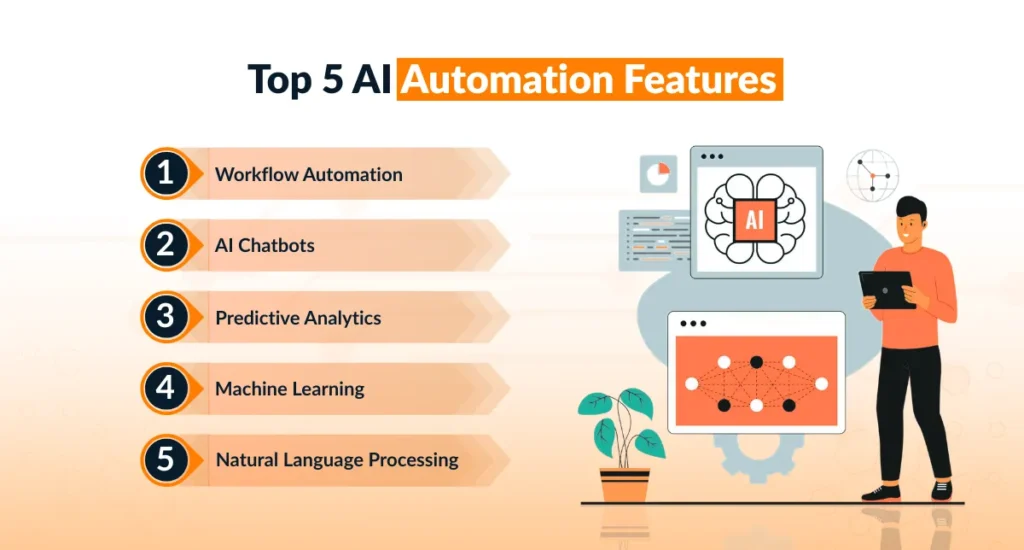
1. Workflow Automation
Automates repetitive tasks and improves operational efficiency.
2. AI Chatbots
Provides instant customer support and reduces response times.
3. Predictive Analytics
Helps businesses forecast trends and make smarter decisions.
4. Machine Learning
Allows systems to improve performance using business data.
5. Natural Language Processing
Improves communication between users and AI systems. Instead of choosing the most advanced platform, choose the one that effectively solves your business problems.
Compare Security and Data Privacy
AI systems are frequently used to manage sensitive customer and business data. Security is always a top priority. Check security measures and compliance policies from various providers before signing up.
These are key elements of security:
- Data encryption
- Secure cloud storage
- Role-based access controls
- Regular security updates
- Compliance with GDPR and industry standards
Compliance and data privacy are of particular concern in sectors like healthcare, finance, and the handling of customer data.
Consider Long-Term Costs
Many businesses only talk about the monthly subscription pricing and do not consider the hidden costs.
An AI automation solution may also require:
- Setup and implementation fees
- Employee training
- Maintenance costs
- Integration expenses
- Future upgrades
The lowest price doesn’t always indicate the highest quality software. Rather, think about the long-term value and return on investment. Over time, a reliable AI automation platform should enable your business to save time, boost productivity, and cut down on operational costs.
Read Reviews and Case Studies
Customer evaluations and case studies provide essential information about how a platform operates in real-world scenarios. Look for reviews from businesses that are similar to yours.
Pay attention to:
- Implementation simplicity
- Quality of customer service
- Reliability of the platform
- Increased productivity
- Overall customer satisfaction
Real-life success stories might help you make more confident decisions.
Request a Demo Before Choosing
Never invest in AI automation solutions without first testing them. The majority of suppliers give free trials or demos so that companies can test the platform before committing.
During the demonstration, evaluate:
- Experience of users
- Automated setup process
- Reporting Features
- Integration capabilities
- Overall performance
Testing the program enables you to determine whether it actually satisfies your business needs.
Common Mistakes to Avoid
Many companies fail to embrace AI because they make preventable mistakes.
Typical errors include:
- Software selection based only on cost
- Scalability is ignored
- Purchasing systems that are too complex
- Not providing training to staff
- Lack of clarity in setting business goals
- Neglecting compliance and security
By avoiding these errors, you may maximize the return on your AI investment and enhance implementation success.
Conclusion
Choosing the appropriate AI automation technology is an important business choice. The right platform can increase efficiency, automate repetitive operations, lower expenses, and promote long-term growth.
Instead of chasing trends, businesses should focus on solutions that address real-world operational difficulties and align with their objectives.
Take time to evaluate your needs, compare features carefully, test the platform, and consider long-term scalability before making a final decision.
As AI technology continues to evolve, businesses that invest in the right automation solutions today will be better prepared for future growth, innovation, and competition.