Table of Contents
Introduction- What Is a Performance Marketing Agency?
- Why Choosing the Right Agency Matters
- 7 Key Factors to Consider a Performance Marketing Agency
- 1. Relevant Industry Experience
- 2. Transparent Reporting
- 3. Testing Strategy
- 4. Focus on Business KPIs
- 5. Strong Tracking and Analytics Setup
- 6. Creative Strategy
- 7. Clear Communication and Contracts
- Conclusion
Performance marketing isn’t measured by impressions; it’s measured by numbers, which is an entirely different process than recruiting for branding or creative. A performance marketing agency is responsible for quantifiable results: cost per acquisition, return on ad spend, pipeline generated, and revenue closed. If you make the wrong selection, it’s not only an underwhelming campaign; it’s wasted media spend for weeks or months that a competitor’s budget didn’t spend.
When it comes to selecting a paid media agency, there is a lot of competition going on in the digital world, and businesses are spending more on paid advertising to get qualified leads, boost online sales, and speed up growth. But it’s not enough to just run ads to get consistent results. The right strategy, accurate tracking, ongoing optimization, and data-driven decision-making are essential for maximizing your advertising budget. That’s why choosing the right performance marketing agency is a critical choice for the success of long-term marketing.
What Is a Performance Marketing Agency?
A performance marketing agency is a business that focuses on providing data-driven advertising campaigns based on measurable business results, not just marketing results. These agencies don’t just aim for impressions or traffic; their campaigns are designed to meet specific targets and objectives like generating quality leads, boosting internet sales, enhancing conversion rates, or creating maximum ROI in performance marketing.
Many performance marketing agencies run channels such as the following:
- Google Ads & Meta Ads (Facebook and Instagram)
- LinkedIn Ads
- Microsoft Ads
- Display and Programmatic Advertising
- Remarketing Campaigns
A good agency isn’t just going to create campaigns and wait to see how they go. It continually audits performance metrics, runs variations, and optimizes campaigns according to measurable results.
Why Choosing the Right Agency Matters
The wrong agency can cost a lot of money. If your advertising budget is not being targeted to the right audience, your ads aren’t being created effectively, you don’t have conversion tracking in place, and you aren’t optimizing your campaigns, your advertising investment could be going towards nothing.
Conversely, the proper agency can be an extension of your group. They know your business goals, adjust campaigns according to the data, and continue optimizing them to better maximize return on investment.
Instead of just looking at cost per click (CPC), a proven agency will be more focused on other numbers that will affect their revenue, such as customer acquisition cost (CAC), return on ad spend (ROAS), conversion rate, and customer lifetime value (CLV).
7 Key Factors to Consider a Performance Marketing Agency
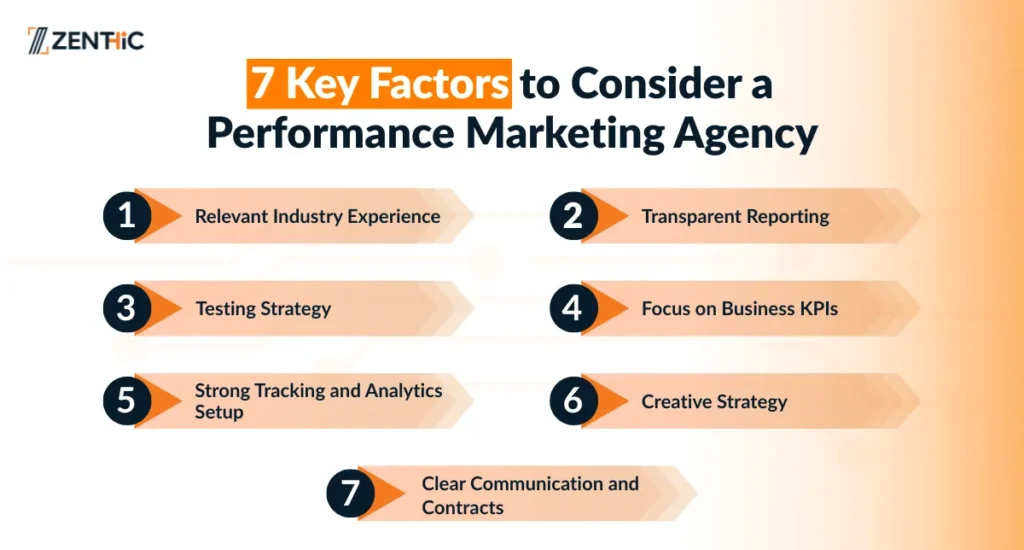
1. Relevant Industry Experience
One of the first things to check is if the agency has experience in dealing with companies like yours. Not every agency is going to be familiar with the same audience, goals, and buying journey, so there are different performance marketing strategies used in various fields.
Request case studies and statistical results showing that it has achieved measurable outcomes like higher ROI, reduced cost per acquisition (CPA), or a higher number of qualified leads. The more their experience is relevant, the quicker they will be able to deliver effective results.
2. Transparent Reporting
Transparency is one of the best signs of a trustworthy digital advertising agency. A successful agency will never provide its campaign data in the form of monthly PDF reports. Rather, they should offer direct access to their advertising accounts, analytics tools, and reporting dashboards.
The following information should be visible:
- Google Ads account
- Meta Ads Manager
- Google Analytics 4 (GA4)
- Google Tag Manager
- Looker Studio reports
- Conversion tracking
Real-time reporting helps you see where your advertising money is going and how your campaigns are doing. Be wary of an agency that won’t give you account access or just gives you a handful of reports.
3. Testing Strategy
In the world of performance marketing, testing is the key to success. Every market is dynamic, customers’ behavior is changing, and advertising platforms continually update their algorithms. Some agencies stick to the same campaigns and can have trouble making improvements over time. Ask questions about any optimization process the agencies have used in the past.
A good agency will regularly test the following:
- Ad headlines
- Images and videos
- Audience targeting
- Bidding strategies
- Landing pages
- Calls-to-action
- Ad copy
For example, rather than thinking that one advertisement will work best, they should launch several ads at the same time, track the conversion data, and allocate more of their budget to the ads that convert best. In addition to lower advertising costs, this systematic testing process increases the performance of advertising campaigns.
4. Focus on Business KPIs
Many agencies focus on amazing statistics such as impressions, clicks, and click-through rate (CTR). While these metrics provide useful insights, they don’t necessarily indicate business success. Define metrics (KPIs) that are important to your business before signing a contract.
These may include:
- Return on Ad Spend (ROAS)
- Cost Per Acquisition (CPA)
- Cost Per Quality Lead (CPQL)
- Revenue Generated
- Conversion Rate
- Customer Acquisition Cost (CAC)
5. Strong Tracking and Analytics Setup
Without accurate tracking, it’s impossible to determine whether your campaigns are successful. Before launching campaigns, the agency should ensure that conversion tracking is properly configured across your website.
This typically includes:
- Google Analytics 4
- Google Tag Manager
- Meta Pixel
- Enhanced Conversions
- Server-side tracking (where appropriate)
- Conversion API integrations
Tracking allows you to determine which campaigns, keywords, audiences, and creatives are performing best and generate the highest return on investment.
6. Creative Strategy
Even the most experienced media buyers can’t beat bad creatives. Effective ads are those that have a clear strategy, a strong message, captivating images, and a possibility of converting leads into customers.
Inquire if the agency assists with:
- Ad copywriting
- Creative design
- Video advertisements
- Landing page optimization
- Conversion rate optimisation (CRO)
For instance, two companies could both invest the same amount of money in Google Ads, and one could have a higher conversion rate due to their landing pages and messaging. Performance marketing is not just about buying traffic; it’s about converting that traffic into customers.
7. Clear Communication and Contracts
Collaboration and accountability should be the foundation of the agency relationship.
Ask them how often they update clients and who will be handling your account. Some agencies will hire a senior strategist to help during the sales cycle and then pass off to a junior strategist once the business is closed.
It is also important to look at the contract in detail. Do not enter into a long-term contract that is hard to break if you are not satisfied with the performance. There are a lot of good agencies that will provide shorter contracts or 90-day contracts so that both parties can try it out before it becomes a long-term commitment.
Conclusion
Choosing the right performance marketing agency is about more than comparing prices or promises. Look for a partner with relevant experience, transparent reporting, a data-driven approach, and a proven track record of delivering measurable results. Taking the time to evaluate your options carefully will help you invest your budget wisely and build a partnership that supports long-term business growth.