Table of Contents
Introduction- What is Front-end-Development?
- Key Responsibilities of Frontend Development
- Common Frontend Technologies
- What is Backend Development?
- Key Responsibilities of Backend Development
- Common Backend Technologies
- Key Difference Between Frontend and Backend Development
- How Frontend and Backend Work Together
- Why Frontend and Backend Both Matter
- 1. Better User Experience
- 2. Secure and Reliable Systems
- 3. Faster Development Decisions
- 4. Scalable Digital Products
- Frontend vs. Backend: Which is More Important?
- Full Stack Development
- Conclusion
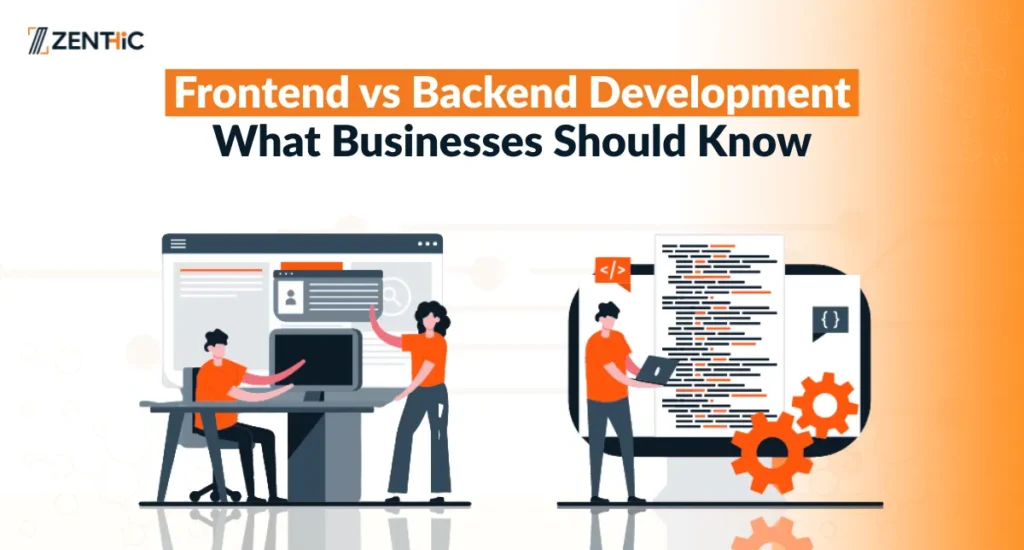
In today’s digital world, every business relies on a website or web application to connect with customers. But behind every smooth, fast, and interactive platform, there are two core parts working together: frontend development and backend development, often powered by modern technologies like AI development.
These terms are heard by many business owners, but they do not know what they are or why they are so important. In simple terms, the frontend is what the users see, and the backend is what makes it all work. Both play an equal role in developing a successful digital product.
Knowing the difference will enable businesses to make more decisions when hiring developers, creating budgets, or developing online platforms.
What is Front-end-Development?
Frontend development is the visual component of a site or application, all that the user sees and touches.
When you access a site, everything you see; the design, buttons, pictures, menus, and animations, are in the front-end. It is also referred to as the client-side of development.
Frontend developers ensure that websites are appealing, responsive, and user-friendly. They aim to provide a seamless user experience on all devices, such as mobile, tablet, and desktop.
Key Responsibilities of Frontend Development
- Creating user interfaces (UI)
- Ensuring mobile responsiveness
- Improving user experience (UX)
- Developing dynamic features such as forms and sliders.
- Speed and performance of websites.
Common Frontend Technologies
- HTML (structure of the website)
- CSS (design and styling)
- JavaScript (interactivity and functionality)
- React, Vue, and Angular frameworks.
Frontend, in simple terms, is all that defines how a user perceives and experiences your site.
What is Backend Development?
The unseen part of a website or application is called the back-end development. It operates behind the scenes and makes sure that everything is going well.
When you log in, place an order, or do anything online, the back-end systems access that data and interact with databases and servers. The backend is also referred to as the server-side of development.
Key Responsibilities of Backend Development
- Database and data management.
- Dealing with user authentication (log in/sign up).
- Processing business logic
- Encryption of applications and data.
- Connection between frontend and servers/APIs.
Common Backend Technologies
- Database and data management.
- Dealing with user authentication (log in/sign up).
- Processing business logic
- Encryption of applications and data.
- Connection between frontend and servers/APIs.
The backend makes sure that the frontend will have the correct data, and all will work without any problems.
Key Difference Between Frontend and Backend Development
Both are web development, but they are used for totally different purposes.
The frontend is concerned with the appearance of things, whereas the backend is concerned with the functionality.
The following is a basic breakdown:
Frontend = Visual + User Interaction.
Backend = Logic + Data + Server.
A website without a frontend would be invisible to users. A website without a backend would be useless. They both should collaborate to make a complete digital experience.
How Frontend and Backend Work Together
Consider a restaurant:
The frontend is the place where the customers are seated and order their meals after looking at the menu.
The kitchen where the chefs prepare their food and handle their ingredients is referred to as the backend.
For example, a customer orders a burger. The order is received by the waiter (this is the analog of the frontend making a request). The order is further directed to the kitchen. where the chef makes the burger (this is the backend processing the request). Once it’s ready, the waiter brings the food back to the customer (just like the backend sending data back to the frontend).
In the same way, a user, clicking a button on a webpage, such as Buy now or Login, sends a request to the backend. It is processed by the backend, which retrieves the necessary data and forwards the response to the frontend. It is this constant interaction that makes modern websites dynamic and interactive.
Why Frontend and Backend Both Matter
To business owners, frontend and backend are not only technical knowledge, but they also have a direct effect on success.
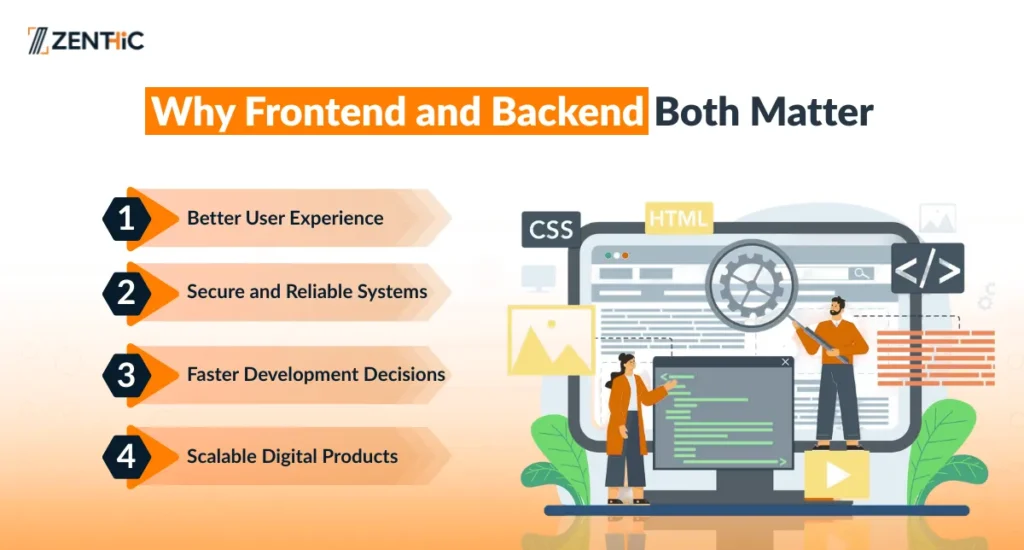
1. Better User Experience
With a powerful frontend, your customers will have a pleasant experience using your site, leading to higher engagement and conversions.
2. Secure and Reliable Systems
A robust backend secures user information and provides a seamless experience even in traffic.
3. Faster Development Decisions
Understanding the difference can make you better communicate with developers and prevent project delays.
4. Scalable Digital Products
By expanding, businesses require the frontend and backend to accommodate future expansion.
Frontend vs. Backend: Which is More Important?
It is a frequent question, yet the fact is, neither is more significant than the other.
The frontend is the user-friendly interface, and the backend is what makes everything work. The failure of one will lead to the failure of the whole system. An effective website always puts both sides in their place.
Full Stack Development
Other developers develop both the frontend and backend. They are referred to as full-stack developers.
They are made aware of the complete system, including designing interfaces and handling databases. Full-stack developers can be cost-effective to hire in the case of startups and small businesses.
However, larger businesses often separate frontend and backend roles for better specialization and performance.
Conclusion
Design or functionality alone cannot create a successful digital product, but the ideal balance of both is needed. Frontend and backend development are two sides of the same coin, where one focuses on user experience while the other ensures functionality and performance.
In the case of businesses, it is necessary to know both to create robust digital platforms. Regardless of whether you are starting a site, mobile application, or SaaS solution, the effectiveness of these two layers is what causes success.
A frontend that is pretty to look at but has a weak backend will have difficulty functioning, and a backend that is strong but does not have a friendly frontend will not be able to draw in and keep users.To summarize, the best digital products are created when the frontend and backend work in harmony. If you’re looking to build a scalable and high-performing solution, partnering with a trusted company like Zenthic can help you turn your ideas into a fully functional, user-focused digital experience.