Table of Contents
Introduction- What Makes an Animated Ad High-Converting?
- 1. A Hook in the First 3 Seconds
- 2. One Clear Message
- 3. Strong Visual Storytelling
- 4. Brand Consistency
- 5. Motion That Guides the Eye
- 6. Audio That Works
- 7. The Right Animation Style for Your Audience
- 8. A Benefit-Focused Script
- 9. Optimized Length for the Platform
- 10. A Clear, Specific Call-to-Action
- Conclusion
Most animated advertisements look good, but in reality, very few people convert.
There is a significant difference between an ad that people see and one that motivates them to act. Despite spending thousands on voiceovers, animation, and motion graphics, brands still receive low click-through rates and a poor return on investment.
Why? because they pay more attention to the advertisement’s appearance than its functionality.
This guide is for you if you’re making animated advertisements for YouTube, social media, or display networks. These ten characteristics set a high-converting animated advertisement apart from one that only occupies a user’s feed.
What Makes an Animated Ad High-Converting?
Here are a few points we can look at.
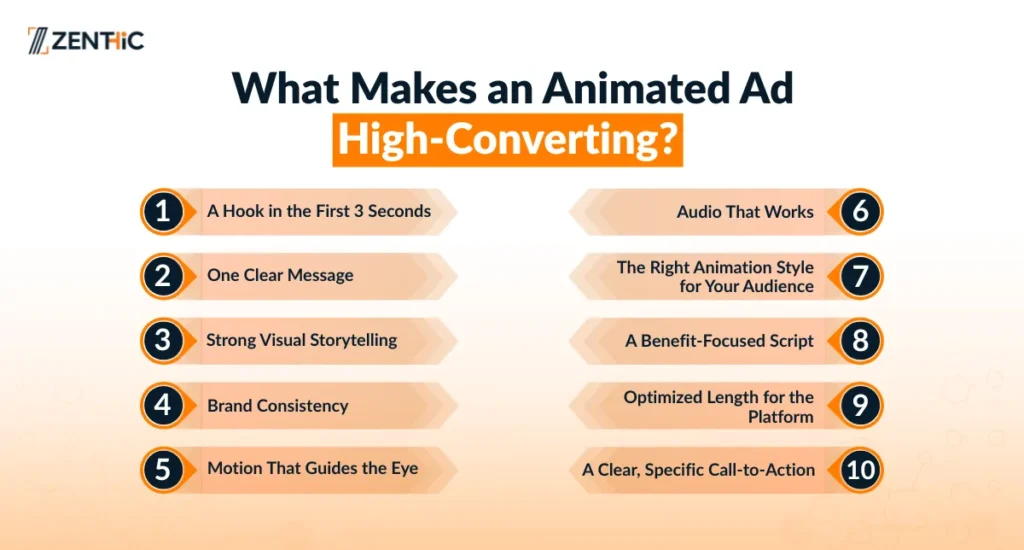
1. A Hook in the First 3 Seconds
People scroll quickly. You have around three seconds on websites like YouTube, Instagram, and TikTok before someone moves on.
An animated advertisement with a high conversion rate doesn’t warm up; instead, it starts off strong. This could be a striking image, an unexpected movement, a question, or a stunning color contrast. The objective is straightforward: make the viewer stop. Think of the first frame as a headline. Nothing else is important if it doesn’t attract attention.
2. One Clear Message
What is the largest error in animation advertising? Trying to say too much.
Your advertisement should have a single main point. Three selling points are not sufficient. This is not a complete overview of the company. In 15 to 30 seconds, a single idea is clearly expressed.
When visitors can immediately comprehend what you’re giving, they’re much more likely to take action. Confusion kills conversions. Clarity is what makes it possible.
3. Strong Visual Storytelling
You have a special advantage with animation: you can represent things that live-action cannot. Use that flexibility to create a visual narrative.
It’s not necessary to have a whole story arc. A 15-second advertisement can demonstrate an issue, a fix, and an outcome. The mini-story style works because our minds are programmed to have a beginning, middle, and end.
Brands that incorporate visual storytelling into their animated advertising regularly receive better engagement than those that just highlight a product.
4. Brand Consistency
A high-converting animated ad supports both your brand and your product. Your brand’s colors, font, visual design, and tone of voice should be consistent throughout the advertisement. When visitors recognize your brand without even seeing your logo, you’ve achieved strong brand consistency.
Consistency is essential for increasing conversions. People are more likely to interact with brands that they recognize and trust. Maintaining a consistent brand identity across all animation ads increases familiarity and credibility and encourages action over time.
5. Motion That Guides the Eye
Every animation is different. Every motion in an animated advertisement with a high conversion rate has a purpose.
Motion should organically lead viewers from one important component to the next, starting with the hook and ending with the call to action. Excessive or unnecessary animation might take viewers away from your message, whereas intentional motion keeps them interested and focused on the desired activity.
This is especially critical with animated banner ads and display advertising, when you just have a few seconds to grab people’s attention and convey value.
6. Audio That Works
Sound design, which includes music, voiceovers, and sound effects, is essential for evoking emotion and making your advertisement memorable. The appropriate audio can help reinforce your message and increase viewer engagement.
On the other hand, a lot of individuals use social media to watch videos without sound. That is why effective animated advertisements are designed to convey clearly, whether with or without audio.
Using kinetic typography, subtitles, and powerful visual storytelling guarantees that your message is clear even in silent viewing conditions. If your ad relies only on sound to deliver its message, you risk losing a significant portion of your audience.
7. The Right Animation Style for Your Audience
Different animation styles convey ideas in different ways. Whether it’s 2D character animation, motion graphics, 3D product visualization, or whiteboard animation, each style has a unique audience and purpose.
For example, a humorous-style 2D animation may be appropriate for a consumer-focused app aimed at younger audiences, whereas clean and professional motion graphics are generally preferred by B2B SaaS organizations. If the animation style doesn’t match the audience’s expectations, even a powerful message may lose its impact.
Choosing the proper commercial animation style helps to establish an immediate connection with viewers and is one of the most ignored variables in increasing conversion rates.
8. A Benefit-Focused Script
Successful animation advertisements emphasize advantages rather than characteristics.
Your target audience is more concerned with how your product improves their lives or solves their problems than with what it does. Instead of saying, “Our software offers 50+ integrations,” focus on the outcome: “Connect all your tools in one place and save hours every week.”
Every line of your script should address the viewer’s basic question: “What’s in it for me?” Viewers are much more inclined to act when the value is obvious, relevant, and easy to understand.
9. Optimized Length for the Platform
An animated advertisement’s “perfect length” is not universally applicable. The location of the advertisement determines the ideal length.
- Ads on social media feeds: six to fifteen seconds.
- YouTube pre-roll: 15 to 30 seconds (the important message appears before the skip).
- Explainer advertising on websites: 60 to 90 seconds.
A lengthy advertisement loses viewers. An advertisement that is too brief might not convey enough information. A straightforward yet effective conversion optimization strategy is to match the duration of your ad to the platform and placement.
10. A Clear, Specific Call-to-Action
The majority of animated advertisements have this flaw.
A vague call to action (CTA) such as “Learn More” or “Visit Us” doesn’t explain to the viewer what has to be done or why. A compelling call to action (CTA) is precise, motivated, and conveys a sense of urgency or advantage.
Strong CTA examples include:
“Launch Your Free Trial Right Now. Take 20% Off This Week Only. See How It Works in 60 Seconds.”
Your CTA should be visible on-screen and, if you have audio, in the voiceover. Allow space at the end of the ad. Take your time. The CTA is where the conversion happens.
Conclusion
A high-converting animated ad is more than just a clean appearance. From the first frame to the last CTA, every second matters.
If your present animated advertising isn’t producing the outcomes you expect, compare it to these ten features. One or two of these components are likely undeveloped or absent. If you do these properly, your animation advertisement will not only receive views but also yield results.
Are you trying to find a team that combines all of these components? Visit Zenthic to see how we make animated advertisements that aim to convert rather than merely impress.