Table of Contents
Introduction- What is Machine Learning?
- What is Deep Learning?
- Key Difference Between Machine Learning and Deep Learning
- 1. Data Requirements
- 2. Human Intervention
- 3. Complexity
- 4. Processing Power
- 5. Training Time
- How They Work Together
- When Should You Use Machine Learning vs. Deep Learning?
- Use Machine Learning When:
- Use Deep Learning When:
- Advantages and Limitations
- Machine Learning
- Deep Learning
- Why This Difference Matters for Businesses
- Conclusion
Artificial intelligence (AI) is changing the way businesses operate, including personalized recommendations or intelligent automation. Machine learning and deep learning are two of the most significant technologies driving this change.
These terms are not identical even though they are frequently used as synonyms. Understanding the difference between machine learning and deep learning can help the business select the appropriate method.
Here, we are going to discuss both concepts simply and straightforwardly in this blog.
What is Machine Learning?
Machine learning (ML) is an aspect of artificial intelligence that enables systems to learn with data and become better, without the need to be programmed.
Instead of following fixed rules, machine learning algorithms analyze data, identify patterns, and make predictions or decisions.
For example:
- Email spam filters
- Product recommendations within e-commerce websites.
- Customer segmentation in marketing
Machine learning models are often highly data-demanding, and they need some form of human supervision to define features and enhance accuracy. In simple words, machine learning is the way machines learn.
What is Deep Learning?
A more sophisticated branch of machine learning is known as deep learning (DL). It is a process that relies on artificial neural networks, which are based on the human brain. to process a lot of data. These are multi-layered neural networks that enable systems to acquire complex patterns automatically.
Deep learning is commonly used in:
- Image and facial recognition
- Voice assistants like Siri or Alexa
- Self-driving cars
- Language translation
Deep learning can be applied to unstructured data, unlike traditional machine learning, which involves images, audio, and text. It also eliminates the use of manual feature selection. Concisely, deep learning allows machines to perform more complicated tasks with minimal human intervention.
Key Difference Between Machine Learning and Deep Learning
Although both technologies are quite similar, the primary distinction is how they learn and process the data.
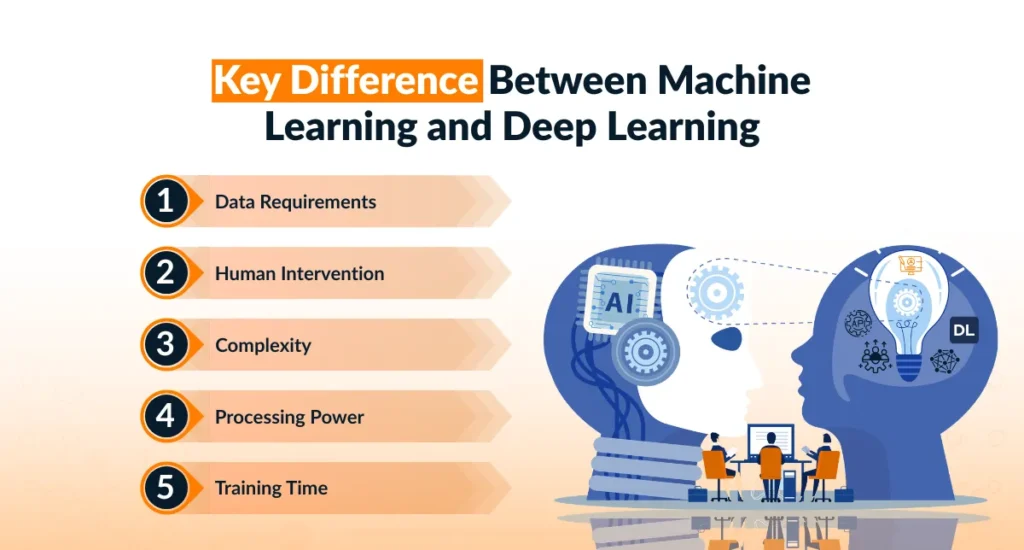
Here are the five key differences we can discuss:
1. Data Requirements
Machine learning is effective when using small, structured data. Deep learning is an algorithmic approach that requires large amounts of data.
2. Human Intervention
Machine-learning models require human intervention for feature engineering. Deep learning models automatically extract features from raw data.
3. Complexity
Machine learning deals with less complex problems, such as prediction and classification. Deep learning is intended to handle complex problems such as natural language processing and image recognition.
4. Processing Power
Machine learning can operate on ordinary computers. Deep learning requires high computational power, often using GPUs.
5. Training Time
Machine learning models learn more quickly. There are several layers and massive datasets that make deep learning models more time-consuming.
How They Work Together
Deep learning and machine learning are not different technologies but a part of the same AI system. Machine learning is commonly applied to simpler processes and well-structured data, whereas deep learning applies to more complicated problems and unstructured data, such as images or text.
Machine learning is commonly used in the development of AI, and deep learning is applied to more complex tasks. To have a full picture of the AI development processes and the best practices, check our guide to AI Development: The Complete Guide to Businesses.
Machine learning is the basis of many applications, and deep learning is an enhancement of the former with more sophisticated features. They also work together to develop smarter and more efficient systems.
When Should You Use Machine Learning vs. Deep Learning?
The choice between machine learning and deep learning depends on your data, problem complexity, and business objectives.
Use Machine Learning When:
- Machine learning is useful when you have limited or structured data and your problem of interest is simple to moderately complex. It is also a better choice when you need faster results and a solution that is easier to implement and manage.
Use Deep Learning When:
- Deep learning is used in cases of large amounts of data and when dealing with unstructured data like images, audio, or text. It is particularly appropriate in issues that need high precision and the ability to identify complex patterns.
In the case of most businesses, it is more realistic to begin with machine learning and proceed to deep learning when the data expands, and the demand increases in complexity.
Advantages and Limitations
Machine Learning
Advantages:
- Quicker to adopt and implement than complex models.
- Works effectively even with smaller and structured datasets.
- Simpler results to interpret, explain, and understand.
Limitations:
- Difficulty in coping with very complex or unstructured issues.
- Needs human intervention in feature selection and preparation of data.
Deep Learning
Advantages:
- Provides high precision on complicated and data-intensive processes.
- Works well with unstructured information such as images, audio, and text.
- Features are learned automatically with little human intervention.
Limitations:
- Large amounts of data are needed to perform well.
- Requires a lot of computing power and hardware.
- Takes a longer time to train and optimize models.
Why This Difference Matters for Businesses
Knowing the difference between machine learning and deep learning is not just a technical issue, but it directly affects business growth and innovation. Machine learning assists organizations in enhancing their decision-making, automating routine operations, and deriving meaningful insights from information.
Deep learning is an extension of these abilities, as it allows more advanced automation, improved customer experiences, and intelligent systems that can even replicate human behaviors. The two technologies will be important in assisting businesses to remain competitive and innovate as AI continues to develop.
Conclusion
Machine learning and deep learning are equally strong technologies, but they are used to achieve different purposes. Machine learning can be applied to solve structured and simpler problems, whereas deep learning is more useful when working with complex problems, large data sets, and unstructured data. Knowing what they are different at, businesses will be able to select the appropriate way and collaborate with a trusted company to develop smarter and more efficient solutions.