Table of Contents
Introduction
Artificial intelligence is no longer just a technology for large organizations. Businesses of all sizes now employ AI automation solutions to streamline processes, increase productivity, eliminate manual labor, and improve customer experiences.
AI-powered business solutions are helping businesses save time and concentrate on strategic growth by automating repetitive operations, managing workflows, and analyzing data. Choosing the appropriate tool can have a big impact on overall performance and productivity as AI technology develops.
In this article, we’ll look at the best AI automation tools for businesses, including their essential features and how they may help businesses work smarter in 2026.
Why Businesses Are Investing in AI Automation
Modern enterprises handle numerous repetitive tasks daily. Time and resources can be wasted on scheduling, reporting, lead management, customer support inquiries, and manual data entry.
Businesses can benefit from AI automation in several ways:
- Reduce repetitive, manual tasks
- Boost the effectiveness of operations
- Improve employee productivity
- Improve client support
- Reduce human error
- Make decisions more quickly
- Reduced operational costs
Businesses that automate routine activities, as described in our guide Everything You Need to Know About AI Automation, generally experience faster growth while maintaining operational consistency.
Top AI Automation Tools for Businesses
There are eight points we can discuss here:
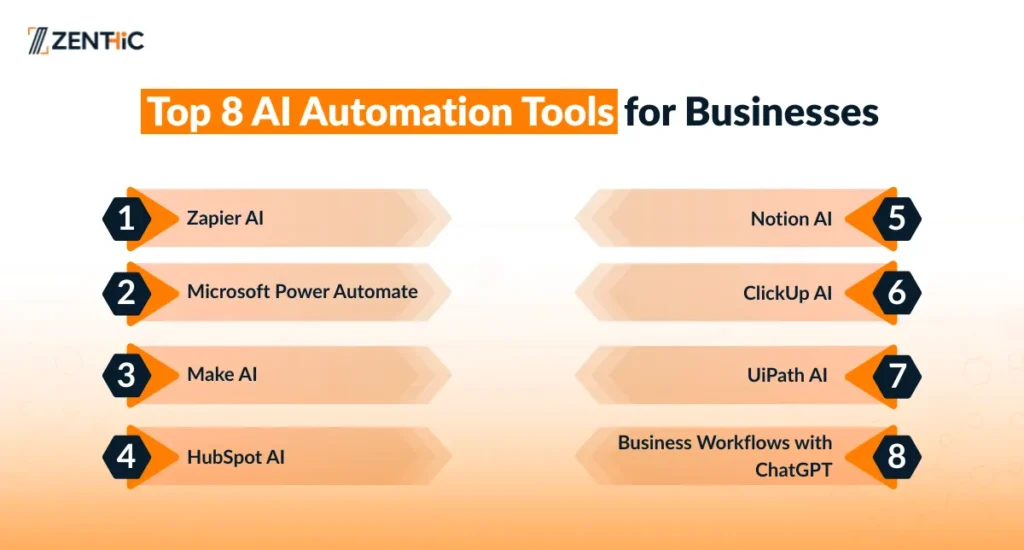
1. Zapier AI
Zapier is one of the most widely used workflow automation solutions for businesses. It enables businesses to automate processes without requiring a high level of technical expertise and links thousands of apps. Businesses can automate workflows that connect CRM systems, email platforms, project management software, and communication apps. It is suitable for small and medium-sized organizations, marketing automation, lead management, and workflow integration.
Key Features:
- Automation without code
- AI-driven workflow development
- Automations with multiple steps
- Large-scale app integrations
- Automated alerts
2. Microsoft Power Automate
Microsoft Power Automate was created to assist companies in automating procedures involving both third-party and Microsoft products.
Power Automate is frequently a successful way for businesses who currently use Microsoft 365 to streamline internal processes. It is ideal for process optimization, Microsoft ecosystem users, and enterprise automation.
Important Features:
- RPA, or robotic process automation
- AI Builder features
- Workflows relying on the cloud
- Automated authorizations
- Monitoring processes
3. Make AI
Make AI, designed for enterprises with extensive automation needs, provides a robust visual platform for creating and managing complicated workflows. Without requiring a lot of coding, it allows businesses to combine different products, automate repetitive procedures, and streamline operations. It is Ideal for Personalized workflow automation, Processing of data, and Integrations across several platforms
Key Features:
- A visual automation tool
- Advanced logic for workflow
- Real-time synchronization of data
- Personalized API integrations
- Automation utilizing scenarios
4. HubSpot AI
HubSpot helps companies manage marketing, sales, and customer service procedures by combining CRM capability with AI-powered automation solutions.
The software allows teams to automate lead nurturing, customer communication, and marketing campaigns. It is best for Marketing automation, customer relationship management, and sales automation.
Key Features:
- AI support for content
- Workflows for automated emails
- Lead the score
- Segmenting customers
- Automation of the sales pipeline
5. Notion AI
Notion AI helps businesses boost productivity by automating content production, document management, and knowledge sharing.
A single workspace allows teams to create content, summarize papers, organize information, and streamline collaboration. Content teams, project management, knowledge, and management can all benefit from AI.
Key Features:
- AI writing support
- Summarization of content
- Automated creation of notes
- Cooperation among the team
- Organization of workflow
6. ClickUp AI
ClickUp AI increases team efficiency by integrating intelligent automation with project management. While keeping visibility across projects, businesses may automate task creation, reporting, content development, and workflow management. It’s ideal for project management, teamwork, and increasing productivity.
Key Features:
- Automation of tasks using AI
- Management of workflow
- Monitoring of projects
- creation of content
- Automated reporting
7. UiPath AI
One of the top intelligent automation solutions for enterprise-level process automation is UiPath. With a focus on robotic process automation (RPA), it assists businesses in automating repetitive business operations on a large scale. It is beneficial for large businesses, back-office operations, and process automation.
Key Features:
- Automation of Robotic Processes
- AI-driven document processing
- Mining processes
- Orchestration of workflow
- Scalability of enterprises
8. Business Workflows with ChatGPT
AI assistants are rapidly being used in daily corporate activities. Businesses utilize ChatGPT workflows to automate customer support, create content, assist staff, and optimize internal communication procedures. It is ideal for knowledge management, employee support, customer service, and content production.
Key Features:
- Processing of natural language
- Automated reactions
- creation of content
- Support for research and workflow
How AI Automation Benefits Small Businesses
Many small business owners believe that investing heavily in automation is necessary. But today’s AI tools are easier to use than ever before.
Automation reduces manual labor and increases operational efficiency, which enables smaller businesses to compete more successfully.
Common use cases include:
- Automated customer service
- Automation of email marketing
- Making an appointment
- Processing of invoices
- Qualification of the lead
- Management of social media
- Automation of data entry
Conclusion
AI automation solutions are now crucial for companies trying to scale effectively, lower operating costs, and increase productivity. Whether you require workflow automation, project management, customer engagement, or corporate process automation, there are options for every business size and industry.
The goal is to choose a platform that matches your business objectives and interacts seamlessly with your existing systems. As AI evolves, companies that embrace automation will be better positioned for long-term growth and competitive advantage.
Partnering with a reputable AI automation company can also help with successful installation, smooth integration, and long-term scalability.
Ready to automate your company processes? Investigate the best AI automation option and begin creating more intelligent, effective workflows that promote long-term success.