Table of Contents
Introduction- What Is the Software Development Life Cycle (SDLC)?
- 6 Key Stages of the Software Development Life Cycle
- 1. Planning and Requirement
- 2. System Design
- 3. Development
- 4. Testing and Quality Assurance
- 5. Deployment
- 6. Maintenance and Support
- How the Stages of Software Development Work Together
- Why the Software Development Life Cycle Is Important
- Conclusion
Software development is a systematic process aimed at helping teams transform ideas into high-quality, reliable digital products. Successful software products, whether mobile applications, web platforms, or enterprise systems, are guided by a clear roadmap. This is referred to as the Software Development Life Cycle (SDLC).
The different software development cycles make teams structured, reduce risks, and make sure that the software can truly meet the needs of users. Once all stages are performed well, the projects will be easier to manage, timeframes will remain realistic, and quality will be significantly increased. In this blog, we will review each stage of software development and demonstrate how it works in a real and practical situation.
What Is the Software Development Life Cycle (SDLC)?
The Software Development Life Cycle is a process for designing, developing, testing, and maintaining software. SDLC breaks down the development process into stages instead of developing everything simultaneously. Each stage has its goals, tasks, and outcomes.
The different teams can use various methods, such as Agile, Waterfall, or DevOps, but the basic process involved in creating a software program usually remains the same.
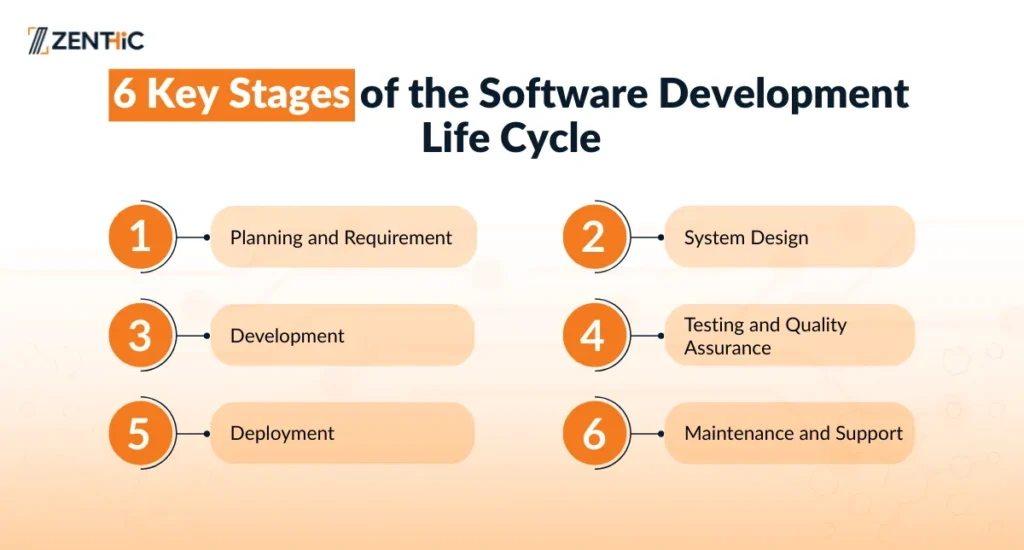
6 Key Stages of the Software Development Life Cycle
These six stages provide a clear path that guides a project from an initial idea to a fully developed and supported software product.
1. Planning and Requirement
Planning is the first phase of software development. This stage is concerned with determining the purpose of the software and what should be constructed.
At this phase, stakeholders, business owners, and technical teams negotiate project objectives, target users, and expected features. All requirements are collected with great caution to prevent future misunderstandings. Project feasibility is also evaluated by teams in terms of budget, timeline, technical constraints, and risk possibilities.
Clarity is achieved through good planning. When a requirement is effectively documented, developers are aware of what is required of them, and clients are aware of what they will get. This is an important step that should not be skipped or rushed because it can cause changes in scope, delays, and higher costs of the project in the future.
2. System Design
After defining the requirements, the project is under the design stage. This stage is concerned with the internal operation of the software and how users interact with it.
System design involves the development of the overall structure, specification of system components, database design, and user interface design. Technical decisions, like programming languages, frameworks, and tools, are also made here.
A well-designed stage is essential, as it will enable the software to expand, remain secure, and be easy to maintain. Besides, it provides development teams with a clear roadmap to follow, which enhances their productivity. Poor design may cause performance glitches, and subsequent updates will be a nightmare.
3. Development
The actual coding begins in the development stage. Code is written by developers based on the initial and approved requirements.
All features or modules are created individually, and then they are added to the main system. Coding standards and best practices are observed to have clean, readable, and maintainable code. Version control systems assist the team in monitoring the changes and working together without conflicts.
This is a highly technical stage, but its success is largely dependent on the quality of planning and design. Development becomes easier and more predictable when previous stages are completed in the right way.
4. Testing and Quality Assurance
Once the software is created, it has to be tested properly before launch. Testing is used to confirm that the software is functional and meets all requirements. Quality assurance teams, including those for functional testing, integration testing, performance testing, and user acceptance testing, conduct various forms of testing.
The purpose of this is to find bugs, security vulnerabilities, and usability problems. Testing is not only about error detection but also about ensuring that the product is reliable and easy to use.
5. Deployment
The implementation is the phase in which the software is published to a live system and made accessible to customers. This may include the installation of the software on the servers, the configuration of the environments, and the migration of data where necessary.
A phased deployment method is implemented by some projects, in which the software is initially shared with a small audience. This will minimize the risk and enable teams to keep track of performance before a complete launch.
Deployment is a significant step in the software development life cycle because the product will have begun to provide real value to actual users.
6. Maintenance and Support
The process of software development does not stop with deployment. Maintenance is a continuous process that is significant in long-term success.
In the maintenance phase, the teams rectify the bugs that the users identify, enhance performance, add new functionality, and upgrade the software to remain compatible with emerging technologies. The feedback of the user is particularly useful at this point because it can be used to shape the future enhancements. The frequent maintenance process helps to keep the software safe, active, and effective in the long run.
How the Stages of Software Development Work Together
Software development is a process that is interconnected, and every step is built on the previous stage. Planning gives it clear direction, design gives it structure, development transforms the ideas into functional solutions, testing gives it quality and reliability, deployment makes it available to users, and maintenance keeps the system stable and up to date.
In current strategies such as Agile, these steps are usually repeated in short cycles, where teams are able to react quickly to feedback and the evolving requirements. Whatever the methodology adopted, the aim of every stage is the same, which is to produce quality software that is reliable and has a well-organized and efficient process.
Why the Software Development Life Cycle Is Important
Following the SDLC offers several benefits for both businesses and development teams:
- It minimizes the project risk and failure.
- It improves communication between stakeholders.
- It helps manage costs and timelines more effectively.
- It enhances the level of software quality and user satisfaction.
In the absence of a clear development process, these projects are usually characterized by a lack of clarity, duplicated work, and missed deadlines.
Conclusion
Software development life cycles offer a systematic approach to the development of successful software products. From the first planning to long-term maintenance, every phase is important to quality, efficiency, and user satisfaction. Understanding these stages to collaborate with one another, businesses and development teams can make their decisions more effectively, prevent the most common mistakes, and provide the software that completely satisfies the needs of users.
A digital transformation agency can also be used to streamline this process, as it introduces the appropriate expertise, tools, and strategy at each level of development. A structured approach not only enhances project results but also assists organizations in coping with emerging technology and market needs. A clear development process in the long term contributes to sustainable growth and long-term digital success.