Table of Contents
Introduction- Top 10 keys ways of Mobile App Development
- 1. Artificial Intelligence & Machine Learning
- 2. 5G: The Connectivity Revolution
- 3. AR and VR
- 4. Low-Code / No-Code Platforms
- 5. Superapps
- 6. IoT Integration
- 7. Enhanced Security & Privacy
- 8. Cross-Platform Development Tools
- 9. Progressive Web Apps
- 10. Focus on Sustainability
- Conclusion
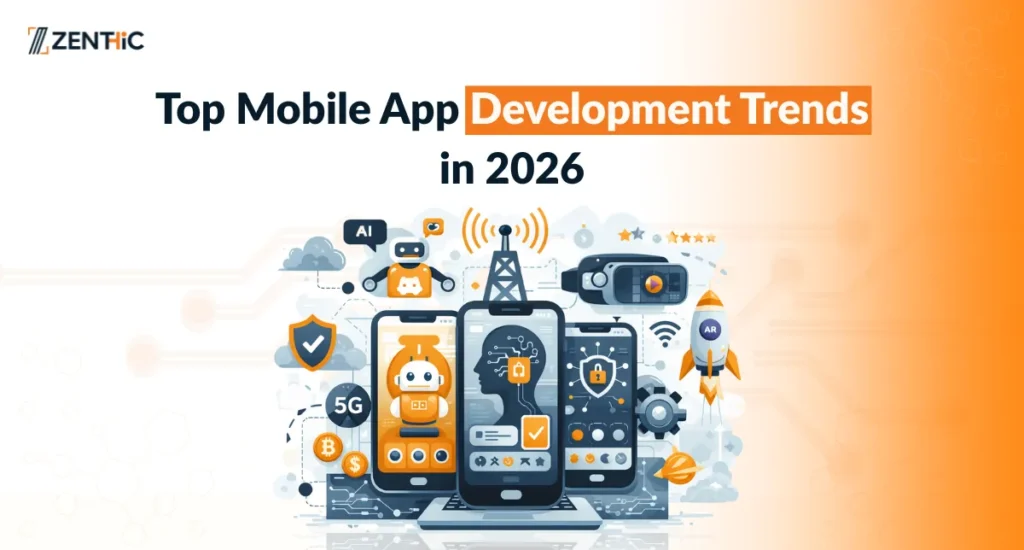
The development of mobile technology is changing fast, and the mobile app market continues to evolve. In 2026, this evolution has brought new challenges and opportunities for businesses. Users’ expectations have changed, technology has become more sophisticated, and competition has never been more intense. To produce successful apps, businesses must follow the latest mobile app development trends that affect performance, design, and user experience.
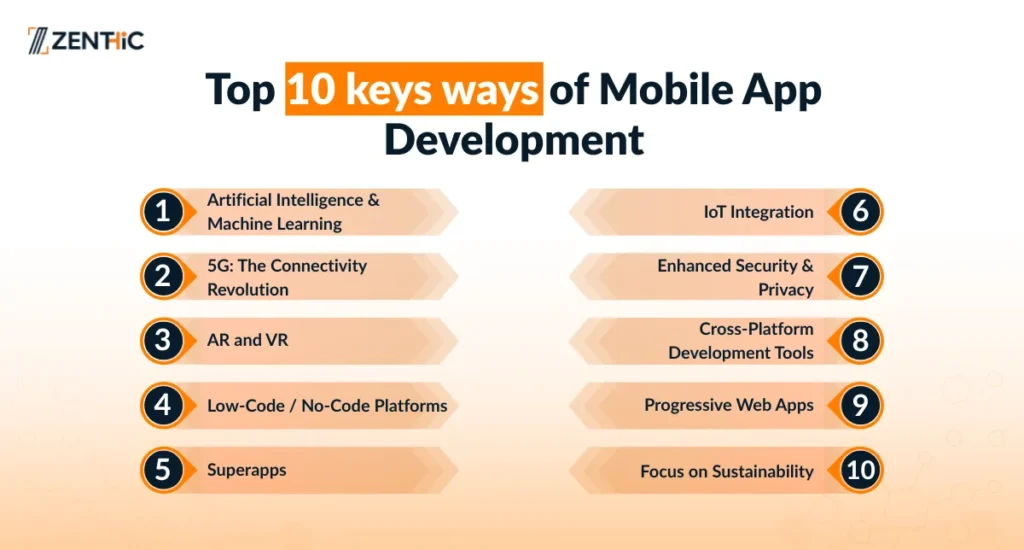
Top 10 keys ways of Mobile App Development
The following are 10 key ways of Mobile App Development:
1. Artificial Intelligence & Machine Learning
In 2026, Artificial Intelligence (AI) will remain the most promising factor in mobile applications. AI is not a trend, it is now integrated into all aspects, including personalized recommendations and advanced analytics.
- Smarter Personalization: AI can analyze the user activity and provide personalized content, recommendations, and designs that seem to be tailored to the specific user.
- Chatbots and Predictive Assistance: AI chatbots respond to customer inquiries in real time, whereas machine learning predicts the next desired action of the user.
- Usage in Multiple Sectors: In health, retail, finance, and travel applications; AI will make the whole experience more intuitive and adaptive.
Artificial intelligence is essential because people want smarter interfaces every time they click on a screen. It makes apps more responsive and engaging.
2. 5G: The Connectivity Revolution
The adoption of 5G networks is affecting how mobile app creators consider the performance of their apps around the world. Because 5G is so fast and has such little buffering, it can offer more sophisticated features and real-time interactions.
With 5G:
- Smooth and high-resolution media can be streamed using apps.
- Online multiplayer games are more interactive.
- Complex collaborative tools, AR, and VR are viable on mobile.
- There is no lag in cloud-based apps.
In short, the apps are becoming more powerful, smarter, and faster via the concept of 5G infrastructure.
3. AR and VR
AR stands for Augmented Reality and VR stands for Virtual Reality. Although AR and VR used to be largely associated with the gaming industry, in 2026 they are influencing real-life applications. These immersive technologies are becoming practical tools rather than merely attractive features.
- Retail and E-commerce: Try-before-you-buy augmented reality allows consumers to see how clothing fits on them or how furniture fits in a space.
- Education and Healthcare: VR creates immersive learning environments and training modules that feel almost real.
- Tourism and Real Estate: Virtual tours allow people to explore areas from around the globe.
AR and VR will continue to grow in common mobile apps as devices get more capable and 5G facilitates high-speed data transport.
4. Low-Code / No-Code Platforms
The low-coding and no-coding systems are transforming the way mobile applications are developed. Even those with no technical experience can easily create apps using basic visual tools. These platforms save time and energy and lower the complexity of development.
- Fast Prototyping: Teams can create, develop, and test applications in a short time without the need for continuous coding; using drag-and-drop features.
- Lower Costs: Companies do not need to have large and costly development teams to create functional apps.
- Business Innovation: Small enterprises and startups are able to realize their ideas into a real mobile solution without technical restrictions.
This trend is democratizing development, so app creation is no longer limited to professional coders only.
5. Superapps
In 2026, the idea of superapps has become mainstream. Users do not need to move to various applications anymore; they want to have everything under a single roof or platform.
These all-in-one apps might combine:
- Messaging and chats
- Online payments and e-wallets.
- Shopping and loyalty programs
- Mini games and entertainment.
Applications such as WeChat and AliPay show how strong such a trend can be – giving customers all the convenience in one application.
6. IoT Integration
The Internet of Things (IoT) is already a part of everyday life, thus it’s not futuristic. In 2026, wearable technology, smart homes, health monitors, and even industrial systems will all be controlled by mobile apps.
Users can:
- Control household devices using their phones.
- Track fitness data remotely
- Adjust temperature or security with a tap
Mobile applications have emerged as the core interface of smart ecosystems and now users can easily control all connected devices within a single application.
7. Enhanced Security & Privacy
Security has become a major concern as mobile apps handle more sensitive and private data. In 2026 applications will secure the information of the user at any level.
- Nowadays, biometric identification methods like Face ID and fingerprints are common.
- Encryption and secure data management help to protect user privacy.
- Privacy-first design assures compliance with worldwide data protection laws.
Users now demand the security of their data. Because of this, security features are now essential for modern mobile apps.
8. Cross-Platform Development Tools
Cross-platform frameworks like Flutter and React Native, which enable a single codebase to function seamlessly across the Android and iOS platforms, are becoming more and more popular among app developers.
Benefits include:
- Faster development cycles
- Reduced maintenance and development expenses
- A uniform user experience across all devices
Businesses can reach customers on many platforms without sacrificing app quality by utilizing cross-platform technologies, which also save time and money.
9. Progressive Web Apps
Progressive Web Apps (PWAs) continue to grow in popularity because they combine the best of web and mobile apps.
PWAs:
- Fast loading
- Work offline
- No need for installation
- Cost-effective to build
For companies that want high performance without heavy investment, PWAs are now a smart alternative.
10. Focus on Sustainability
In 2026, developers care not only about performance but also about how apps impact device battery, data usage, and carbon footprint.
- Efficient coding reduces wasted resources
- Eco-friendly app practices attract users who care about sustainability
This trend benefits both consumers and businesses by integrating ethical responsibility with technical innovation.
Conclusion
In 2026, mobile apps will be faster, smarter, and more integrated than ever. With advances in AI, 5G, AR/VR, security, and cross-platform technologies, app development is now centered on offering seamless, personalized, and dependable experiences. Following these trends enables developers and corporations to create apps that not only function effectively but also establish brands as reliable businesses, gaining long-term user confidence in a digital market that is becoming more and more competitive.