Table of Contents
Introduction- What Is Cloud Computing in Software Development?
- 5 Key Advantages of Cloud Computing in Development
- 1. Scalability and Performance
- 2. Cost-Effective Infrastructure
- 3. Faster Development and Deployment
- 4. Enhanced Collaboration
- 5. Cloud Security
- The Cloud and DevOps: A Perfect Match
- Cloud-Native Development: Shaping the Future of Software
- Popular Cloud Tools Empowering Developers
- Challenges of Cloud-Based Development
- 1. Vendor Lock-In
- 2. Data Privacy
- 3. Complexity in Management
- Conclusion
The way in which software is developed, implemented and supported has transformed significantly in the last ten years. In the present world, businesses are demanding applications that are scalable on demand, frequently updated and operate perfectly on all platforms. A lot of development methods that existed in the past are not enough to meet these expectations; they are bound by physical infrastructure and slower release cycles.
This is where cloud computing and AI automation come together to give developers the flexibility, scalability and efficiency needed to meet modern demands. Through the use of cloud technology, companies are in a position to speed up innovation, cut down expenses and provide superior digital experiences quicker than ever before.
What Is Cloud Computing in Software Development?
Cloud computing offers computing resources including storage, databases and server access on a pay-as-you-use basis. Developers do not have to maintain on-premises servers anymore, using platforms such as AWS, Microsoft Azure and Google Cloud, developers can easily build, test and deploy applications to the cloud.
This method not only makes the development process easier but also provides a team-focused atmosphere where teams can operate successfully, no matter where they are located. The cloud is now a part of new software engineering not just initial coding, but deployment and maintenance.
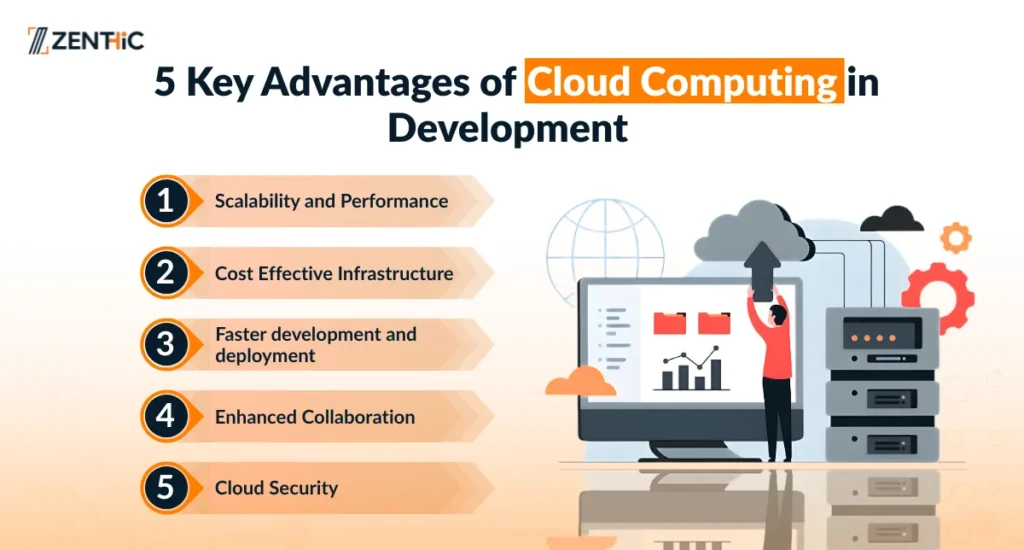
5 Key Advantages of Cloud Computing in Development
There are five key advantages we can discuss here:
1. Scalability and Performance
Scalability is one of the reasons why businesses are migrating to the cloud. Cloud applications are capable of scaling automatically to support more traffic or increased workload. The developers do not have to be concerned about physical server performance; they can just increase or decrease on demand, making sure that performance stays the same and customers enjoy a better experience.
2. Cost-Effective Infrastructure
Cloud computing requires businesses to pay only the resources they actually use, rather than huge investments in hardware or complicated maintenance. This flexibility is ideal for startup and small business level and it enables the small business to grow at a greater rate, remain cost-efficient and compete with larger businesses confidently.
3. Faster Development and Deployment
Cloud platforms simplify the overall development experience by providing pre-configured solutions and automated environments with additional features, such as CI/CD pipelines, auto-scaling and serverless computing. Allowing developers to write, test and deploy code much faster; release faster and in less time. This enables companies to provide instant updates and be responsive to market trends.
4. Enhanced Collaboration
The modern software teams are often distributed over various locations, which makes it extremely important to collaborate smoothly. Cloud technology fills in this gap by allowing real-time access to shared repositories, communication channels and project management tools. GitHub, GitLab and Bitbucket are the platforms that enable developers to collaborate effectively, monitor changes without any difficulties and release updates more regularly.
5. Cloud Security
Top cloud vendors spend much on modern security systems including encryption of data, access management and threat detection. They also provide in-built backup and disaster recovery to reduce down time and loss of information. In the case of most organizations, this reliability and protection is many times greater than what the traditional in-house systems can offer.
The Cloud and DevOps: A Perfect Match
DevOps is all about automation, teamwork and continuous delivery which is guaranteed by cloud computing in a seamless manner. Providing the ability to incorporate version control, testing and monitoring tools into the cloud, helps developers simplify the work process and save a lot of manual labor.
The use of CI/CD pipelines on platforms like AWS CodePipeline and Azure DevOps enables one to build, test and deploy updates in real-time, enhancing the efficiency of the process as well as the reliability of the software.
Cloud-Native Development: Shaping the Future of Software
Whereas cloud computing offers the infrastructure and services to deploy and operate the applications, cloud-native development determines the manner in which the applications are created to take full advantage of the flexibility and scalability of the cloud.
The emergence of the cloud-native applications has changed how modern software is being designed and delivered. In contrast to the traditional development, cloud-native development is concerned with developing cloud specific applications based on microservices architecture, containers and Kubernetes orchestration.
This model has a number of major benefits: it provides faster innovation cycles, eases maintenance and updates, permits application components to be independent by scale and provides higher fault tolerance and resilience.
Companies can be more innovative, explore new ideas and keep up with their customers in real time by practicing cloud-native in order to have a strong competitive advantage in a constantly developing digital market.
Popular Cloud Tools Empowering Developers
A broad range of cloud-based tools and platforms are now available to help developers streamline and accelerate the software development process. Together they allow for scalability, automation and easy deployment of applications.
- Amazon Web Services (AWS) launches various versions such as EC2 that provide virtual servers, S3 that offers secure storage and Lambda that does serverless computing that makes it a versatile platform for a developer.
- Microsoft Azure provides app services to easily build and deploy applications and Azure DevOps to simplify collaboration.
- Google Cloud Platform (GCP) has got tools like Cloud Run, Firebase and Kubernetes Engine to help build scalable and high-performance applications
- Docker and Kubernetes help in containerization and management. They make deployment easier and improve productivity.
- GitHub and GitLab provide version control, collaboration and CI and CD pipelines right within the cloud.
Together, these tools empower developers to manage the entire software lifecycle from writing the first line of code to deploying and maintaining production-ready applications with greater speed and precision.
Challenges of Cloud-Based Development
Although cloud computing has such amazing benefits, it has its own problems. There are three major challanges that developers and organizations must overcome in order to take full advantage of it.
1. Vendor Lock-In
Vendor lock-in is one of the biggest concerns When a company develops its system based on a certain cloud provider, it might be complex and expensive to switch to another provider. Each platform comes with its own tools, APIs, and configurations, making migration a complex process.
2. Data Privacy
Data privacy and compliance is another issue that is important. The risk of storing sensitive information in external servers will always exist. To secure the information of the users, businesses have to remain in touch with the regional data laws and industry security standards.
3. Complexity in Management
Then there is complexity in management. The multi-cloud or hybrid environment management demands technical skills in order to sustain performance, provide security and manage cost effectively.
Conclusion
The use of cloud computing has changed the way new software is developed, constructed and delivered. It empowers groups to operate more quickly, automate processes and collaborate smoothly without reference to geographies. The cloud is the foundation of innovation in the modern digital environment; it can be utilized to build scalable infrastructure, integrated pipelines of CI/CD and much more.
With the ongoing development of technology, the concept of the cloud first development strategy is not a trend anymore, it’s a necessity. With the ongoing development of technology, the concept of the cloud first development strategy is not a trend anymore, it is a must. By collaborating with an experienced and trusted software development company , businesses can completely harness the strength of cloud computing to innovate quickly, maximize resources and create superior digital customer experiences that will keep them on top of a competitive market.