Table of Contents
Introduction- What Is UI/UX Design?
- Why UI/UX Design Is Important for Mobile Apps
- 1. Strong First Impression
- 2. Improves Usability and Navigation
- 3. Increases User Engagement
- 4. Boosts User Retention
- 5. Builds Brand Trust
- 6. Improves Conversion Rates
- 7. Reduces App Abandonment
- 8. Scalability and Future Growth
- UI/UX Design Best Practices for Mobile App Success
- Conclusion

In today’s competitive mobile app industry, success is not determined by features or technology. Users demand quick, easy, and visually appealing experiences. This is why UI/UX design plays a critical role in a mobile app’s success or failure. An effective user interface and user experience can enhance engagement and retention, as well as overall business growth. This blog describes the actual effect of UI/UX design on the success of mobile apps, its impact on user behavior, and why thoughtful design is a necessary investment in long-term results.
What Is UI/UX Design?
UX (User Experience) and UI (User Interface) work together, but each plays a different role in shaping how users interact with an app.
UI design focuses on a mobile app’s visual features, such as layouts, colors, buttons, typography, and icons. It determines how the app appears and feels.
UX design is concerned with how users feel when using the app. It involves navigation flow, ease of use, accessibility, and how easily users are able to complete tasks.
The interaction of UI and UX allows users to interact with the app smoothly and gives it a clean and professional appearance.
Why UI/UX Design Is Important for Mobile Apps
Mobile users have unlimited choices. When an application seems to be a mess or slows down, users will uninstall it within a few seconds.
Here are eight key ways UI/UX design impacts the success of a mobile app.
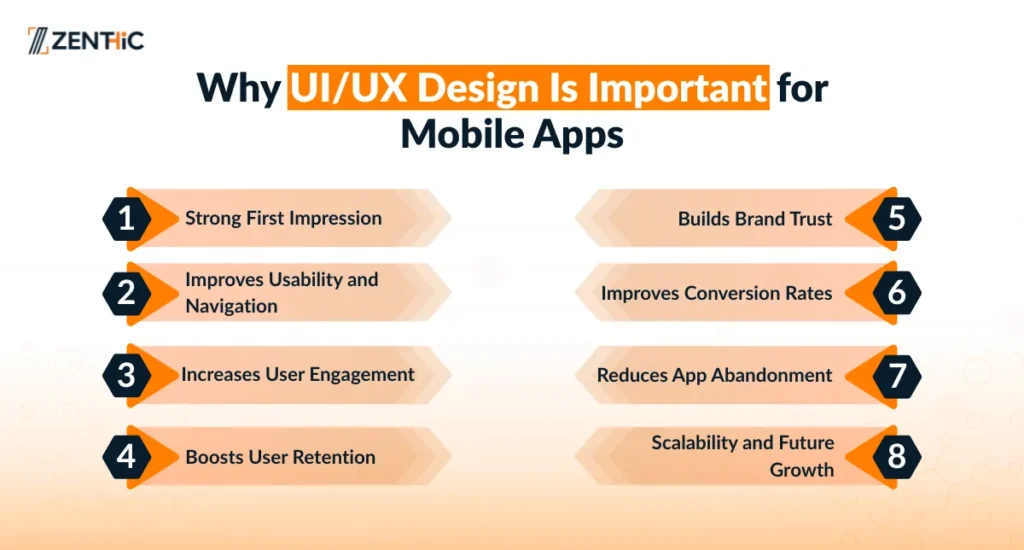
1. Strong First Impression
First impressions are important. Within the first few seconds, users determine whether to keep using an app or not. A clean interface, intuitive layout, and smooth onboarding process instantly build trust. When users do not understand the app initially, they are likely to give up. User experience is designed to enable users to feel comfortable and confident, even during their first interaction with the interface.
2. Improves Usability and Navigation
One of the most significant factors in UX design is usability. The app must be user-friendly, and the user should not have to struggle with it. There is easy navigation and straightforward interactions that enable users to accomplish tasks in a short period of time. When an app is user-friendly, people will spend more time using it and visit it more frequently. Poor usability is frequently the cause of dissatisfaction and app uninstallation.
3. Increases User Engagement
The use of UI/UX design is important to ensure that users are engaged with an app. With visual consistency, fluid animations, and interactive features, the entire experience would be pleasant and easy to navigate. Good UX design is also concerned with reducing the amount of effort required to accomplish things. When actions are simple and user-intuitive, the users will become more ready to use the app regularly. This will not only improve the app’s performance and retention but also encourage long-term growth.
4. Boosts User Retention
User retention is an important metric of a mobile app’s success. Poor UX apps have high drop-off rates after initial use. The user experience will be easy to use, which will make people revisit the app. Such attributes include customized content, easy-to-use dashboards, and smooth transitions, enabling users to develop good habits with the app. This will create loyalty and promote long-term growth.
5. Builds Brand Trust
Design represents the quality of a brand. A smooth and professional user interface/user experience will not only create credibility and trust, but when an application does not seem up-to-date or reliable, users may doubt its trustworthiness. A modern design, featuring consistent visuals and predictable interactions, enhances brand identity and boosts user confidence.
6. Improves Conversion Rates
Conversion is strongly influenced by UI/UX design. Design has a big influence on the choices of the users, whether you want to acquire sign-ups, subscriptions, or sales. Friction is reduced through clear call-to-action buttons, easy-to-use forms, and smooth checkout procedures.
7. Reduces App Abandonment
Complicated designs and unnecessary procedures may cause frustration. UX design plays a significant role in identifying and removing pain points that may push the user away. UX design allows designers to simplify workflows by analyzing user behavior and receiving feedback to eliminate any misunderstandings.
8. Scalability and Future Growth
A well-planned UI/UX design allows apps to scale easily. As new features are added, a strong design system keeps the experience consistent.
Scalable design ensures that growth does not compromise usability. This is especially important for apps that are aiming for long-term success in competitive markets.
UI/UX Design Best Practices for Mobile App Success
To make your UI/UX shine, it is better to remember the following best practices:
- Learn about your target audience by doing comprehensive research and testing.
- Always maintain clean and simple layouts.
- Make sure that there is consistency in all screens to have a smooth experience.
- Making design more accessible and inclusive.
- Ensure that your application is fast and efficient.
- You should always test and improve accordingly on the basis of real user responses.
Such practices contribute to the development of applications that are user-friendly, attractive, and match user expectations.
Conclusion
The effect of the UI/UX design on mobile apps extends way beyond the look. It determines how users use an app, the duration of their stay, and their revisions. Design, based on first impressions as well as long-term retention, has a direct impact on user satisfaction and business.
Investing in strong UI/UX design is not an option, but it is a necessity. Businesses that work with an experienced digital transformation agency can create user-focused apps that drive engagement, build trust, and support sustainable growth.