Table of Contents
Introduction- What Is Off-the-Shelf Software?
- Benefits of Off-the-Shelf Software
- 1. Lower Upfront Cost
- 2. Quick Implementation
- 3. Regular Updates
- 4. Proven Reliability
- 5. Easy To Use
- Limitations of Off-the-Shelf Software
- 1. Limited Customization
- 2. Integration Challenges
- 3. Scalability Limitations
- 4. Ongoing Subscription Costs
- 5. No Competitive Edge
- What Is Custom Software?
- Benefits of Custom Software
- 1. Tailored To Your Needs
- 2. Scalability and Flexibility
- 3. Better Integration
- 4. Competitive Advantage
- 5. Long-term Cost Efficiency
- Limitations of Custom Software
- 1. Higher Initial Cost
- 2. High Development Time
- 3. Requires Technical Expertise
- 4. Time-Consuming Process
- 5. Dependency on Development Team
- Key Differences of Off-The-Shelf and Custom Software
- Which One Should You Choose?
- Conclusion
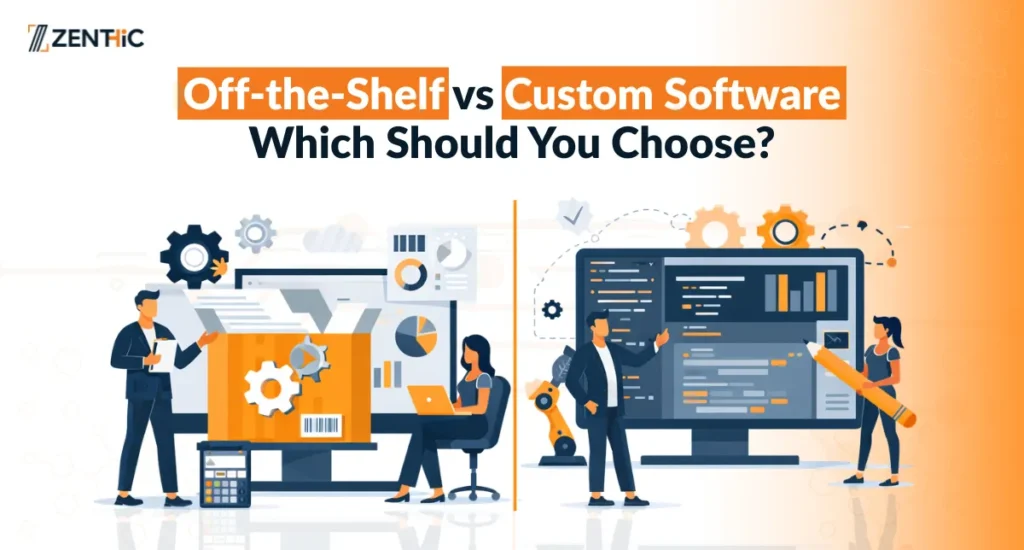
One of the most important decisions a business can make today is selecting the appropriate software. Regardless of whether you are a startup, small business, or growing enterprise, the software you are using has a direct impact on productivity, efficiency, and long-term growth.Most companies face a difficult decision when selecting business software. Should you buy off-the-shelf software or invest in custom software?
Each of these has its benefits and drawbacks. Your business requirements, financial capability, and future objectives will determine the decision.
We will discuss the difference between off-the-shelf and custom software, their advantages and disadvantages, and how to choose the software that will benefit your business.
What Is Off-the-Shelf Software?
Ready-made software is known as off-the-shelf software. This type of software is designed to suit a broad market. It comes with standard features, and it can be utilized right after purchase or subscription. Off-the-shelf software is generally inexpensive and easy to install since the cost of development is spread among multiple users.
Examples of such popular tools include accounting solutions, customer relationship management systems, and project management software. These solutions are designed to serve mass markets, meaning that a large number of businesses rely on the same solution.
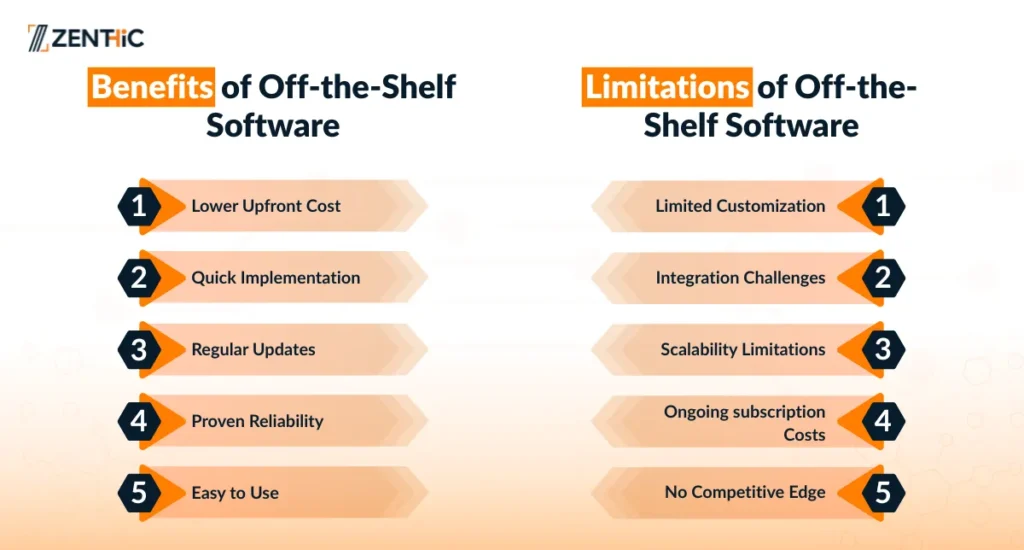
Benefits of Off-the-Shelf Software
1. Lower Upfront Cost
The biggest advantage of off-the-shelf software is affordability. Since it is produced in large volumes, the expenses are distributed among many customers, and hence it is inexpensive compared to the creation of custom software.
2. Quick Implementation
It can be used almost instantly. It does not have a development stage, which is why it can be utilized by many businesses that require a quick solution.
3. Regular Updates
Most vendors provide automatic updates, security patches, and customer support. This minimizes maintenance responsibilities among businesses.
4. Proven Reliability
It is very popular software and has already been tested by many users, which improves the stability and performance.
5. Easy To Use
Off-the-shelf software is designed for a wide range of users and it has a user-friendly interface and requires minimal training.
Limitations of Off-the-Shelf Software
1. Limited Customization
Off-the-shelf software is only created to be applied in general; hence, it is not suitable for your processes or workflows.
2. Integration Challenges
The existing tools may not be easily integrated with those that have already been implemented, which may lead to inefficiencies or extra manual work.
3. Scalability Limitations
The software does not support the new requirements, and you will change systems as your business grows.
4. Ongoing Subscription Costs
Initially, the spending is low; however, long-term costs, including licensing, upgrades, and add-ons, may accumulate to a substantial expenditure in the long term.
5. No Competitive Edge
Since many businesses use the same software, it may not give you a unique advantage or help you stand out from competitors.
What Is Custom Software?
Custom software is specifically designed to meet your unique business needs. The software is designed to reflect the way your business operates, rather than requiring you to change your processes to fit a tool. It is formulated based on your operations, data structure, and business objectives.
Benefits of Custom Software
1. Tailored To Your Needs
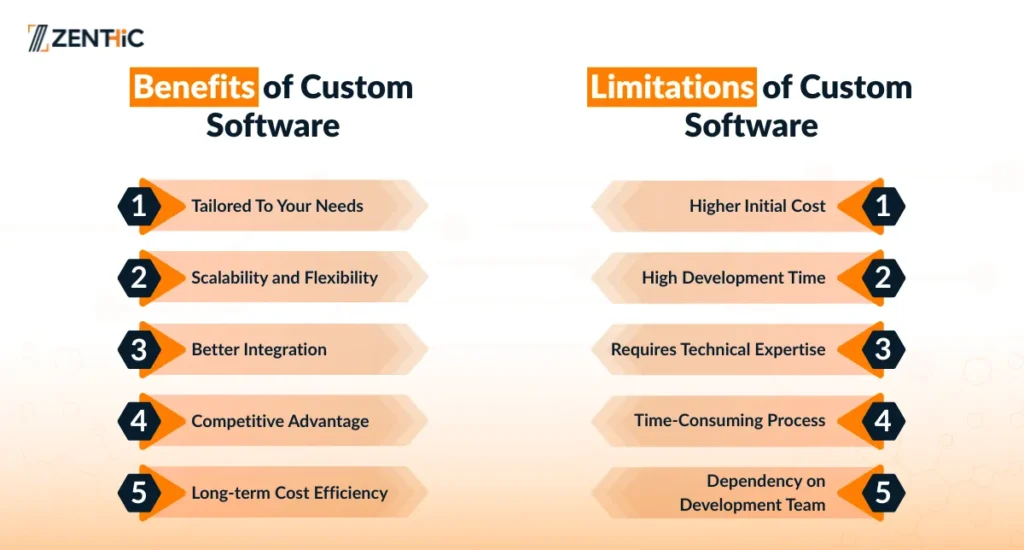
Custom software is specific to your business processes and makes them more efficient or productive.
2. Scalability and Flexibility
The software can be updated and expanded without significant restrictions as your business grows.
3. Better Integration
Custom solutions can integrate perfectly with existing tools and systems, enhancing data flows and automation.
4. Competitive Advantage
Your business has unique features and a workflow that your competitors may struggle to imitate.
5. Long-term Cost Efficiency
Custom software may have a high initial cost, but it ultimately saves money on licensing, manual labor, and operational inefficiencies.
Limitations of Custom Software
1. Higher Initial Cost
Although custom software often requires a larger initial investment, it can ultimately save money by reducing licensing costs and enhancing productivity. Custom development involves the cost of design, development, testing, and implementation.
2. High Development Time
Custom software development can take months depending on its complexity.
3. Requires Technical Expertise
It requires an experienced development team or technology partner to maintain and upgrade the system.
4. Time-Consuming Process
Software development is time-consuming, particularly when developing sophisticated features.
5. Dependency on Development Team
You can strongly depend on your development team to update and fix as well as future upgrades.
Key Differences of Off-The-Shelf and Custom Software
| Factor | Off-the-Shelf Software | Custom Software |
| Integration | Limited | High Upfront |
| Ownership | Immediate | Takes Time |
| Scalability | Limited | Fully Customizable |
| Customization | Limited | Highly Scalable |
| Deployment | Vendor Controlled | Full Ownership |
| Integration | Restricted | Seamless |
Which One Should You Choose?
Each business is different and requires a unique solution. The best option will be determined by your needs, budget, and long-term objectives
Choose off-the-shelf software if:
- You require a fast and affordable solution.
- Your business requirements are standard
- You have a limited budget
- You don’t need heavy customization
Choose custom software if:
- Your business has its own unique processes and workflows.
- It is a long-term growth and scalability plan.
- You require high levels of integration with other systems.
- Software is a crucial aspect of achieving a competitive advantage.
Off-the-shelf solutions are often the starting point for many businesses due to their speed and low cost. They usually move to custom software as their needs become more specific or complex in order to have the ability to customize and have more control.
Conclusion
The choice of off-the-shelf software and custom software can have a strong impact on the future and efficiency of your business. Off-the-shelf and custom software have useful benefits. Off-the-shelf solutions are feasible, inexpensive, and easy to deploy, whereas custom software is often more flexible, scalable, and has long-term benefits.
The right option will be based on your business objectives, finances, and expansion strategies. Off-the-shelf software can be the best choice in case speed and simplicity are the key factors. When it comes to complete control, sophisticated integrations, and long-term cost-effectiveness, custom software can be a more intelligent choice. Collaborating with a reliable digital transformation agency will help you assess your requirements and determine the most suitable solution for sustainable growth. Ultimately, the most appropriate software is the one that aligns with your business goals and drives growth