Table of Contents
Introduction- What Is Custom Software?
- Role of Custom Software in Business Growth
- 1. Tailored to Your Business Needs
- 2. Unique Capabilities
- 3. Higher Efficiency
- 4. Better Integration
- 5. Stronger Security
- 6. Scalability
- 7. Improved Customer Experience
- 8. Long-Term Cost Efficiency
- 9. Full Control and Ownership
- When to Choose Custom Software:
- Conclusion
In the modern digital era, the business environment has become highly competitive in all industries. Customers demand quicker services, a customized experience, and efficient interactions throughout the process. Meanwhile, businesses must operate efficiently, manage costs, and remain dynamic enough to meet evolving market needs. Many businesses are investing in custom software instead of generic solutions to stay competitive.
Custom software is tailored to the needs, processes, and goals of a specific company, whereas ready-made solutions are usually used by many companies. This customized approach provides businesses with the flexibility, efficiency, and innovation that enable them to outperform competitors.
What Is Custom Software?
A computer program that has been specifically created to meet the needs of a business is known as custom software. Custom software is designed to meet your company’s demands and objectives rather than adapting your operations to fit standard software.
It includes an internal management system, a customer platform, automation systems, and mobile and web applications to meet particular business challenges.
The software development lifecycle is a systematic process in which companies plan, design, test, and deploy the software before full implementation.
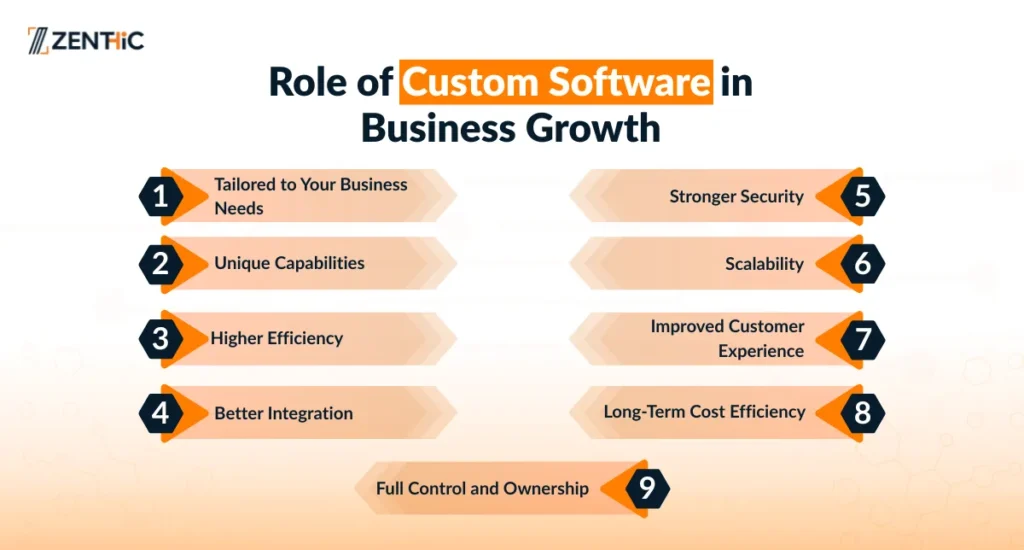
Role of Custom Software in Business Growth
In this blog, we will discuss the role of custom software in enabling businesses to develop a genuine competitive edge and why it has become a long-term strategic investment.
1. Tailored to Your Business Needs
Every company operates in a different way. Since off-the-shelf software is designed to serve multiple businesses simultaneously, it may have many features that are either missing or unnecessary. Custom software solves the problem by allowing you to focus on what your company really needs.
Features are designed specifically to fit your workflow, which makes processes simpler and more efficient. Teams that successfully align technology with business processes execute more efficiently, make fewer errors, and achieve better results.
2. Unique Capabilities
Differentiation is one of the most powerful competitive advantages. It is challenging to make a difference when businesses employ the same standardized tools as others. You can use custom software to create something unique, whether it is a service or a user experience that competitors cannot easily duplicate. It could be a dedicated customer portal, a sophisticated automation system, or a customized service platform. These technical advantages grow your business in the long term, which is a key component of your competitive strategy.
3. Higher Efficiency
Growth requires efficiency. Repetitive tasks, manual processes, and disconnected systems slow down businesses and introduce a high risk of errors. Custom software helps optimize business processes by automating repetitive tasks, including data collection, reporting, communication, and workflows.
Automation saves time, minimizes human error, and enables employees to concentrate on more strategic work. A business that is more efficient than its competitors will have a strong competitive edge in terms of productivity and performance.
4. Better Integration
Most businesses rely on multiple digital tools, such as accounting programs, customer relationship management software, analytics, and communication applications. When these systems don’t work together smoothly, data becomes fragmented, and processes become inefficient.
Custom software can be developed to integrate with the existing tools. This provides a connected digital environment where information circulates between systems. The integration results in improved decision-making, accuracy, and streamlined operations.
5. Stronger Security
Modern businesses are concerned with data security. Standard software is widely used and is therefore a frequent target of cyber threats. However, with custom software development, your business will have complete control over security. You can implement protection features that can accommodate your needs, control user access, and decide exactly how your data is stored and processed.
6. Scalability
Technology must evolve with business growth. Most organizations reach a point where they can no longer use standard software and struggle with limitations that restrict their growth.
Custom software is developed in a scalable manner. The business may change in terms of new features, users, and capabilities. Companies do not need to replace the whole system; they only need to expand the current solution. This flexibility enables technology to facilitate long-term growth.
7. Improved Customer Experience
One of the most significant aspects of business success is customer experience. Customers demand quick service, smooth communication, and customized services.
Custom software allows companies to design solutions that are tailored to the unique requirements of their clients.
A better user experience can be achieved through customized solutions that include automated customer care, faster service delivery, and personalized dashboards. Satisfied clients are more loyal, and loyalty strengthens a company’s competitive position.
8. Long-Term Cost Efficiency
Custom software is more expensive in the short run, but it can be more cost-effective in the long term. Companies do not have to pay repeated subscription payments, unwanted features, and expensive workarounds. Since the software is designed for a specific organization, it enhances efficiency and minimizes operational costs. It gives high returns on investment in the long run.
9. Full Control and Ownership
Using off-the-shelf software, companies rely on third parties for updates, prices, and features, which restrict flexibility and control. Custom software provides total ownership to companies. Businesses can scale, upgrade, and modify the system whenever needed, without outside limitations. This enables them to adapt to new opportunities and market needs. As a result, businesses gain greater control over their software and can respond more quickly
When to Choose Custom Software:
Custom software is an intelligent investment where:
- Current tools restrict productivity.
- Business processes are either unique or complex.
- Scalability and growth are important.
- Data security is critical.
- There is a need to improve customer experience.
- Long-term efficiency is important.
When any of these conditions apply, custom software can significantly impact the way your business operates.
Conclusion
Technology is key in today’s competitive business world. Companies that rely on generic tools often face limits that can hold back growth and flexibility.
Custom software offers tailored functionalities, increases efficiency, enhances security, and supports long-term scalability. Most importantly, it allows businesses to do things in a manner that cannot be easily imitated by competitors.We are a digital transformation agency that collaborates with organizations to develop custom solutions that enhance performance, innovation, and sustainable development. Custom software is not just a technical upgrade but a competitive advantage, specifically for businesses that want to grow rapidly and innovate continuously or deliver more value to their customers.