Table of Contents
Introduction- Understanding Google Ads
- Key Benefits of Google Ads
- Understanding Meta Ads
- Key Benefits of Meta Ads
- Google Ads vs Meta Ads: Key Differences
- Cost Comparison: Which Is More Affordable?
- Conversion Performance: Which Platform Converts Better?
- Google Ads Targeting
- Meta Ads Targeting
- When Should You Use Google Ads?
- When Should You Use Meta Ads?
- Which One Performs Better Overall?
- Final Thoughts
When it comes to paid advertisements, companies may have to choose between Google Ads and Meta Ads and determine which one is more effective.
Both platforms are extremely strong, but they work in very different ways. Your decision will depend on your audience, goals, budget and your general performance marketing approach.
In this article, we’ll explore the key differences between Google Ads and Meta Ads, compare their performance, and help you choose the right platform for your business.
Understanding Google Ads
Google Ads is an advertising platform driven by search intent. It allows businesses to show ads to users who are actively searching for products or services on Google.
Key Benefits of Google Ads
- Identifies users with high intent.
- Displays advertisements at the precise moment when individuals look for solutions.
- Local and service-based companies show strong performance.
Google Ads performs best when users know exactly what they’re looking for. It’s an ideal choice for businesses focused on conversion-driven, performance marketing strategies.
Understanding Meta Ads
Meta Ads (including Instagram Ads) are based on audience targeting rather than search intent. Meta Ads deliver content to users based on their demographics, interests, and behavior rather than waiting for them to search.
Key Benefits of Meta Ads
- Advanced possibilities for audience targeting.
- Excellent for increasing brand recognition and engagement.
- Effective visual storytelling using images and videos.
- Reduced costs for reach and impressions.
Meta ads are the best way to reach new audiences, establish credibility, and guide people before they become customers.
Google Ads vs Meta Ads: Key Differences
Both platforms can deliver results, but their performance depends on how and when they are used.
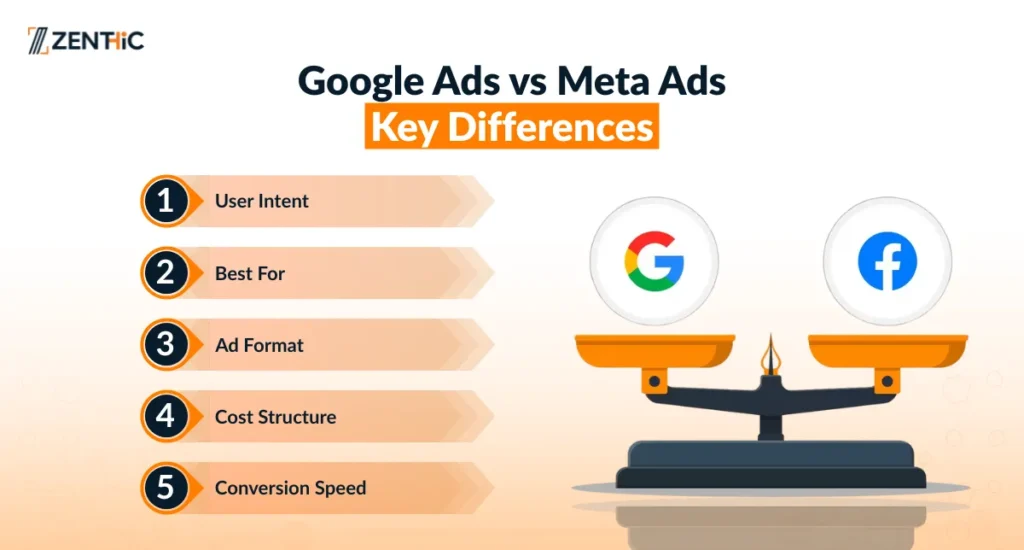
| Feature | Google Ads | Meta Ads |
| User Intent | High (search-based) | Low to medium (interest-based) |
| Best For | Leads & sales | Brand awareness & engagement |
| Ad Format | Text, shopping, display | Image, video, carousel |
| Cost Structure | CPC-based | CPC / CPM-based |
| Conversion Speed | Faster | Slower but scalable |
Cost Comparison: Which Is More Affordable?
When comparing Google Ads and Meta Ads, cost is an important consideration.
- Google Ads typically has a higher cost per click, particularly in competitive industries such as real estate, finance, or SaaS.
- Meta ads are more cost-effective for awareness campaigns, because they often have lower CPC and CPM.
However, cheaper clicks don’t always mean better results. Google Ads often deliver higher-quality leads, which can justify the higher cost.
Conversion Performance: Which Platform Converts Better?
Google Ads can be more effective for immediate sales or leads. Meta Ads are most effective at raising awareness. While users may not convert immediately, continuous messaging and retargeting strategies can turn interest into long-term ROI.
- Users are already looking for solutions.
- Purchase intent is very high.
- Conversion rates are generally stronger.
- Audience Targeting Comparison
Google Ads and Meta Ads offer different targeting strategies, each designed to reach customers at various stages of the purchasing process.
Google Ads Targeting
Google Ads targeting based on the following factors:
- Keywords
- Location
- Device
- Search intent
Meta Ads Targeting
Meta Ads targeting based on the following factors:
- Interests
- Behaviors
- Custom audiences
- Similar audiences
Meta Ads provide higher audience targeting options, whereas Google Ads focus on reaching users with specific search intent.
When Should You Use Google Ads?
Google Ads is the best option when:
- You want quick conversions.
- Your product immediately resolves an issue.
- You provide SEO, web development, and local business services.
- Your audience is actively searching for the solutions you can provide.
When Should You Use Meta Ads?
Meta advertisements work better when:
- You want to raise brand awareness.
- You are introducing a new product or service.
- The importance of visual storytelling
- You wish to retarget website traffic and social audiences.
Which One Performs Better Overall?
Meta Ads and Google Ads have different functions in a well-organized digital advertising plan. Google Ads are frequently used by trusted businesses to achieve intent-based conversions, whereas Meta Ads are used to increase brand exposure, engagement, and scalable reach across larger audiences.
Using both platforms together is frequently the most successful option. Meta Ads facilitate audience nurturing and retargeting to enhance total campaign performance, whereas Google Ads assist in capturing high-intent consumers during the decision stage.
As a trusted company, we combine Google Ads and Meta Ads to drive measurable growth and long-term performance.
Final Thoughts
The decision between Google Ads and Meta Ads is influenced by your audience’s behavior, budget, and business objectives. Instead of asking which platform is better, the smarter strategy is identifying which platform aligns with your current marketing objectives.
Businesses may maximize ROI and develop a scalable advertising plan by understanding how each platform operates and monitoring the appropriate performance marketing metrics.
The best approach to long-term success of companies that are determined to grow sustainably is still to experiment with both platforms and optimize campaigns based on real-life data.