The purpose of performance marketing is to provide measurable results in clicks, leads and sales that can be tracked and optimized. Mostly, the issue is not the platform or budget, but a few performance marketing mistakes that are common, which gradually impact the performance of the campaigns. When you already know the fundamentals of paid campaigns and the principles of performance marketing, you should know what to avoid next. The following are five common mistakes that may hold campaigns along with their corrections; in order to achieve better results.
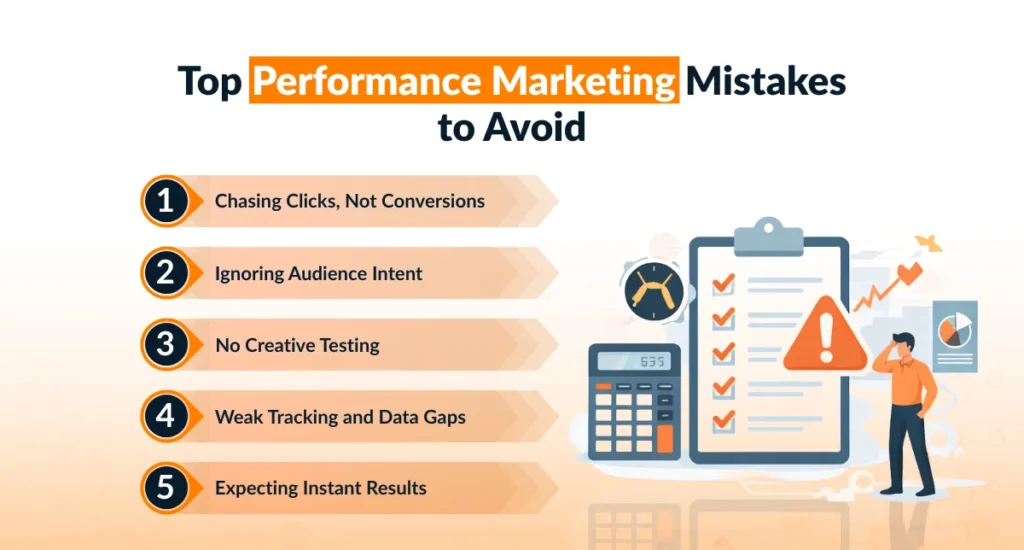
1. Chasing Clicks, Not Conversions
The biggest error of performance marketing is giving too much attention to the clicks. Although clicks are signs of interest, they do not necessarily create revenue. High-traffic but low-conversion campaigns often indicate a deeper issue.
Clicks without intent can:
- Increase ad spend
- Lower ROI
- Prepare false performance reports.
How to fix it
Focus on what truly matters, such as purchases, sign-ups, or qualified leads, rather than superficial numbers.
2. Ignoring Audience Intent
Not all users are at the same stage of the buying journey. Treating all platforms and audiences the same often leads to wasted spend and poor campaign performance.
For example:
- Search ads usually reach users who are ready to take action, while social ads appear when users are still exploring or discovering products and services.
How to fix it
Align your messaging and goals with user intent. Awareness campaigns should focus on education, while conversion-oriented campaigns should remove friction and guide users toward action, especially when choosing the right Google Ads vs Meta Ads strategy.
3. No Creative Testing
One of the biggest mistakes that most brands commit is to run the same ads too long, in the hope that performance will remain constant. The targeted campaigns cannot work when the creatives do not reach out to the audience
Over time, this leads to:
- Ad fatigue
- Lower engagement
- Rising acquisition costs
How to fix it
Create experiments with various headlines, images, formats, and calls to action in order to test creatives on a regular basis. Ongoing creative testing keeps campaigns updated and improves overall ad performance, especially when supported by AI-driven ad optimization.
4. Weak Tracking and Data Gaps
Accurate data is essential in performance marketing. Inadequate tracking systems usually lead to wrong judgments and ambiguous conclusions.
Common issues include:
- Missing conversion events
- Inaccurate attribution
- Relying only on platform-reported data
How to fix it
Make sure that tracking has been configured on all platforms. Apply high-quality analytics tools and analyze performance marketing trends rather than responding to daily changes.
5. Expecting Instant Results
Performance marketing has the capacity of achieving quicker outcomes compared to organic channels. Most of the campaigns fail due to unrealistic expectations.
Short-term thinking often leads to:
- Early campaign shutdowns
- Missed optimization opportunities
- Inconsistent performance
How to fix it
Performance marketing is a process that should be repeated. Allow campaigns to build up data, targeting and increase efficiency by testing and optimizing
Conclusion
Performance marketing is most effective when strategy, information and implementation are aligned. By avoiding these common mistakes, companies will be able to save on wasted money, achieve higher conversion rates, and create sustainable campaigns that can be expanded over time, a strategy that every trusted company values. Better performance is achieved when you know your audience, apply the right data and optimize campaigns as a result of performance rather than short-term strategy.