When you need to build a large mobile application or even use custom software to automate business processes, the first thing that comes to mind is the cost of creating a custom application. The cost of a custom app depends on the features, design, platform, and team you hire.
In this blog, we will explain the cost of custom app development in simple terms so you can clearly understand where your money is going and how to plan your budget effectively.
Custom App Development Cost
The cost of developing a custom app refers to the amount of money spent on turning your idea into a fully functional solution. In contrast to off-the-shelf software, a custom app is created to match your specific needs. There is no universal number. Instead, the price is determined by a combination of technical, creative, and business decisions.
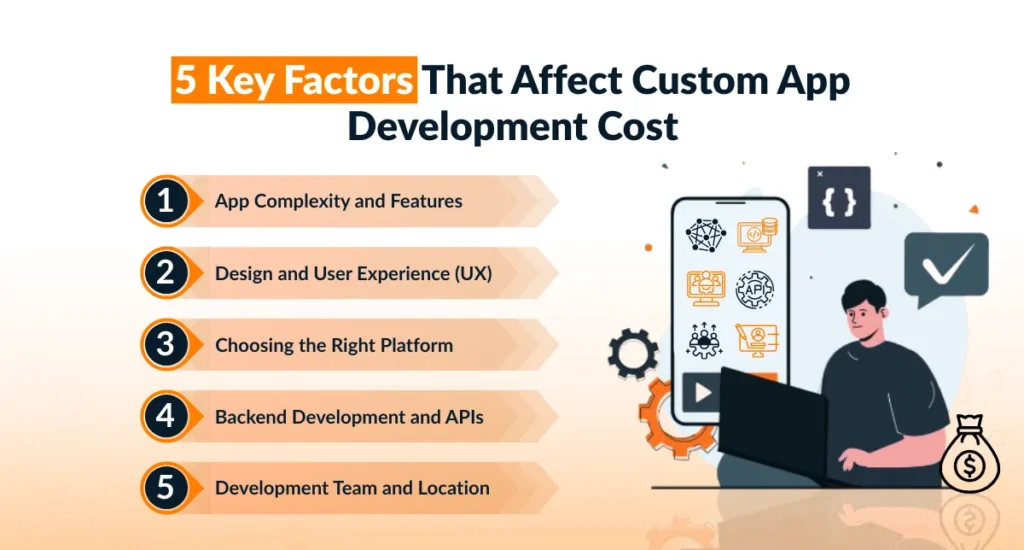
5 Key Factors That Affect Custom App Development Cost
When creating a custom app, it’s important to consider the costs. The following are the five key ways that influence the total cost of development.
1. App Complexity and Features
App complexity is the most important factor in the cost of app development. A simple app with a few features, such as user login and a few screens, is significantly less expensive than a sophisticated app with real-time chat, payment integration, social logins, GPS and maps, or AI capabilities.
Each additional feature requires more time for development, design, and testing. This is why it’s crucial to identify your Minimum Viable Product (MVP), which is a basic version of the app that will solve the primary problem without any unnecessary features, before developing a product.
2. Design and User Experience (UX)
Design is not only about how an application looks, but it is also about how easy and smooth it is to use. Custom designs that include animations and original layouts require more time and effort compared to the ready-made templates and will raise the total cost. User experience is a major determinant of the success of an app, so it is important to consider and invest in the design at an early stage.
3. Choosing the Right Platform
One of the biggest factors affecting the cost of a custom app is the platform you choose. Whether you go for a native or cross-platform solution, each option comes with its own set of cost implications. iOS apps tend to be quicker and simpler to develop due to fewer devices and screen sizes to support. Android apps need to be tested and optimized because of the large number of devices and screen resolutions.
Other development teams utilize cross-platform frameworks, such as Flutter or React Native, to save time and cost. However, this may have a performance impact or restrict access to certain native functionalities. The choice of the platform should be based on the purpose of your app and your target audience.
4. Backend Development and APIs
A reliable backend is essential for most apps. It is responsible for data storage, request processing, real-time communication, and links to other services. If your app needs a backend and APIs, costs increase, especially when security and scalability are priorities.
5. Development Team and Location
The choice of the team and its location significantly affects the cost and quality of the app. Small agencies are more affordable and provide support, whereas enterprise teams are more expensive and offer the best quality. App development rates differ by region: North America and Western Europe are generally more expensive, while Eastern Europe and Asia are more affordable. Still, price shouldn’t be the only consideration; technical skill and good communication are equally important.
Estimated Cost to Build a Custom App
Here are three cost ranges to give you a clearer picture of app pricing.
1. Simple App
Simple applications are the budget-friendly option for custom app development. They have simple functionality and a limited number of screens, which reduces the development time. These prices typically range from $10,000 to $30,000 and are suitable for MVPs, small startups, or business applications that require a fast and practical solution.
2. Medium App
The medium-complexity applications provide the balance between features and price. These applications tend to have user logins, databases, and API integrations that are more difficult to develop. Medium application costs typically range from $30,000 to $80,000, covering business apps, booking systems, and service-oriented apps that need features beyond a basic application.
3. Complex App
Complex applications are meant to support advanced and large-scale requirements. They have advanced features and real-time data handling, which are more time-consuming and demanding in terms of technical labor. The price usually starts at $80,000 and $200,000, depending on requirements. The apps are most applicable in e-commerce systems, social networks, and enterprise systems. But the final price can be different depending on certain features and the scope of the project.
Hidden Costs of App Development
Many people forget these extra costs.
1. App Maintenance
After the app is launched, ongoing maintenance becomes essential; it needs frequent bug fixes, updates, and security enhancements to perform effectively. Usually, the maintenance cost should be 15-25% per year of the original cost of development.
2. Server and Hosting
Apps that have active users require servers and hosting. Server costs cover data storage and keeping the app running smoothly, and they increase as the number of users grows.
3. App Store Fees
There is also a cost of publishing your app in app stores. Apple and Google impose annual charges on developers, and there are extra fees based on in-app purchases and payment transactions.
How to Reduce App Development Cost
You can save money by planning smartly.
- Start with a basic version: You can start your application with the minimal number of features to keep the costs down.
- Specific about requirements: Clear instructions reduce changes and delays.
- Select the appropriate team: Good communication can save errors and additional expenses.
- Pre-development planning: Wireframes and effective planning save time and money.
Conclusion
Building a successful app starts with the right approach. When you have a clear picture of what influences development costs, it will be easy to plan wisely, manage your budget, and make the proper decisions. Working with a reliable company helps you make better decisions and build an app for long-term success. A custom app is not only about producing code, but it is also about building value that matters to customers and helps them build their future. In case you are willing to move to the next stage, consider our mobile app development services and transform your idea into a scalable digital solution.