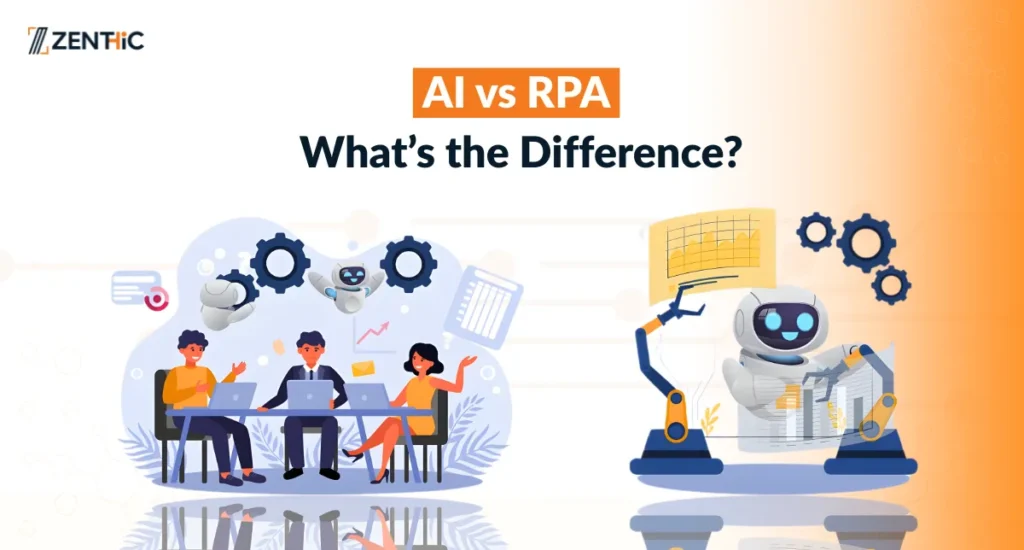
Automation is defining the operations and growth of reliable businesses in the modern dynamic digital world. Artificial Intelligence (AI) and Robotic Process Automation (RPA) are some of the most popular technologies that drive this change.
Although they are not similar, they are commonly used together. Knowing the difference between RPA and AI can help you make a better decision to determine which would work best for your company.
What is RPA (Robotic Process Automation)?
RPA is a software technology that helps businesses to automate repetitive and rule-based digital tasks. It uses bots that replicate human activities like pressing buttons, typing data, pasting data and creating reports. Robotic Process Automation (RPA) will reduce human error in business, save time and automate repetitive tasks.
Key Characteristics of RPA:
- Rule-Based
It uses predetermined logic and directions.. - Structured Data
Supports fixed data such as databases or excel. - No Learning Ability
RPA is not intelligent, it is just executing. - Fast Implementation
It can easily be integrated with the existing systems.
Common RPA Use Cases:
- Automating data entry
- Invoices and payroll processing.
- Generating routine reports
- Moving information between systems.
What is AI (Artificial Intelligence)?
Artificial Intelligence (AI) is the next level of intelligent automation. It allows systems to interpret data, identify trends and make more intelligent decisions based on superior algorithms and machine learning methods.
In contrast to Robotic Process Automation (RPA) that has set rules to follow, AI develops with each interaction, which can enable businesses to automate complex, data-driven tasks more easily.
Core Capabilities of AI:
- Learning from Data
The AI systems are constantly enhanced by training and feedback. - Working with Unstructured Data
It is able to manipulate pictures, video, text, and voice. - Decision-Making
AI makes smart decisions depending on the option and circumstances. - Natural Language Understanding
It is able to understand and act on human language.
Common AI Applications:
- Virtual assistants (such as Siri or ChatGPT)
- Risk analysis and fraud detection.
- Forecasting and predictive analytics.
- Image and voice recognition
Concisely, AI automates thinking whereas RPA automates doing.
AI vs RPA: The Key Differences
Comparing AI vs RPA, it becomes evident that both are automation motives, but with different objectives. One strives to improve efficiency by rules, and the other by adding intelligence by learning. Learning about their fundamental differences can assist the businesses to select the relevant technology in their respective requirements.
| Feature | RPA | AI |
| Purpose | Automates repetitive, rule-based tasks | Simulates human intelligence and reasoning |
| Data Type | Structured | Structured and unstructured |
| Learning Ability | No learning, fixed rules | Learns and adapts from data |
| Complexity | Simple to implement | Requires data and model training |
| Outcome | Speed and accuracy | Insight and intelligence |
When to Use RPA vs AI
Understanding the appropriate time to apply RPA or AI can assist you in selecting an appropriate automation tool to implement in your business. Both technologies are efficient; however, they are best applied to various kinds of work.
Choose RPA when:
- You have repetitive, high-volume tasks.
- Processes follow strict rules.
- You need quick automation results.
- Data is structured and consistent.
Example: Automating data entry or invoice generation.
Choose AI when:
- Your tasks involve complex decisions or predictions.
- You have unstructured data such as text, voice or images that you would like to process.
- You must have systems that learn and get better as time goes on.
- You need systems that learn and improve over time.
Example: Using chatbots that understand customer intent or predictive tools that forecast demand.
How AI and RPA Work Together
Although the roles of RPA and AI are different, they can become even more powerful when applied together. This combination is referred to as Intelligent Process Automation (IPA) or Hyperautomation.
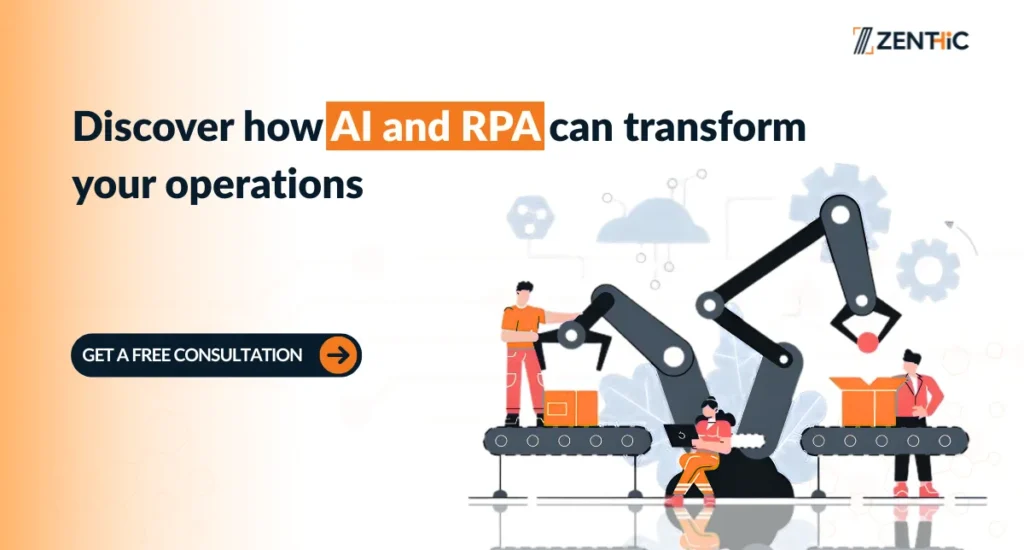
The following is an example of how they are complementing each other:
- AI interprets, analyzes and makes decisions.
- RPA performs such decisions effectively.
For example:
An AI system is able to read an email request and comprehend it by the customer. After that RPA bot will be able to extract that information, revise the database, create a report, or make a response, but without human intervention. This interrelation allows the end-to-end automation, between knowledge and action.
Benefits of AI and RPA
The effects of AI and RPA extend beyond automation to include accuracy, speed and smarter decision-making throughout the business processes. AI and RPA play an important role in digital transformation, but their advantages differ according to their applications. Now, let’s discuss the advantages of each.
Benefits of RPA:
- Reduces manual workload
- Improves speed and accuracy
- Increases adherence and congruency.
- Saves time and costs
Benefits of AI:
- Makes smarter and data-driven decisions.
- Processes unstructured and complicated data.
- Makes predictions of consequences and trends.
- Never stops learning and advancing.
Combined Benefits:
When using AI and RPA together, businesses will be able to automate complete workflows, not only repetitive ones but also decision-making. This develops a smarter and more adaptive system, which is able to handle end-to-end operations.
The Future of Automation
The future of automation is rapidly growing toward AI automation, where the intelligence of artificial intelligence combines with the precision of RPA. This powerful combination allows companies to automate complicated decision-making tasks that previously required human input in addition to repetitive operations.
Businesses can more successfully implement AI automation by partnering with a reliable company, which guarantees smooth integration, streamlined processes, and long-lasting digital transformation.
As businesses adopt AI automation, they build smarter systems that learn, adapt and improve over time. Artificial intelligence (AI) automation frees up teams to concentrate on innovation, strategy and expansion rather than replacing human labor.
Conclusion
Although improving efficiency is the goal of both AI and RPA, their methods differ. RPA automates structured, rule-based, and repetitive operations quickly and accurately, whereas AI focuses on learning, reasoning and making intelligent decisions. When these technologies are coupled, they produce Intelligent Automation, which allows organizations to run their operations faster, smarter and more precisely.
RPA is a good starting point for businesses wishing to automate straightforward, rule-driven procedures, but integrating AI is the next step for organizations aiming to scale automation with intelligence and flexibility. AI and RPA are transforming the future of digital transformation by enabling enterprises to optimize procedures, boost performance, and unlock new levels of innovation.