Table of Contents
Introduction- What is AI Development?
- Why AI Development Matters for Businesses
- 1. Process Automation
- 2. Data-Driven Decision Making
- 3. Personalized Customer Experiences
- 4. Cost Efficiency
- 5. Competitive Advantage
- 8 Key Steps in AI Development
- 1. Define the Business Problem
- 2. Data Collection
- 3. Data Preparation
- 4. Choose the Right AI Model
- 5. Model Development and Training
- 6. Testing and Validation
- 7. Deployment and Integration
- 8. Continuous Improvement
- Common AI Use Cases in Business
- AI Chatbots
- Predictive Analytics
- Fraud Detection
- Recommendation Systems
- Supply Chain Optimization
- Challenges of AI Development
- 1. Data Quality
- 2. High Cost of Adoption
- 3. Ethical and Privacy Concerns
- How Businesses Can Get Started with AI
- Conclusion

Artificial Intelligence (AI) is rapidly transforming how businesses operate. AI may help businesses become more efficient and competitive by automating repetitive tasks and providing highly customized customer service.
Today, organizations in all sectors are investing in the development of AI to process data, optimize operations, and make smarter decisions. Nevertheless, AI is not a clear and simple concept to many business executives.
This article covers AI development, its significance to business, and how businesses may effectively implement AI solutions.
What is AI Development?
The process of designing, building, and deploying software systems that can perform tasks usually requiring human intelligence is called artificial intelligence development. These systems can analyze data, recognize patterns, predict results, and automate decision-making.
AI development often involves technologies such as the following:
- Machine Learning (ML)
- Natural Language Processing (NLP)
- Computer Vision
- Predictive Analytics
- Conversational AI
Unlike traditional software, AI systems improve over time as they learn new data. This capability helps businesses to continuously enhance their performance and gain deeper insights.
Why AI Development Matters for Businesses
AI is becoming essential for businesses that want to compete in the rapidly evolving digital world. It has a number of important advantages.
1. Process Automation
Repetitive and time-consuming activities, including customer support questions, document analysis, and data input, can be automated using AI. Automation enhances efficiency and minimizes the possibility of human error. This means that employees are able to concentrate on more strategic and creative tasks that advance the business.
2. Data-Driven Decision Making
Modern businesses produce massive amounts of data on a daily basis. The AI systems are capable of processing this data in a short time and delivering information that assists leaders in making decisions. For example, AI can determine customer behavior trends, predict demand, and outline opportunities.
3. Personalized Customer Experiences
Customers want brands to engage with them on a personal level. Artificial intelligence can be used to examine user behavior, preferences, and purchase history in order to provide targeted recommendations and personalized marketing campaigns. Such personalization increases customer satisfaction and brand loyalty.
4. Cost Efficiency
The use of AI solutions can enable organizations to minimize the cost of operation. Automated systems need fewer human resources, reduce mistakes, and simplify operations. The overall business productivity can be significantly improved in the long run with the help of AI-driven processes.
5. Competitive Advantage
Early adopters of AI have a major advantage. AI can help businesses to be more innovative, enhance products and services, and be more responsive to market changes. With the use of AI technologies, organizations will be able to become the leaders of digital innovations
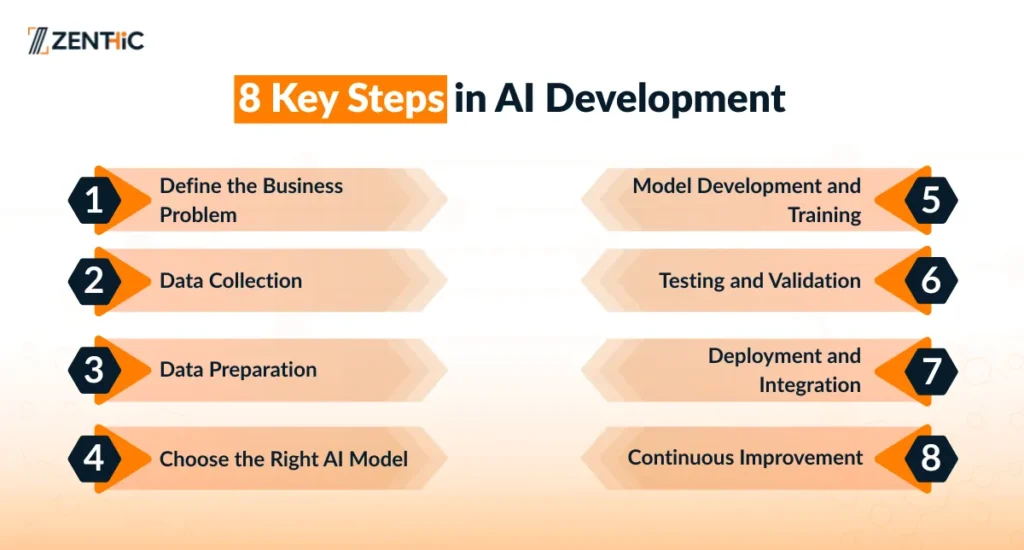
8 Key Steps in AI Development
The development of AI should be systematic. The process of creating AI-based solutions has the following steps that are usually followed.
1. Define the Business Problem
The first step is to determine a specific problem that can be addressed by the use of AI. This is because businesses should work on the areas where artificial intelligence can make measurable outcomes, like enhancing customer service, forecasting sales patterns, or automating internal operations. Clear goals will help to make the AI project align with the overall business objectives.
2. Data Collection
AI systems require a lot of data to function. Customer interactions, sales records, CRM, and operational databases are some of the information sources that businesses employ to gather data. The quality of the AI model will improve as the information becomes more precise and useful.
3. Data Preparation
Raw data is usually filled with errors, duplication, or the absence of information. The data should be cleaned and organized before it is used to train AI models. This step will make sure that the AI system is learning correct patterns and giving valid results.
4. Choose the Right AI Model
At this point, you determine the AI strategy that is the most appropriate to the business problem, including machine learning, NLP, or computer vision. The correct model will have a direct effect on the performance and the accuracy of your solution. That is why it is necessary to select a model that fits your data and business objectives.
5. Model Development and Training
At this phase, developers select the most suitable machine learning algorithms and optimize the AI model with prepared datasets. The model learns to recognize relationships in the data and provides predictions or automatic responses.
6. Testing and Validation
AI models should be tested before deployment to make sure they are accurate, reliable, and free of bias. Developers test the performance of the system and improve it where needed. Intensive testing will avoid any errors and will improve the performance of the AI solution.
7. Deployment and Integration
After its validation, the AI system is incorporated into business applications, including websites, mobile applications, or internal software platforms. At this stage, customers and employees can start communicating with the AI-powered solution.
8. Continuous Improvement
AI systems are not static. They should be checked and revised periodically in order to sustain performance. The model can be retrained as new data appears to enhance the accuracy and reflect the new business environment.
Common AI Use Cases in Business
The development of AI automation is being implemented in numerous industries in order to enhance efficiency and customer experiences. It can be used in some applications:
AI Chatbots
Chatbots are being utilized by businesses to respond to customer inquiries, offer instant feedback, and reduce response time.
Predictive Analytics
AI assists businesses in predicting sales and trends and evaluating customer behavior.
Fraud Detection
AI algorithms are applied by financial institutions to identify suspicious transaction trends and eliminate fraud.
Recommendation Systems
Recommendation engines are AI-powered tools that suggest products or services to customers depending on their preferences.
Supply Chain Optimization
AI helps companies to optimize inventory management, demand forecasting, and logistics planning.
These applications show that AI can revolutionize the way businesses are run and create new growth opportunities.
Challenges of AI Development
While AI offers many benefits, businesses must also consider potential challenges.
1. Data Quality
AI models rely on high-quality data. The wrong predictions and unreliable results are possible due to poor or incomplete data
2. High Cost of Adoption
AI solutions require investment in infrastructure, tools, and skilled professionals, making the initial setup costly.
3. Ethical and Privacy Concerns
Companies need to ensure that artificial intelligence can manage information ethically and meet privacy standards. There should also be such ethical considerations as bias and transparency.
How Businesses Can Get Started with AI
Companies looking to adopt AI should start with a clear strategy. Rather than adopting AI in all business processes at once, it is more appropriate to start with small projects that focus on a particular business issue.
Businesses often collaborate with an experienced tech company like Zenthic to develop AI-driven solutions that are customized to meet their unique business requirements. Long-term AI success will also be achieved by investing in data infrastructure, employee training, and research and development.
Conclusion
The development of AI is transforming the way businesses operate, compete, and develop. The opportunities presented by AI technologies in automation and predictive analytics, as well as in personalized customer experiences, are incredibly strong and useful to organizations across multiple industries. Effective implementation of AI needs proper planning, quality data, and appropriate technical knowledge. Companies that adopt AI development will be more equipped to respond to any future change in technology and stay competitive in the digital economy.