Table of Contents
Introduction
Artificial Intelligence (AI) is reshaping the way businesses operate, from automating tasks to enhancing decision-making capabilities. However, creating successful AI solutions is not as easy as it appears. Many companies struggle to progress past the early stages of development due to various technical, organizational, and strategic issues.
If you’re new to AI, it’s essential to understand the development process first. A complete guide to AI can help you build a solid foundation and avoid common mistakes. Before solving challenges, businesses should follow the right steps to plan and execute AI projects effectively. Knowing these challenges and finding ways to overcome them can help businesses realize the full potential of AI and reach long-term success.
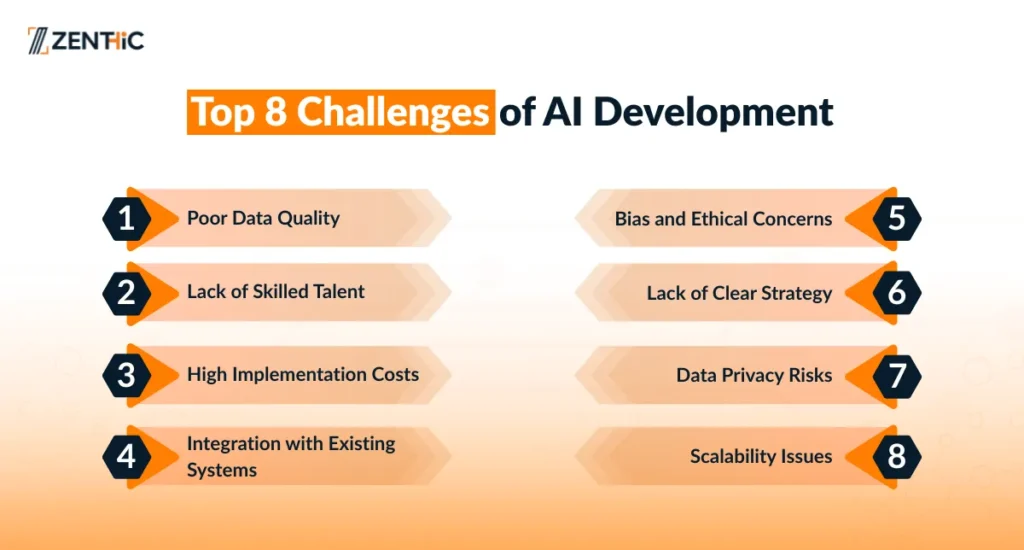
Top 8 Challenges of AI Development
Here are eight key challenges in AI development we can discuss.
1. Poor Data Quality
Data is the backbone of AI systems. If the data is lacking, outdated, or inconsistent, the outcomes generated by AI models can be quite unreliable. Studies reveal that one of the biggest hurdles to AI success is poor data quality, which can significantly affect accuracy and decision-making. A strong data foundation is essential for your AI models to deliver accurate, meaningful insights.
How to Overcome It
- Invest in robust data collection and management systems.
- Make sure to clean and standardize your data before training your models.
- Implement data validation and monitoring tools.
2. Lack of Skilled Talent
AI development requires a good mix of skills in machine learning, data science, and software engineering. However, many organizations are running into a shortage of qualified professionals, which complicates their ability to implement AI effectively. About 42% of companies report that the lack of in-house AI expertise is a major obstacle. To succeed in AI, assembling the right team is key.
How to Overcome It
- Invest in training programs to upskill your current team.
- Hire experienced AI developers or consultants.
- Partner with specialized AI development companies.
3. High Implementation Costs
Building AI solutions can be quite pricey. Costs for infrastructure, tools, data storage, and hiring skilled professionals need to be taken into consideration. This can pose a big challenge for many businesses, especially startups. A phased approach can help you manage expenses while still delivering measurable results.
How to Overcome It
- Start with small pilot projects instead of diving into full-scale implementation.
- Utilize cloud-based AI services to help lower infrastructure expenses.
- Prioritize high-impact use cases to maximize your efforts.
4. Integration with Existing Systems
Many organizations continue to depend on legacy systems that aren’t designed with AI in mind. Integrating AI into these older systems can be quite complicated and time-consuming. When your infrastructure is outdated, it can significantly slow down AI adoption and limit how much you can grow. A seamless integration will help your AI solutions perform efficiently alongside your existing setup.
How to Overcome It
- Gradually update your IT infrastructure for the best results.
- Use APIs to bridge your AI solutions with the systems you already rely on.
- Choose architectures that are both scalable and flexible to meet your needs.
5. Bias and Ethical Concerns
AI models are trained on historical data, which can occasionally reflect biases. This can lead to unfair or incorrect results, especially in critical areas such as hiring or finance. Bias and misinformation are significant concerns in the current landscape of AI adoption. Building trust in your AI systems is crucial to ensure fairness and transparency.
How to Overcome It
- Use a variety of balanced datasets.
- Regularly check AI models for bias.
- Adopt ethical AI guidelines and governance.
6. Lack of Clear Strategy
Many AI projects are failing because companies don’t have a clear roadmap. Without well-defined goals, AI initiatives often find themselves stuck in the experimental phase. In fact, many AI projects never get past the pilot stage due to insufficient planning. A clear strategy is key to ensuring that your AI efforts provide real value to your business.
How to Overcome It
- Establish clear business goals for your AI initiatives. Ensure your AI projects align with the company’s broader goals. Evaluate success by measuring key performance indicators.
7. Data Privacy Risks
When handling large volumes of sensitive data, AI systems are particularly vulnerable to security threats. A data breach or misuse of information can result in significant legal troubles and harm to your reputation. Focusing on security is essential for protecting both your business and your users.
How to Overcome It
- To ensure your data is safe, it’s essential to implement robust security protocols. Make sure to use encryption and store your data securely. Also, don’t forget to adhere to compliance regulations and standards.
8. Scalability Issues
Many AI solutions perform impressively in testing phases but often struggle when applied in real-world scenarios. This is frequently due to inadequate infrastructure or insufficient planning. Ensuring scalability is crucial for your AI solutions to evolve with your business.
How to Overcome It
- Start with AI architectures that can scale
- Take advantage of cloud and distributed computing options
- Keep an eye on performance and make adjustments as needed
Conclusion
AI development offers numerous possibilities, but it also has considerable obstacles. Businesses must overcome these obstacles to flourish, including poor data quality, limited experience, and excessive expenses.
Adopting a strategic approach, starting small, investing in the appropriate resources, and continuously upgrading your AI systems is the key to overcoming these obstacles.
Businesses can build dependable, scalable, and effective AI systems that promote real growth by understanding these challenges and applying the appropriate solutions.