Table of Contents
Introduction
Artificial Intelligence (AI) is transforming how businesses create and develop online products. AI-driven applications are helping companies automate operations, make better decisions, and deliver personalized experiences to end users. Such applications have intelligent chatbots, predictive analytics, and recommendation systems.
However, creating an AI-powered application is not about using algorithms. It requires a planned strategy, appropriate data, and continuous enhancement.
How to Build an AI-Powered Application
Developing an AI-based application needs a precise plan and the appropriate method. Follow these key steps:
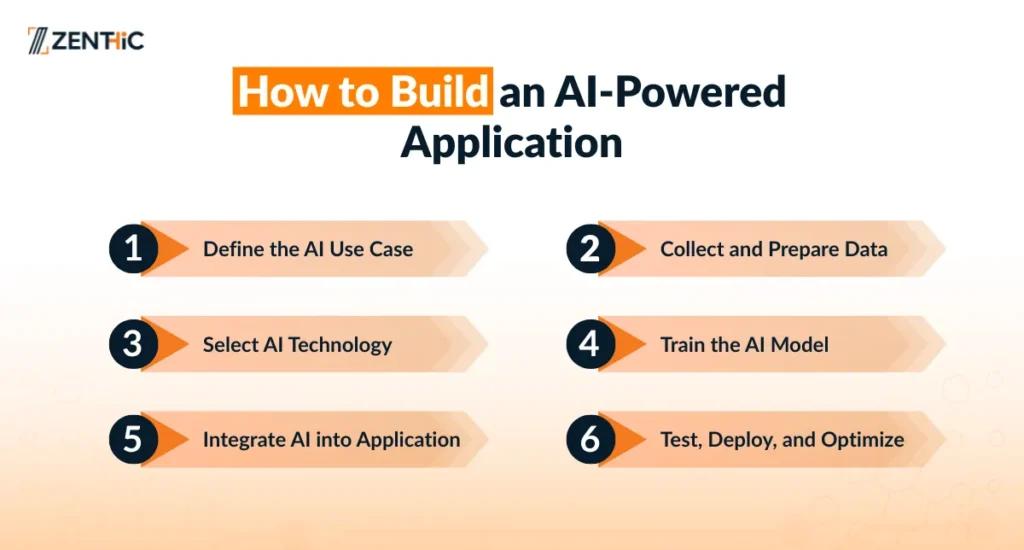
1. Define the AI Use Case
The first and most significant step when creating an AI-powered app is to identify the problem you want to address. Many companies commit the error of applying AI without a clear objective. Rather, they should consider a scenario in which AI can be used to create real value.
Some common uses for AI are:
- Chatbots as automated customer service.
- Detecting fraud and risk analysis.
- Product suggestions of what suits you.
- Getting business insights with the help of predictive analytics.
A clearly defined use case allows your AI solution to align with your business strategy and increases its overall success. Every AI system is based on data. Your data must be of high quality because it determines the accuracy and performance of your application.
You can collect data from:
- In-house database and customer relationship management.
- Behavior tracking and user interaction.
The next step after collection is preparing the data. This includes:
- Eliminating repetitions and inconsistencies.
- Handling missing values
- Organizing and coding information.
The quality of data determines the quality of results obtained by your AI model.
3. Select AI Technology
Selecting an appropriate AI approach is quite crucial for creating a functional app. Not all issues require complex deep learning models.
Depending upon your needs, you can use the following:
- Machine learning (ML) is applied to; making predictions, sorting, and analyzing data.
- Natural Language Processing (NLP) is used for chatbots, sentiment analysis, and text comprehension.
- Computer Vision: For finding objects and recognizing images
The choice of the right technology will save time in the development process and deliver better performance.
4. Train the AI Model
Once your tools and data are ready, the next step is to create and train your AI model.
This process comprises:
- Choosing the right algorithm
- Use your dataset to train the model.
- Evaluating performance using criteria such as accuracy and precision
It is important to recognize that model creation is a process. To achieve the greatest outcomes, you may want to try and modify a variety of techniques and factors. Continuous testing and improvement are key to the creation of an effective AI system.
5. Integrate AI into Application
An AI development model will not bring value on its own; it must be integrated into a working application.
This step includes:
- Integrating an AI model with your back-end systems.
- Designing APIs to communicate.
- Creating an appropriate and clean interface.
It should be integrated to improve the user experience. The characteristics of AI must be smooth, quick, and user-friendly instead of complicated and difficult.
6. Test, Deploy, and Optimize
It is important to test your AI-powered application before its release. This ensures that the system functions successfully in real-world scenarios.
After deployment:
- Track performance and accuracy.
- Collect user feedback
- Add new data to the model.
AI systems are becoming better with time, and thus, constant optimization is required to sustain performance and relevance.
Key Considerations for AI Application Development
Consider the following factors while developing an AI-driven application:
- Ensure that your system can grow to accommodate more data and users.
- Respect the law and protect private information.
- Optimize speed and processing in real time.
- Make the interface easy and user-friendly.
These are the factors that are key to success in the long run.
Conclusion
Building an AI-driven application does not only demand technical execution. It involves knowing your business needs, processing high-quality data, and constantly upgrading your system.
By following these six steps, businesses may develop scalable, effective AI automation solutions that add significant value. The best way to achieve success with AI is often to start with a simple strategy and build up capabilities gradually.
When you have a project to build an AI application, collaborating with an established andtrusted software development company can facilitate the process, reduce risks, and avoid common pitfalls.