Table of Contents
Introduction
Software development is a rapidly evolving process, and choosing the right programming language is a critical step in creating an effective and scalable solution. All software products, whether web-based, enterprise-scale, or mobile, are built on programming languages.
There are many programming languages on the market today, and developers and organizations must determine which language to employ most effectively in their projects. The right language can boost the system’s development speed, performance, and future scalability.
Top Programming Languages for Software Development
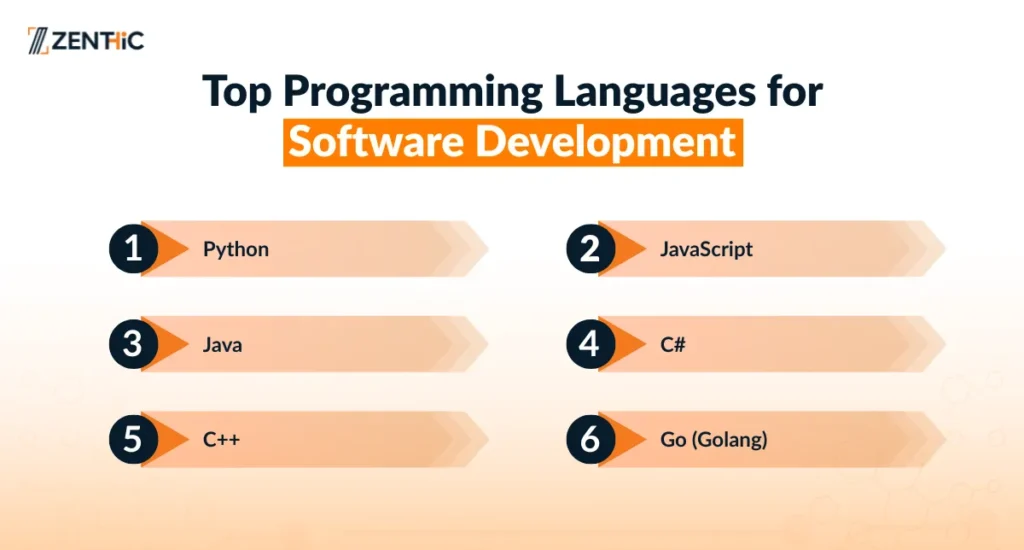
In this article, we discuss the 6 top programming languages used in software development that are widely popular among developers and trusted by businesses worldwide.
1. Python
Python is one of the most popular programming languages. It is a language known for its simple syntax and readability that allows developers to build powerful applications with fewer lines of code. Python is also used in various fields such as artificial intelligence, machine learning, automation, and web development.
It is extremely adaptable in terms of software solutions because it has a vast ecosystem of frameworks and libraries. Due to its simplicity and flexibility, Python is frequently used when building data-driven applications, especially by startups and enterprises.
Why Python is popular:
- Easy to learn and beginner-friendly.
- Strong support for AI and data science.
- Large developer community.
- Powerful frameworks like Django and Flask.
2. JavaScript
Modern web app development is based on JavaScript. JavaScript is used in almost all interactive websites and web applications to provide real-time experiences and dynamic features to the user.
Another major benefit of JavaScript is that it can be utilized in front-end development as well as back-end development through technologies such as Node.js. JavaScript is a software development language that is required by startups and international tech firms.
Why developers prefer JavaScript:
- A modern requirement of web development.
- Supports full-stack development.
- Big ecosystems of frameworks such as React, Angular, and Vue.
- Ideal for interactive web applications.
3. Java
Java is a reliable programming language that has served for decades and still runs large enterprise systems. Java is stable, secure, and scalable, which is why many organizations are finding it useful.
One of the greatest strengths of Java is its platform independence, sometimes referred to as being “write once, run anywhere.” This implies that the software in Java can be executed on other operating systems without being changed. Java remains widely used due to its strong performance and reliability in large organizations.
Common use cases of Java:
- Enterprise software systems
- Android mobile applications
- Backend APIs and cloud services
- Banking and financial systems.
4. C#
C# is a powerful programming language created by Microsoft. It is popular for enterprise application development, desktop software, and game development. C# integrates with the .NET framework, enabling developers to build secure and scalable solutions,
It is also the main language that is used to create games with the Unity engine. C# is a powerful and stable development platform for companies that operate in the Microsoft ecosystem.
Advantages of C#:
- Great collaboration with Microsoft technologies.
- Perfect for the development of enterprise software.
- Unity is used in game development.
- Cross-platform development supported.
5. C++
C++ is a high-performance language. It is common in performance-critical applications, systems programming, and game development. C++ offers more control over system resources and memory management to a developer, but it has a steeper learning curve than most modern languages.
C++ is utilized in many high-performance software products, such as game engines and large financial systems, where maximum performance is required.
Key benefits of C++:
- High performance and speed.
- Suitable for system-level programming.
- Used in game engines and operating systems.
- Ideal for performance-critical applications.
6. Go (Golang)
Go, or Golang, is a programming language that is relatively new and created by Google. It was created to streamline the process of developing software for large-scale systems and cloud applications.
Go is popular due to its simplicity, high performance, and built-in concurrency support features, which make it ideal for cloud-based software and distributed systems. Many modern companies use Go to build scalable backend services and cloud infrastructure.
Why Go is gaining popularity:
- Simple and clean syntax.
- Fast compilation and execution.
- Excellent for cloud and microservices architecture.
- Efficient handling of concurrent tasks.
How to Choose the Right Programming Language
The selection of an appropriate programming language is based on a variety of factors, including the nature of an application, project requirements, and developers’ skill sets.
The following are some of the things to consider:
- Project type: Web, mobile, enterprise, or AI software
- Performance requirements: Some applications require faster execution speeds.
- Development speed: Higher-level languages support faster development.
- Community support: Large communities have more resources and tools.
For example, Python can be considered the most suitable language in the field of AI, whereas JavaScript is essential for web development.
Conclusion
Due to technological advancements, programming languages continue to evolve. A mature ecosystem where new languages emerge; some of them are significant because of their dependability, developed ecosystem, and popularity.
The six programming languages presented in this paper, Python, JavaScript, Java, C#, C++, and Go, are some of the most popular programming languages today in software development. There are some specific benefits of each language based on the kind of software being developed.
In the end, the right programming language fits your project goals, technical requirements, and available resources. With the right language, businesses and developers can design future-ready, scalable, and efficient software.