Table of Contents
Introduction- 10 Most Important Performance Marketing Metrics
- 1. Return on Ad Spend
- 2. Conversion Rate
- 3. Cost Per Acquisition
- 4. Click-Through Rate
- 5. Cost Per Click
- 6. Customer Lifetime Value
- 7. Customer Acquisition Cost
- 8. Marketing Efficiency Ratio
- 9. Engagement Rate
- 10. Lead Quality & Funnel Metrics
- Why These Metrics Matter
- Best Practices for Tracking Metrics
Performance marketing succeeds when you focus on the right numbers. In a world where every click, view, and action can be measured, companies that rely on assumptions fall behind, while data-driven brands advance more quickly and become more powerful. This is the reason why it is important to know the key performance marketing metrics. These metrics show which campaigns are making money, who is converting the most, and where your money is being wasted. You can optimize more quickly, scale intelligently, and have predictable growth by regularly monitoring the appropriate KPIs.
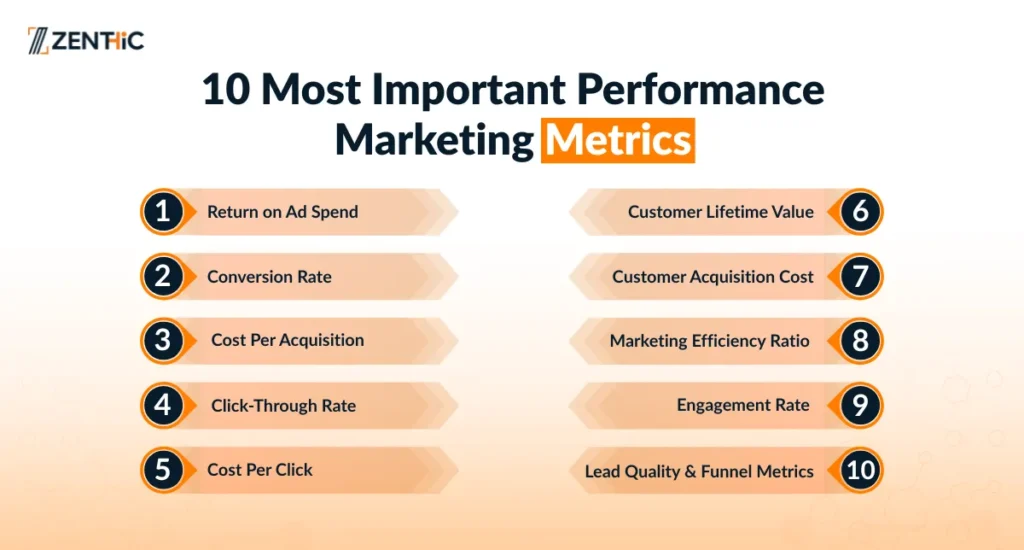
10 Most Important Performance Marketing Metrics
This article divides all ten essential indicators into separate sections to assist you in making smarter, data-driven decisions. Whether you’re using paid advertisements, various channels, or funnel optimization, these analytics help you scale efficiently, increase ROI, and provide clarity on success.
1. Return on Ad Spend
The amount of money your ads have generated for every dollar spent is shown by ROAS. It is one of the most important performance marketing metrics since it will determine the profitability of your projects.
Formula: Revenue ÷ Ad Spend
When ROAS is high, your ads are effective; when it is low, you should adjust your targeting or create better ads.
2. Conversion Rate
Conversion rate measures the number of users who take a desired action, such as purchasing a product, filling a form, or registering.
- A high CVR indicates that your landing page, user experience, and offer are excellent.
- A low CVR indicates a problem with your message, design, or target.
Optimizing conversion rate can provide the quickest growth without raising the number of ads.
3. Cost Per Acquisition
The cost per acquisition (CPA) is the amount you pay to acquire a customer or lead.
- Reduced CPA = Cost-effective campaigns.
CPA will also show you which channels or campaigns would deliver the highest performance for the lowest cost.
4. Click-Through Rate
CTR is one of the quickest measures of relevance and interest in advertising. CTR shows how successful your advertisement is.
- A high CTR shows that individuals are interested in clicking your ad.
- A low click-through rate (CTR) suggests that you are either not targeting the proper audience or your ad is not attractive.
5. Cost Per Click
The cost per click on your advertisement is known as CPC. It can be used to compare the performance of various platforms, like Google Ads, Meta Ads, and TikTok. Low CPC is good, but only if the clicks come from qualified users who convert.
6. Customer Lifetime Value
CLV is the amount of revenue that a customer will generate during their relationship with your brand. It delivers a more accurate picture of long-term profitability than CPA. Healthy brands are always strong, and their CLV is consistently greater than their client acquisition cost. This approach is especially helpful for service-oriented businesses, internet retailers, and subscription-based plans.
7. Customer Acquisition Cost
Cost Per Click is referred to as CPA, and Customer Acquisition Cost is referred to as CAC. Whereas CPA considers the cost of each campaign, CAC considers all the expenses incurred in marketing and sales to get a customer. Monitoring CAC helps you determine the sustainability of your business strategy. The CLV: CAC ratio is an effective metric for maintaining a good benchmark, which will be approximately 3:1.
8. Marketing Efficiency Ratio
MER evaluates the performance of your total marketing expenditure.
- Formula: Total Revenue / Total Marketing Spend.
In contrast to ROAS, which only looks at each campaign, MER provides a more comprehensive view of whether your marketing efforts are generating profitable results across all channels.
9. Engagement Rate
The engagement rate measures user participation with your brand in terms of likes, shares, comments, time on page, and bounce rate. High engagement will show that your audience is interested in your content and that it has the potential to build trust before conversion. A lack of interaction is frequently the result of a bad creative strategy or a failure to target the appropriate audience.
10. Lead Quality & Funnel Metrics
Each lead is unique. The funnel progression shows how many leads convert into qualified prospects and, eventually, consumers following their first interest. Some important funnel metrics are:
- Leads generated
- Marketing Qualified Leads (MQLs).
- Sales Qualified Leads (SQLs)
- Closed customers
Why These Metrics Matter
Performance marketing is about more than just traffic; it’s about achieving measurable and long-term revenue. By keeping an eye on these ten key indicators:
- You can invest in campaigns that will yield results..
- Find areas of weakness before they become costly.
- Learn the customer interaction at each level.
- Enhance the overall ROI.
- Grow your business with ease.
These indicators may also divert your attention from vanity metrics like impressions or follower counts, which are effective but don’t generate actual money.
Best Practices for Tracking Metrics
- Before you begin to measure anything, set clear campaign goals.
- It is important to track trends in the form of a regular report (weekly, monthly, or quarterly).
- Compare performance by channel, audience, and creatives to see what is truly being accomplished.
- Integrate metrics (e.g., CPC + CVR + CPA) to have more actionable insights.
- Quality over quantity—concentrate on meaningful numbers that influence growth and revenue.
When these practices are implemented on a regular basis, your data provides a road map for making better decisions, optimizing campaigns, and expanding your business in the long run.
Conclusion
Performance marketing is bringing real results when you target the right metrics. With the help of Return on Ad Spend (ROAS), Cost Per Acquisition (CPA), Click-Through Rate (CTR), Conversion Rate (CVR), Customer Lifetime Value (CLV), Customer Acquisition Cost (CAC), Marketing Efficiency Ratio (MER), and funnel progression understanding will give you a clear picture of what is producing results and what is using resources. These insights will help your company or any other reliable business that maximize campaigns, reduce waste, improve conversions, and expand marketing with ease.
Measuring the proper metrics is not only good practice; it is a competitive advantage that will distinguish between effective marketers and trustworthy businesses.