Table of Contents
Introduction- Key Trends Shaping Modern Software Development
- 1. Artificial Intelligence and Machine Learning
- 2. Low-Code and No-Code Development
- 3. Cloud-Native and Serverless Computing
- 4. Progressive Web Apps
- 5. DevSecOps and Built-In Security
- 6. Microservices Architecture
- 7. Edge Computing
- 8. Cross-Platform Development
- 9. Sustainable and Green Software Engineering
- 10. Extended Reality
- Conclusion
Introduction
Software development is a dynamic, ever-evolving field. Developers are setting new standards of how they develop solutions, optimize workflow, and deliver greater value to users through new technologies and approaches each year. When businesses are interested in long-term development, they usually invest in software solutions that are custom-made and meet their specifications.
The rate of innovation is higher than ever. Developers and businesses should keep up with the current trends to remain competitive and produce high-quality software products.
Key Trends Shaping Modern Software Development
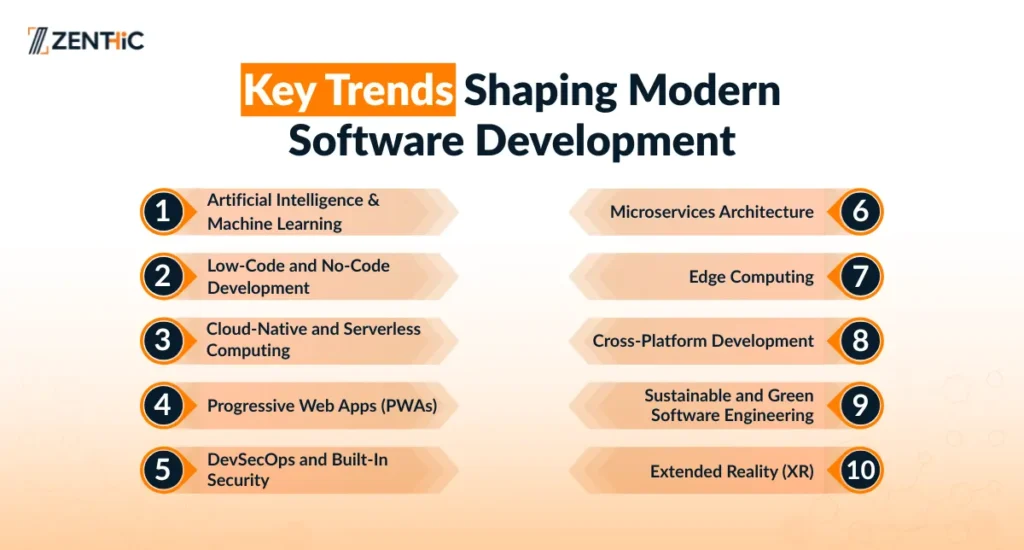
Here, we discuss 10 emerging trends in software development that are defining the future of the industry, from automation and artificial intelligence to secure coding and sustainability. These trends represent significant changes in the way modern software is designed, developed, and delivered.
1. Artificial Intelligence and Machine Learning
Artificial intelligence and machine learning are rapidly becoming an essential element of modern software development. Companies are no longer designing products with AI as an additional feature; they are designing products with intelligence built in from the beginning. Smart tools are used by developers to help accelerate the coding process and detect problems during the initial stages, as well as enhance the quality of software.
Machine learning is another technology that enables applications to learn. This implies that software is able to suggest content, evolve according to preference, and become smarter over time. Intelligent systems are assist takes businesses to provide more meaningful user experiences through customized dashboards and predictive analytics.
2. Low-Code and No-Code Development
No-code and low-code platforms are transforming the software development process. Instead of the teams writing thousands of lines of code, they are now able to develop applications with the help of simple visual builders and drag-and-drop tools. This method makes software development more accessible and efficient, especially for those with limited technical skills.
In the case of businesses, it implies faster launches, lower development expenses, and reduced reliance on large engineering forces. Developers can focus on the actual business issues rather than wasting time on repetitive code writing. This speed and flexibility can be significant in the case of startups and developing companies.
However, companies that need a unique competitive edge tend to choose custom development strategies.
3. Cloud-Native and Serverless Computing
Cloud technology is no longer optional; it is the backbone of modern software development. Companies are moving towards cloud-native applications, as they are easier to scale, upgrade, and manage as they expand. Moreover, this is further advanced in serverless computing. Developers do not need to worry about servers and infrastructure; instead, they can concentrate on code writing and code improvement. The back-end processes are handled by the cloud service provider.
This approach saves time, lowers the cost of operation, and makes systems more accessible. That is why cloud-native and serverless solutions are rapidly becoming the new standard for developing reliable and future-proof software.
4. Progressive Web Apps
Progressive Web Apps (PWAs) are an intelligent alternative to mobile applications in the current mobile-first world. A combination of web and mobile experiences; they are fast, can be used when offline, and also provide push notifications without the need for the user to download anything from an app store.
Because the same codebase is used on several devices, firms can save money on development and maintenance expenditures. It implies immediate access and a faster experience for users. PWAs are also becoming an effective and affordable option as companies seek to increase their online presence.
5. DevSecOps and Built-In Security
With the increased complexity of software and the growing threat of cyber attacks, security must be considered at every stage of development. DevSecOps is the combination of development, security, and operations.
This technique identifies and eliminates flaws rather than addressing them at the end of the process. This proactive approach reduces risks, lowers long-term costs, and improves software quality overall.
6. Microservices Architecture
The microservices architecture replaces traditional monolithic systems by developing software as a collection of small, autonomous services. The services carry out certain tasks and communicate with others using APIs.
This approach improves fault isolation, scalability, and flexibility. Teams can upgrade or scale individual components without affecting the entire system, which streamlines and speeds up maintenance.
7. Edge Computing
Instead of sending all the data to a cloud server, edge computing uses data that is stored closer to the source. This will save a lot of time on delays and allow faster response time. It is especially beneficial for applications that require real-time performance, such as IoT devices, autonomous systems, and augmented reality. Edge computing decreases network strain by by processing data close to the source, resulting in more dependable, high-performance data.
8. Cross-Platform Development
Developers are under pressure to create applications that can be used on a variety of platforms, including web, mobile, and desktop apps. Recent cross-platform systems, such as Flutter, React Native, and .NET MAUI, allow developers to release their applications across operating systems using a single code base.
This method saves a lot of time and maintenance. Rather than having to maintain two or more sets of code on different platforms, updates and enhancements can be made simultaneously. It also provides a universal user experience across devices, which helps in building brand identity and user satisfaction.
9. Sustainable and Green Software Engineering
The concept of sustainability is a new consideration in modern software design. To reduce the environmental impact, developers are currently focused on the amount of energy used by their apps, selecting high-performance algorithms, and optimizing infrastructure.
Green software engineering is not only about environmental protection; it also makes a business case. Efficient applications consume fewer computing resources, reduce cloud expenses, and enhance the performance of the entire system. Sustainable software practices are perceived as a competitive edge and not merely a trend as organizations continue to pay increasing attention to long-term responsibility.
10. Extended Reality
Digital experiences no longer exist on screens and clicks. Extended Reality (XR), including Augmented Reality (AR), Virtual Reality (VR), and Mixed Reality (MR), is quickly revolutionizing the way customers interact with technology, and it is no longer just about gaming and entertainment. Immersive technologies are now being used in industries like retail, education, and healthcare as well as in corporate training to make the experiences more interactive and engaging.
XR is transforming how individuals engage with digital content, starting with virtual product try-ons to real medical simulations and distance learning environments. To the developers, this creates opportunities to create absolutely new interfaces, extending beyond the traditional web and mobile applications. Immersive software solutions will continue to expand more rapidly in the coming years as hardware becomes more accessible.
Conclusion
Software development is evolving more than ever, and to grow and remain competitive in the long term, it is crucial to keep up with the new trends. These innovations are transforming the way modern applications are developed and consumed, including AI-based automation and secure DevOps, as well as cloud-native and immersive technologies.The selection of the appropriate development strategy, including the decision to invest in custom software, can make a great difference in terms of scalability, efficiency, and business success. Those who evolve and develop early and intentionally will be the digital leaders in the future.